 Blaine Exterior
 Why Sumas Roofs Age the Way They Do
Sumas sits at the edge of Whatcom County, close enough to the border and the open farmland of the Nooksack valley that roofs here take a different kind of beating than roofs twenty miles south in a denser suburb. The same marine weather system that soaks the whole Blaine corridor pushes moisture-laden air inland, and out here it combines with wide-open exposure and long, wet winters. The result is a roofing environment defined by three things: near-constant low-grade dampness, driving rain that comes in sideways more often than straight down, and a moss season that can run from October well into April.
None of that is exotic. It's just persistent. A roof that would coast along fine in a drier climate gets tested every single month here, and small mistakes in the original installation — a poorly lapped underlayment, an undersized vent, a flashing detail that was "close enough" — tend to show up as leaks within a handful of years instead of a couple of decades.
What This Means in Practice
For homeowners in Sumas, this translates into a shorter effective lifespan for lower-grade roofing systems and a much bigger payoff for doing the underlying details right. Two roofs can use the exact same shingle and look identical from the street, yet one will leak at year eight and the other will still be tight at year twenty-five. The difference is almost never the shingle brand — it's the deck prep, the underlayment strategy, the flashing, and the ventilation underneath it.
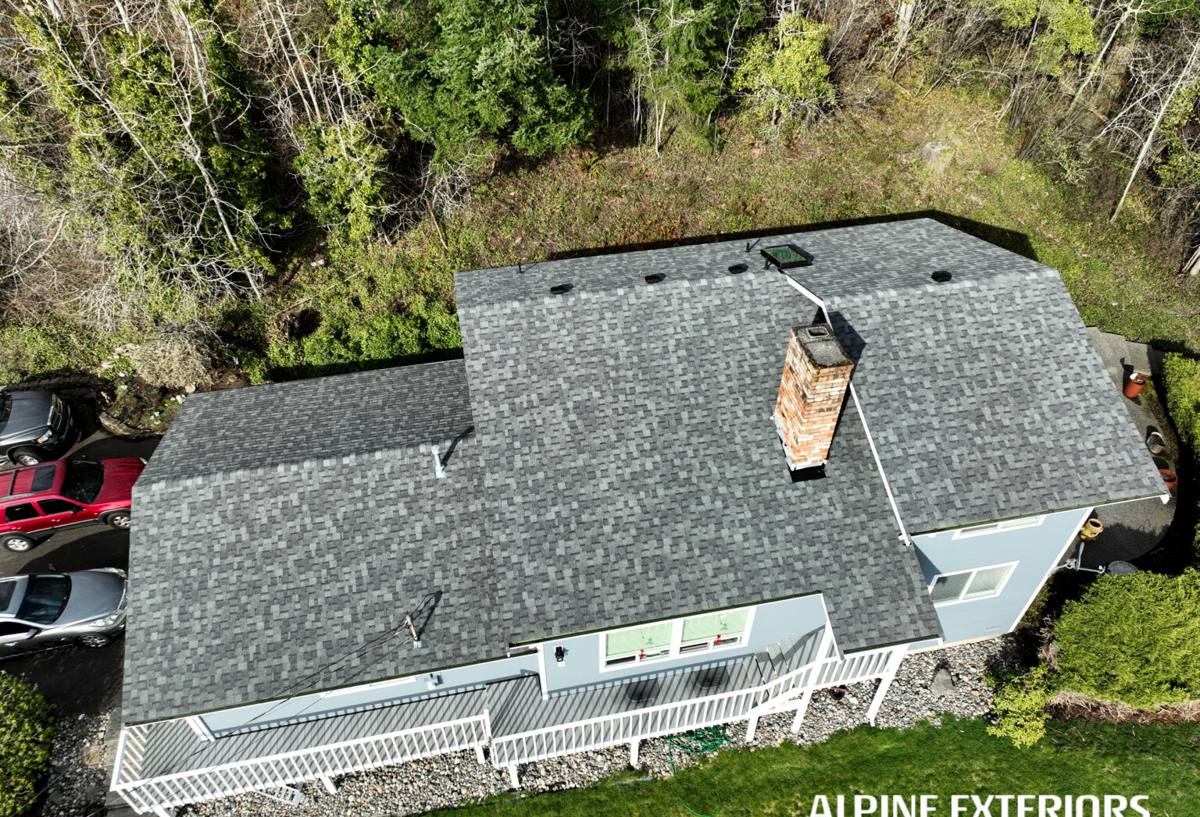
Signs a Sumas Roof Is Ready for Replacement, Not Another Patch
Roof replacement is a bigger decision than a repair, so it's worth being honest about when a roof has actually crossed the line from "fixable" to "replace it." A few patches on an otherwise sound roof can be money well spent. Chasing the same leak every wet season on a roof that's already past its design life usually isn't.
- Granules collecting in gutters or downspouts by the handful, not just a few grains
- Shingles that are cupping, curling at the edges, or cracking when touched
- Moss establishing itself in mats rather than a light surface film, especially on north-facing slopes
- Daylight visible through the roof deck from inside the attic
- Soft or spongy decking underfoot during an inspection
- Repeated leaks around the same penetration, chimney, or valley despite prior repairs
- A roof already at or past 20-25 years old on standard asphalt shingles in this climate
If two or three of these apply, a replacement conversation is worth having before another winter puts more water behind the surface.
What a Correct Roof Replacement Actually Involves
A roof replacement done right is not just "new shingles on the old roof." In a climate that punishes shortcuts, the work that happens before a single shingle goes down matters more than the shingle itself.
Full Tear-Off and Deck Inspection
We remove the old roofing down to the deck rather than layering over it. That's the only way to actually see the plywood or plank decking underneath — and in a moisture-heavy area like Sumas, hidden rot around valleys, chimneys, and eaves is common enough that skipping this step is how homeowners end up with a roof that looks new but fails from underneath within a few years.
Underlayment and Water-Entry Points
Self-adhered ice-and-water membrane goes in the areas most exposed to wind-driven rain: eaves, valleys, and around every penetration. Synthetic underlayment covers the rest of the field. This is the layer that does the real work when wind pushes rain sideways under the shingle line, which happens more often on exposed, open lots than in tightly built neighborhoods.
Flashing Details
Chimneys, skylights, sidewalls, and vent pipes are where the overwhelming majority of roof leaks actually originate — not in the open field of shingles. Step flashing, counter-flashing, and properly lapped valley metal are non-negotiable details, not upgrades.
Ventilation
Balanced intake and exhaust ventilation keeps the attic temperature closer to outdoor temperature, which reduces condensation, ice-damming risk, and premature shingle aging from trapped heat and moisture. It's also one of the biggest factors in how fast moss and algae reestablish themselves after a new roof goes on.
Material Installation and Fastening
Correct nail placement, exposure, and fastening pattern matter more in higher-wind, higher-moisture climates than in mild ones. Manufacturer installation specs exist for a reason, and cutting corners here is invisible until a storm finds the weak point.
Comparing Roofing Materials for a Sumas Home
There's no single "best" material for every home — it depends on budget, roof pitch, how long you plan to stay in the house, and how much long-term maintenance you want to take on. Here's how the common options stack up against this specific climate.
| Material | Typical Lifespan Here | Moss/Moisture Behavior | Maintenance Burden |
|---|---|---|---|
| Standard 3-tab asphalt | 15-20 years | Moss establishes relatively easily; needs periodic cleaning | Low upfront cost, higher long-term upkeep |
| Architectural (dimensional) asphalt | 25-30 years | Better shedding profile, still benefits from moss treatment | Moderate |
| Metal (standing seam or panel) | 40-50+ years | Sheds water and moss growth far better; smooth surface resists buildup | Low, but higher upfront cost |
| Synthetic/composite shingle | 30-40 years | Good moisture resistance, performance varies by product | Moderate |
We don't push homeowners toward the most expensive option by default. A well-installed architectural asphalt roof, done with the right underlayment and ventilation, will serve most Sumas homes well for decades. Metal earns its higher price tag on homes where the owner wants to stop thinking about the roof entirely, or on steeper pitches where water sheds fast and moss has less chance to grip.
Moss and Ventilation: The Two Issues That Define Roofs Out Here
Moss isn't just cosmetic. As it establishes on a roof, it holds moisture against the shingle surface, works its way under tab edges, and accelerates granule loss. On shaded, north-facing slopes — common on homes with mature trees or those tucked against tree lines near open farmland — moss can become a real problem within a few seasons of the last cleaning.
A new roof gives you a clean start, but the long-term fix isn't more frequent cleaning — it's designing the roof to resist moss in the first place. That means adequate slope where the design allows it, zinc or copper strips at the ridge on moss-prone slopes, and ventilation that keeps the deck and shingles drying out between rain events instead of staying damp for weeks at a time.
Our Process for a Roof Replacement in Sumas
- On-site inspection — we look at the roof from the ground and from the deck level where safely possible, checking current material condition, decking, ventilation, and flashing points.
- Honest scope and estimate — a written quote that spells out material choice, tear-off scope, and any deck repair allowances, with no pressure to decide on the spot.
- Scheduling around the weather — in this climate, timing a tear-off matters. We plan the job to minimize the window the deck is exposed.
- Tear-off and deck assessment — old roofing removed, deck inspected board by board, and any soft or damaged sections replaced before anything new goes down.
- Underlayment, flashing, and material installation — installed to manufacturer spec, with extra attention to valleys, penetrations, and eaves.
- Ventilation check — intake and exhaust balanced for the attic size and roof design.
- Cleanup and walkthrough — site cleaned, magnetic sweep for nails, and a final walkthrough so you know exactly what was done and why.
Why Local Experience in This Area Matters
A roofing crew that regularly works Whatcom County properties understands things that don't show up in a spec sheet: which slopes in the area tend toward heavier moss growth, how wind exposure on open lots near the border changes fastening and flashing decisions, and how to sequence a tear-off around a weather pattern that can turn wet with little warning. That local pattern-recognition is the difference between a roof that's technically installed to code and one that's actually built for how weather behaves on this specific piece of ground.
It also matters for practical logistics — knowing realistic weather windows for tear-off days, understanding permitting expectations in the area, and having a track record on similar homes nearby that you can ask about directly.
What Replacement Typically Costs
Exact pricing depends on roof size, pitch, current layer count, deck condition, and material choice, but a few general factors consistently move the number:
| Factor | Effect on Cost |
|---|---|
| Roof size (square footage) | Largest single driver of total cost |
| Pitch and complexity (valleys, dormers, chimneys) | More cutting, flashing, and labor time |
| Number of existing layers to remove | More tear-off labor and disposal cost |
| Deck repair needed | Added cost, usually not known until tear-off |
| Material selected | Wide range from standard asphalt to metal |
We'd rather give you a real number after seeing the roof than a rough figure that doesn't hold up once we're up there. Deck condition in particular is hard to fully judge from the ground.
If your roof in Sumas is showing its age or you just want an honest read on how much life is left in it, we're glad to come take a look. The estimate is free, there's no pressure attached to it, and you'll get a straight answer about whether you need a full replacement or just a targeted repair — you can request one using the form below.