 Blaine Exterior
 Birch Bay sits right on the water, and that location is exactly what makes the neighborhood beautiful and exactly what makes it hard on a house. Homes here take a steadier beating from the elements than houses even a few miles inland in Blaine or elsewhere in Whatcom County. Salt-laden air off the water, wind-driven rain that comes in sideways during winter storms, and a moss season that seems to start earlier and last longer every year all work on siding, trim, roofs, and decks in ways that shorten the life of the wrong materials and the wrong installation choices. This page walks through what we see on Birch Bay homes and how our siding, roofing, window, and deck work is built around those conditions.
What Birch Bay's Climate Actually Does to a House
It helps to be specific about the mechanisms at work, because "coastal weather" undersells what's happening on an exterior wall or roof plane near Birch Bay.
Salt Air
Airborne salt is corrosive to exposed metal fasteners, flashing, and hardware, and it accelerates the breakdown of finishes that aren't formulated to handle it. Paint films chalk and fade faster near the water. Uncoated or poorly coated wood trim absorbs moisture more readily once salt has worked into the surface. Over years, this shows up as premature caulk failure, rust streaking below fasteners, and paint that needs recoating far sooner than the same product would need inland.
Driving, Wind-Driven Rain
Birch Bay's exposure to wind off the water means rain doesn't just fall on a house here — it gets pushed into seams, laps, and joints under pressure. That matters enormously for how siding is installed. A product and installation method that would perform fine in a sheltered inland yard can leak at Birch Bay if flashing details, lap spacing, and caulking aren't done to a coastal standard. This is a house-by-house craftsmanship issue as much as a materials issue.
A Long Moss Season
Cool, damp, and shaded conditions are ideal for moss and algae growth, and Birch Bay gets more of that combination than sunnier parts of the county. Moss holds moisture against roofing and siding surfaces far longer than the surface would otherwise stay wet, which accelerates rot in wood substrates and shortens the service life of roofing materials that aren't algae-resistant.
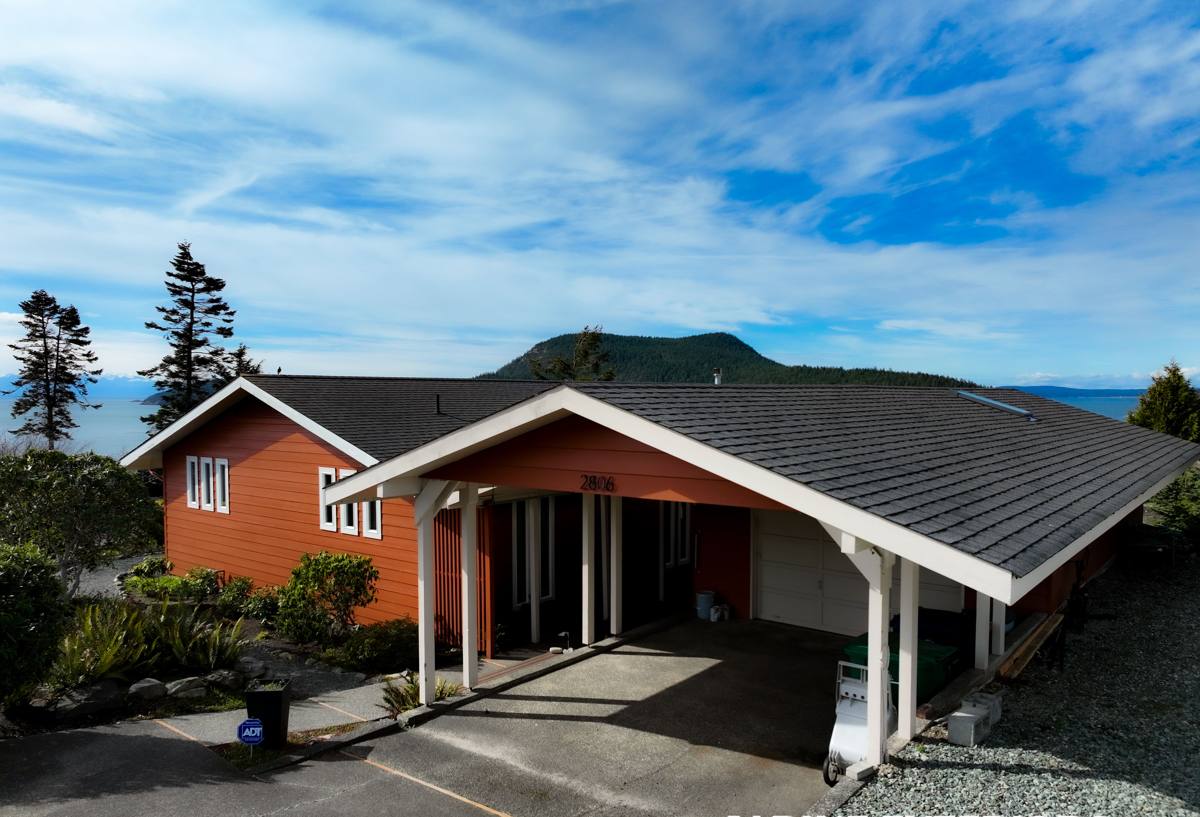
Siding for a Birch Bay Home
We install James Hardie fiber cement siding exclusively, and Birch Bay is a good example of why. We don't install vinyl siding, LP SmartSide (or other engineered wood products), Cemplank or Allura fiber cement, or primed spruce or cedar lap siding — not because those products have no merit anywhere, but because we've made a standard for our own installs and we stand behind it on every house we touch.
Why Not the Alternatives, Specifically Here
- Vinyl siding expands and contracts significantly with temperature swings and can distort or crack in high wind exposure, which is a real factor on an open, waterfront-adjacent lot. It also doesn't hold paint, so fading over years of salt and UV exposure isn't something you can simply repaint away.
- LP SmartSide and other engineered wood products are wood-based, which means the cut edges and any breach in the factory coating are vulnerable to moisture intake. In a driving-rain, high-moisture environment like Birch Bay, that's the exact failure point we want to avoid on a house we're putting our name on.
- Cedar and primed spruce are natural wood. They can look excellent, but they require an ongoing maintenance commitment — recoating, caulk inspection, moisture monitoring — that's more demanding right on the water than it would be inland. Skipped maintenance shows up faster here.
- Other fiber cement brands (Cemplank, Allura) are legitimate fiber cement products, but we've standardized on James Hardie specifically for its factory-applied ColorPlus finish, its HZ5 product engineering for wet climates, and the strength of its transferable warranty. Consistency in one product line also means our crews install it to the same high standard on every job.
James Hardie fiber cement is non-combustible, doesn't absorb water the way wood-based products do, and the ColorPlus factory finish is baked on and warrantied against fading and chipping — which matters when your siding is facing salt air and sun reflecting off the water for years at a stretch. Hardie's HZ5 line is specifically engineered for the kind of wet, marine-influenced climate that Birch Bay sits in.
Roofing in a Salt-Air, Moss-Prone Environment
Roofing near Birch Bay has to deal with the same moss pressure and wind-driven rain as siding, plus direct sun and salt exposure on the highest, most exposed plane of the house. A few things matter more here than they might on a sheltered inland roof:
- Proper flashing at every valley, penetration, and wall intersection, sized and lapped for wind-driven rain rather than just gravity drainage
- Ventilation that actually moves moist air out of the attic, since trapped moisture combined with cool coastal temperatures is a recipe for condensation and rot in the roof deck
- Material choice and maintenance planning that accounts for moss and algae growth rather than ignoring it until it's established
- Fasteners and hardware rated for corrosion resistance in a salt-air environment
We evaluate roofs as part of a full exterior, because a roof leak and a siding leak often trace back to the same flashing detail at a wall-roof intersection.
Windows That Hold Up to Wind and Moisture
Window performance in a spot like Birch Bay comes down to two things: the unit itself and the installation. A well-built window installed with poor flashing will leak in driving rain regardless of its energy rating. We pay close attention to window flashing integration with the siding system — this is one of the most common failure points we find on older homes in wind-exposed coastal areas, and it's also one of the easiest to get right the first time when siding and windows are addressed together rather than as separate, disconnected projects.
Energy performance matters too. Homes near the water often see more temperature swing between still, sunny days and cold, wind-driven storms, and a window with a solid seal and appropriate glazing keeps that swing from translating into drafts and higher heating costs.
Decks: Built for Wet, Shaded Conditions
Decks in Birch Bay deal with the same moss and moisture pressure as roofs and siding, often worse, because they're horizontal surfaces that hold standing water and organic debris. Board spacing, proper drainage underneath, and material choice all affect how long a deck stays safe and good-looking before boards start cupping, staining, or growing slick with algae. We build and repair decks with attention to airflow underneath the structure and drainage away from the house, which matters more here than in a drier part of the county.
Comparing Exterior Materials for Coastal Whatcom County
| Material | Moisture Behavior | Maintenance | Typical Coastal Concern |
|---|---|---|---|
| James Hardie fiber cement | Does not absorb water like wood; HZ5 engineered for wet climates | Occasional cleaning; factory finish reduces repainting needs | Minimal when installed to spec |
| Vinyl siding | Sheds water but seams and fasteners can be entry points | Low, but fading isn't repairable | Wind flex and distortion in exposed locations |
| Cedar / primed spruce | Absorbs moisture if coating is breached | High — recoating and caulk checks needed regularly | Salt-accelerated finish breakdown |
| LP SmartSide / engineered wood | Wood-based core vulnerable at cut edges and breaches | Moderate to high | Moisture intake at joints and edges |
| Other fiber cement brands | Generally water-resistant | Low to moderate | Finish and warranty vary by manufacturer |
Why a Local Crew Matters in Birch Bay
Exterior work here isn't generic. A crew that mainly works inland jobs may not think twice about lap spacing, flashing overlap, or fastener spacing being "close enough" — details that hold up fine away from the water but fail faster under Birch Bay's wind and salt exposure. Knowing the local conditions changes real installation decisions: how tight the flashing laps need to be, where extra sealant attention pays off, and which details on a roof-to-wall intersection are worth the extra ten minutes. We work throughout Blaine and Whatcom County, and Birch Bay's waterfront exposure is part of what we plan for on every job in the area, not an afterthought.
A Practical Checklist for Birch Bay Homeowners
- Check painted wood trim and siding for chalking, fading, or peeling more often than you would inland — salt air accelerates finish breakdown
- Watch north-facing and shaded roof and siding areas for moss buildup, especially through fall and winter
- Inspect caulking around windows and doors annually; wind-driven rain finds gaps that gravity-fed rain never would
- Look for rust streaking below fasteners or flashing, a sign that hardware isn't holding up to salt exposure
- Keep gutters and downspouts clear — clogged drainage compounds every other moisture issue on the list
- Have deck framing and ledger board connections checked periodically, since hidden moisture damage there is a safety issue, not just cosmetic
How We Approach a Birch Bay Project
Whether the job is a full siding replacement, a roof, new windows, or a deck rebuild, we start by looking at the whole exterior system rather than one component in isolation — because on a coastal home, siding, roofing, window flashing, and drainage all interact. A leak that shows up as a siding stain might originate at a roof valley. A drafty window might be a flashing issue rather than a window issue. Treating the exterior as one connected system, built for Birch Bay's specific salt, wind, and moisture pressures, is how work actually holds up here rather than needing attention again in a few years.
If you're dealing with an aging exterior in Birch Bay, or just want a straight assessment of what your siding, roof, windows, or deck actually need, we're happy to take a look. Request a free, no-pressure estimate below and we'll walk the property with you and tell you honestly what we see.