 Blaine Exterior
 One Product, One Standard
Homeowners sometimes ask why we don't carry a full lineup of siding brands the way some contractors do. The honest answer is that we made a decision years ago to install James Hardie fiber cement exclusively, and we haven't found a reason to change our minds. That's not a marketing position — it's a practical one. When a crew installs the same product system day after day, they know its quirks, its fastening requirements, its clearances, and its failure points cold. Switching between vinyl one week, LP SmartSide the next, and fiber cement after that spreads a crew's expertise thin. In a climate like Blaine's, where salt air off Semiahmoo Bay and Drayton Harbor combines with long stretches of driving rain and a moss season that can run from October into May, thin expertise shows up on a house within a few years.
This page explains what James Hardie siding actually is, why it holds up to Whatcom County's specific conditions, and what correct installation involves — so you can evaluate any bid, ours included, with real information instead of a sales pitch.
What Fiber Cement Actually Is
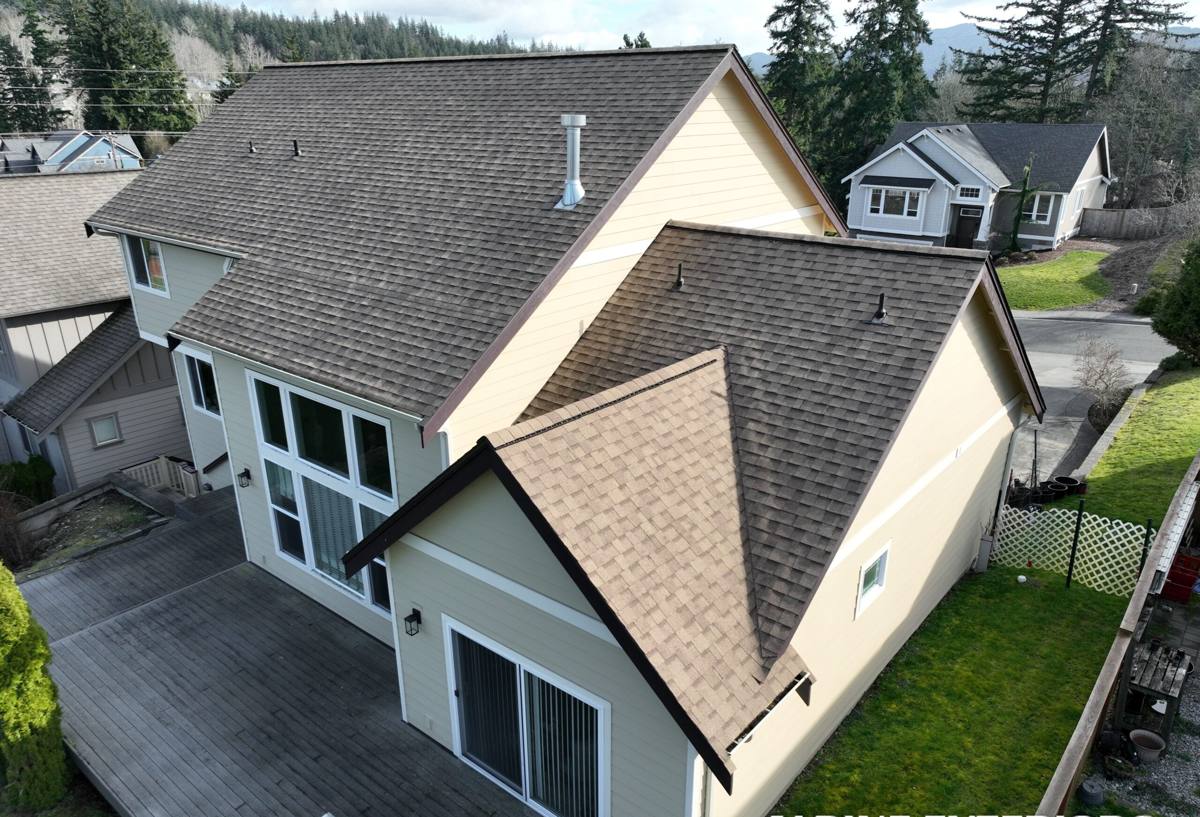
James Hardie siding is made from Portland cement, sand, cellulose fiber, and water, cured under pressure into dense, rigid boards. It is not plastic, and it is not wood. That composition matters for three reasons that come up constantly in this region:
- It doesn't feed moss or algae the way wood-based products can. Blaine's damp, shaded lots grow moss on almost everything organic — fences, roofs, decking. Fiber cement gives it nothing to root into.
- It's dimensionally stable in wet-dry cycling. Wood and wood-composite sidings expand and contract with moisture; fiber cement barely moves, which keeps caulk lines and paint film intact longer.
- It's non-combustible. That's a separate benefit from moisture performance, but it matters to insurers and to homeowners who've watched wildfire risk creep west of the Cascades in recent summers.
None of this means fiber cement is magic. It still needs correct flashing, correct fastening, and correct clearance from grade and roof lines. A poorly installed Hardie board will fail just like a poorly installed anything else. The product buys you a much larger margin for error than most alternatives — it doesn't buy you immunity from bad workmanship.
Why Blaine's Climate Is Genuinely Different
Blaine sits at the far northwest corner of Washington, right on the water, which means the siding on a typical house here deals with a combination most inland Whatcom County homes don't see to the same degree: wind-driven salt spray, near-constant winter humidity, and rain that comes in sideways off the Strait of Georgia rather than straight down. That combination attacks siding in specific ways:
Salt Air
Airborne salt accelerates corrosion on fasteners and metal flashing, and it can degrade some paint and coating systems faster than manufacturers' standard testing accounts for. This is one of the reasons fastener choice and flashing detail matter as much as the siding material itself on waterfront and near-waterfront lots.
Driving Rain
Wind-driven rain doesn't just wet a wall surface — it tests every joint, every butt seam, and every point where siding meets a window, door, or roofline. A siding system's water-resistive barrier and flashing details do more work here than in a calm, dry climate.
Moss and Prolonged Dampness
Blaine's moss season is long because the region rarely gets the hard freeze-thaw cycles or sustained dry heat that kill moss spores elsewhere. Siding on the north and west faces of a house — the shaded, wind-exposed sides — can stay damp for days at a stretch. Materials that absorb and hold moisture pay for it in swelling, rot, and coating breakdown over time.
James Hardie's HZ5 climate-engineered product line was developed specifically for the wetter, cooler regions of the country, including the Pacific Northwest. It's not a different chemical formula so much as it's manufactured and rated with this exact moisture profile in mind — which is a large part of why we don't spend time evaluating alternatives for homes in this area.
ColorPlus Factory Finish
One of the most practical advantages of the Hardie system is the ColorPlus finish — a multi-coat color baked onto the boards at the factory under controlled conditions, rather than paint rolled or sprayed on site after installation. Site-applied paint has to cure in whatever weather shows up that week; a factory finish cures in a controlled environment every time. In a region where a dry, calm painting window can be hard to schedule between October and April, that difference is not cosmetic — it's a real driver of how long the finish actually lasts before it needs attention.
ColorPlus finishes carry their own longer finish warranty separate from the substrate warranty, and the color-matched caulk and touch-up products are formulated to work with the finish rather than against it. Field-painted fiber cement can look identical on installation day and diverge noticeably within five to seven years, especially on sun- and salt-exposed elevations.
The Product Lines, Compared
James Hardie makes several distinct product lines, and choosing the right one for a given house and elevation is part of what a competent installer should be doing at the estimate stage, not defaulting to whatever is easiest to install.
| Product | Typical Use | Notes for This Climate |
|---|---|---|
| HardiePlank lap siding | Primary wall cladding, most common choice | Widest color and texture range; workhorse product for full re-sides |
| HardiePanel vertical siding | Modern/farmhouse styling, accent walls, gables | Fewer horizontal joints to maintain on tall gable faces |
| HardieShingle | Accent gables, dormers, Cape Cod-style detailing | Higher labor cost; used selectively rather than whole-house |
| HardieTrim | Corners, fascia, window and door trim | Matched substrate to siding avoids the mismatched-movement problems of wood trim on cement board |
| HardieSoffit | Eaves and overhangs | Vented options matter for attic moisture control in a damp climate |
A house near the water in Blaine, with wide roof overhangs and heavy salt exposure on one or two elevations, might reasonably use a different combination than a house set back on a tree-sheltered lot in the county interior. That's a design conversation, not a one-size-fits-all product pick.
Why Installation Quality Matters More Than the Brand Name
Fiber cement is unforgiving of shortcuts in ways that are easy for a homeowner to miss until years later. The most common installation mistakes we see when we inspect other contractors' work — or older homes being prepped for a re-side — include:
- Face-nailing without following the manufacturer's fastener spacing and edge-distance requirements
- Butt joints without proper flashing or sealant behind them
- Siding installed tight to grade, decking, or roofing with no clearance gap
- Caulk used in place of flashing at windows, doors, and trim intersections
- Cutting boards without the recommended dust-control and blade specifications, which affects finish edges and long-term durability at cut lines
James Hardie publishes detailed installation manuals for a reason, and many of the warranty claims that get denied nationally trace back to installation that didn't follow them — not product failure. That's a core reason we don't diversify across brands: we'd rather have a crew that installs one system perfectly than several systems adequately.
Questions Worth Asking Any Siding Contractor
- Are you a James Hardie certified or preferred installer, and can you show current documentation?
- Will the manufacturer's warranty be registered in my name after the job, and who handles that paperwork?
- What fastener type and flashing details will you use at butt joints and penetrations?
- Do you carry current liability insurance and workers' comp coverage, and can I see certificates?
- What does your own workmanship warranty cover, separate from the manufacturer's warranty?
Warranty Structure, Honestly Explained
James Hardie's warranties are transferable to a subsequent homeowner within a defined window after a sale, which is a genuine selling point if you plan to move within the coverage period — most alternative sidings offer weaker or non-transferable coverage. But warranty coverage is conditioned on installation following the manufacturer's published instructions. That's exactly why we treat the installation manual as non-negotiable rather than as a set of suggestions, and why we don't cut corners to hit a lower bid on labor.
It's worth reading any siding warranty's fine print yourself before signing a contract with anyone. Coverage terms, prorated schedules, and what voids a claim vary by product line and are worth understanding up front rather than after a problem shows up.
Cost Factors to Expect
We won't quote prices here because every house is different — square footage, number of stories, trim complexity, tear-off scope, and access all move the number. But these are the factors that most affect a Hardie siding estimate in this area:
| Factor | Why It Matters |
|---|---|
| Tear-off vs. new construction | Removing old siding, dealing with rot repair, and disposal add labor beyond the material cost |
| House complexity | Dormers, multiple gables, and cut-up elevations increase both material waste and labor hours |
| Product line mix | Shingle accents and vertical panel details cost more per square foot than straight lap siding |
| Trim scope | Full HardieTrim window and corner packages add cost versus reusing sound existing trim |
| Site access | Waterfront lots and tight urban lots in Blaine can add staging and material-handling time |
A detailed, written estimate should break these out rather than bundling everything into a single per-square-foot number — that's the only way to compare bids apples to apples.
Get a Straight Answer for Your House
Every house in and around Blaine carries this climate a little differently depending on how close it sits to the water, how much shade and moisture it holds, and what condition the existing siding and sheathing are in. We're happy to walk your house, look at what's actually going on, and give you a straightforward, no-pressure estimate for a James Hardie re-side — no upsell to a product we don't stand behind. Reach out through the form below to get started.