 Blaine Exterior
 Two Products, One Decision You'll Live With for Decades
If you've been researching siding for a home in Blaine or anywhere else in Whatcom County, you've almost certainly run into two products competing for the same job: James Hardie fiber cement and LP SmartSide engineered wood. Both are marketed as upgrades over vinyl and traditional wood. Both claim long service life. Both show up on contractor bids in this area. But they are fundamentally different materials with different failure modes, and the difference matters more here than it does in a drier climate.
We install James Hardie fiber cement exclusively. We don't install LP SmartSide, and we want to explain why in plain terms — not by trashing the product, but by walking through how each one is actually built, how each one behaves over time in a marine climate, and where the trade-offs land.
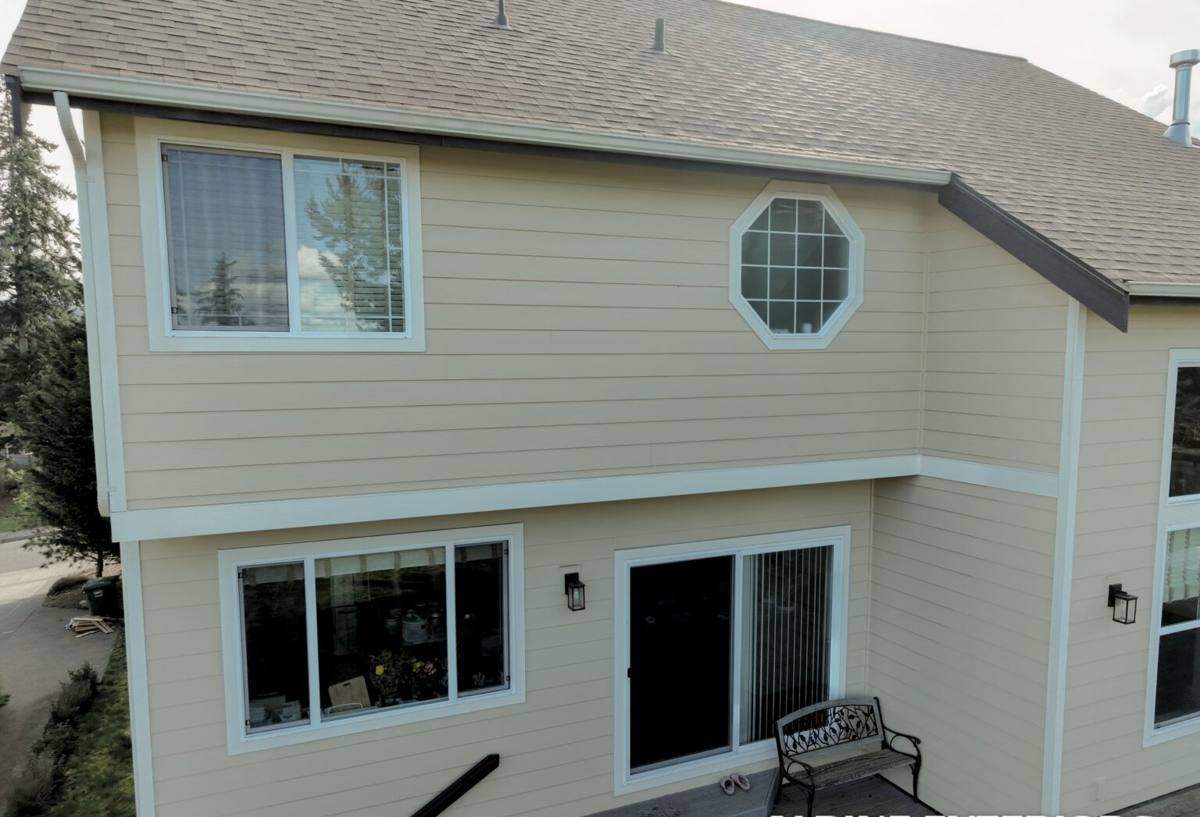
What Each Product Actually Is
James Hardie Fiber Cement
Fiber cement siding is made from Portland cement, sand, and cellulose fiber, cured under pressure and heat. The result is a rigid, non-combustible board that doesn't expand and contract with humidity the way wood-based products do. Hardie's HZ5 product line is specifically formulated for wetter, cooler climates like the Pacific Northwest, with an engineered moisture barrier and finish designed to resist freeze-thaw cycling and prolonged dampness.
LP SmartSide
LP SmartSide is an engineered wood product — strand board made from wood fibers bonded with resin, then treated with a zinc borate additive for insect and fungal resistance and coated with a wax-based moisture barrier. It's a real improvement over old-school untreated wood siding and hardboard products that gave engineered wood a bad reputation in the 1990s. LP has addressed a lot of those historical failure points. It is still, at its core, a wood product — meaning its long-term performance depends heavily on an intact factory coating and correctly sealed field cuts.
Why Moisture Behavior Is the Real Question in This Climate
Blaine sits right on the water, and homes here deal with a specific combination of stresses: salt-laden air off the Strait of Georgia, driving wind-driven rain for a good chunk of the year, and a long moss and algae season on north-facing walls and anything shaded by trees. None of that is unique to us, but it's more constant here than in most of the country, and it changes how a siding product's weak points show up.
Fiber cement is cementitious — it doesn't rot, and moisture that reaches the surface doesn't feed the material itself. The concern with fiber cement is almost entirely at the finish layer and the joints: if factory finish is scratched through, or if caulking and flashing details are done wrong, water can get behind the board. That's a workmanship risk, not a material risk.
Engineered wood is different. Because the core is wood fiber, any point where moisture gets past the coating — a field cut that wasn't sealed, a fastener that split the surface, a butt joint that wasn't caulked correctly — gives water a path into a material that can actually swell, delaminate, or deteriorate from the inside. The zinc borate treatment slows fungal growth, but it doesn't make the board waterproof. In a climate with this much sustained rain and humidity, the margin for installation error is smaller with engineered wood than it is with cement.
What "Installation Sensitivity" Actually Means
Every siding product has installation requirements. The difference is what happens when those requirements aren't followed exactly:
- Field-cut edges: Hardie's cut edges need primer/paint touch-up mainly for color match and long-term finish integrity. LP SmartSide's cut edges need proper sealant to keep moisture out of the wood fiber core — skip it, and that edge becomes a moisture entry point.
- Fastener placement: both products specify exact nailing patterns and clearances, but a split or over-driven fastener on engineered wood opens a path into the fiber core in a way that's more consequential long-term.
- Ground and roof clearance: both require gaps from grade, decks, and roof lines — but sustained ground moisture and splashback are harder on a wood-fiber product than on cement.
- Caulking at joints and trim: critical on both, but the consequence of a caulk failure is a stain and a repaint on fiber cement, versus a potential swelling or soft spot on engineered wood.
None of this means LP SmartSide is doomed to fail when installed correctly — plenty of installations perform fine. It means the acceptable margin for error is tighter, and in a county that gets driving rain off the water for months at a stretch, we'd rather not build a business on hoping every joint and cut gets sealed exactly right, forever, including by whoever touches the house after us.
Fire Performance: A Real Difference, Not a Marketing Line
Fiber cement is non-combustible. Engineered wood, even with treatments, is still a wood-based product and carries a wood product's fuel load. This isn't a Whatcom County-specific concern the way moisture is — wildfire risk here is lower than in parts of Eastern Washington — but it's a legitimate, verifiable difference in the materials themselves, and it's part of why insurers and building codes increasingly favor non-combustible cladding.
Finish and Maintenance Over Time
James Hardie's ColorPlus finish is baked on at the factory under controlled conditions, with a warranty that covers the finish separately from the substrate. It's formulated to resist fading and doesn't need repainting on the manufacturer's typical schedule — most homeowners go well over a decade before considering a repaint, and many just don't.
LP SmartSide comes primed and is intended to be field-painted, with repainting on a more conventional maintenance cycle — similar to painted wood siding, though less frequent than untreated wood. That's not a defect; it's just a different maintenance model, and one more coating cycle for a homeowner to keep on top of, especially with the moss and mildew growth that shaded, damp walls get in this part of Washington.
Side-by-Side Comparison
| Factor | James Hardie Fiber Cement | LP SmartSide Engineered Wood |
|---|---|---|
| Core material | Cement, sand, cellulose fiber | Wood strand fiber with resin binder |
| Combustibility | Non-combustible | Combustible (treated) |
| Moisture response | Does not rot; risk is at finish/joints | Can swell or degrade if coating/seal is breached |
| Factory finish | ColorPlus baked-on finish, separately warrantied | Primed; typically field-painted |
| Repaint cycle | Often 15+ years or never, per manufacturer spec | More conventional repaint schedule |
| Field-cut sensitivity | Touch-up mainly cosmetic/finish | Sealing cut edges is a moisture-critical step |
| Typical material cost | Moderate-to-higher upfront | Generally lower upfront |
| Warranty structure | Long, transferable, factory-backed | Manufacturer warranty, terms vary by product line |
Cost: Upfront Price Isn't the Whole Story
LP SmartSide typically costs less per square foot than James Hardie fiber cement, and we won't pretend otherwise — it's a legitimate reason it gets specified on budget-driven projects. But the honest comparison has to include the maintenance side of the ledger: repainting cycles, caulk maintenance, and the labor cost of doing those things correctly on a marine-climate home. Over a 20-30 year ownership horizon, the total cost gap narrows, and in some cases reverses, once you account for the upkeep engineered wood requires to perform the way it's supposed to.
Why We Standardized on Hardie
We're not installing LP SmartSide because we think it's a bad product — plenty of manufacturers have built real, legitimate businesses on engineered wood siding, and it performs fine in a lot of climates and installations. Our decision comes down to running one product line, to one installation standard, in a place where wind-driven rain, salt air, and moss are a near-constant condition rather than an occasional stress test. Fiber cement's tolerance for moisture exposure and its non-combustible core match that environment better, and it lets us stand behind a single, consistent installation process instead of managing two different sets of moisture-sensitivity rules across a crew.
James Hardie's HZ5 line was engineered specifically for climates like ours, the ColorPlus finish removes a maintenance task most homeowners are happy to be rid of, and the warranty structure is transferable if you sell the home. That combination is why it's the only siding system we put on houses.
Questions Worth Asking Any Contractor Before You Sign
- Which specific product line and thickness are being quoted — not just "fiber cement" or "engineered wood," but the exact model?
- Who is manufacturing your local siding boards, factory-finished, and is that finish separately warrantied?
- What is the manufacturer's required fastener pattern, clearance from grade, and joint treatment — and will it be followed exactly?
- Is field-cut sealing/priming part of the installation process, and who's responsible if it's skipped?
- What does the warranty actually cover — material only, finish, labor — and is it transferable to a future buyer?
If you're weighing siding options for a home in Blaine or elsewhere in Whatcom County, we're glad to walk through what we see holding up and what we see failing over time, with no pressure to book anything. A free estimate gets you a straight answer on what your home actually needs.