 Blaine Exterior
 Building an Exterior for Blaine Harbor's Marine Climate
Blaine Harbor sits right where Puget Sound weather meets the Canadian border, and homes here take on a specific combination of stresses that inland Whatcom County properties don't deal with in the same way. You've got salt-laden air coming off Semiahmoo Bay and Drayton Harbor, wind-driven rain that doesn't just fall straight down but gets pushed sideways into wall assemblies, and a long, damp shoulder season each year where moss and algae get a real foothold on anything that stays shaded and wet. None of this is exotic — it's just the reality of building close to saltwater in the Pacific Northwest — but it means an exterior built for a subdivision forty miles inland won't necessarily perform the same way three blocks from the marina.
We work throughout Blaine and the surrounding Whatcom County waterfront, and the properties around Blaine Harbor specifically tend to show wear patterns that point straight back to exposure: siding that's chalking or delaminating on the water-facing elevation, roof edges and valleys holding moss longer than the rest of the field, window frames with corrosion or seal failure from salt air, and deck fasteners that have started to bleed rust stains into the boards around them. This page is about what causes that wear and what actually holds up against it.
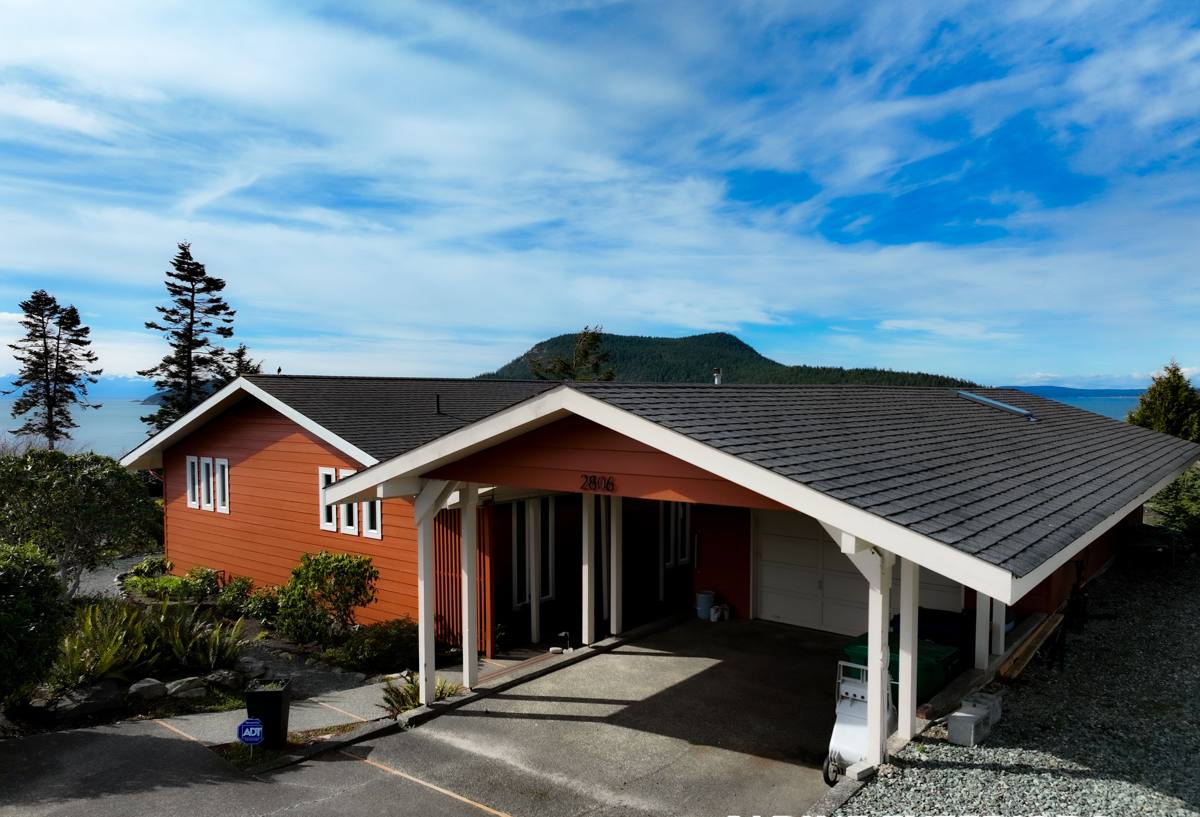
Salt Air: The Quiet Corrosion Problem
Salt air doesn't announce itself the way a storm does. It works slowly, settling into metal fasteners, flashing, and hardware, and accelerating oxidation on anything that isn't rated for coastal exposure. On a harbor-adjacent home, that means:
- Standard fasteners and flashing corroding faster than their inland-rated equivalents
- Paint and coatings breaking down sooner on the windward, water-facing side of the house
- Metal window and door hardware pitting or seizing years before it would elsewhere
- Caulk and sealant joints failing early, opening small gaps that let moisture behind the exterior skin
The fix isn't complicated in concept — use materials and fasteners rated for coastal/marine exposure, and pay closer attention to the water-facing elevation during both installation and maintenance — but it does require knowing which details matter and not defaulting to whatever spec sheet works fine forty miles inland.
Driving Rain and the Wall Assembly Behind the Siding
Why Direction Matters More Than Volume
Whatcom County gets plenty of rain generally, but what makes harbor-facing homes different is the wind direction. Rain that's being pushed horizontally by wind off the water finds every lap, seam, and penetration in a siding system that a straight-down rain would never reach. That's a drainage-plane problem as much as a surface problem — the siding itself matters, but so does the water-resistive barrier, the flashing at windows and doors, and whether the assembly behind the cladding can actually shed water that gets past the first line of defense.
What We Check on Every Blaine Harbor Job
On homes in this area we pay particular attention to flashing details around windows, doors, and any roof-to-wall transitions, along with proper clearance between the bottom of the siding and grade or hard surfaces like patios and walkways. Splash-back from driving rain is a common source of moisture damage at the base of a wall, and it's an easy thing to get wrong if the crew isn't thinking about wind-driven exposure specifically.
Moss, Algae, and the Long Damp Season
Whatcom County's shoulder seasons run long and damp, and shaded north- and east-facing surfaces near the water can stay wet for extended stretches. That's exactly the environment moss and algae need. On roofs, moss works its way under shingles and lifts them, which is a mechanical problem, not just a cosmetic one — it opens paths for water intrusion that get worse every season it's left unaddressed. On siding, algae growth is mostly cosmetic but it does hold moisture against the surface longer, which matters more for some materials than others depending on how they handle sustained dampness.
Practical Moss Management
- Keep gutters and valleys clear so water isn't sitting anywhere on the roof
- Trim back vegetation that's shading and keeping roof or wall sections perpetually damp
- Have moss physically removed rather than just treated, since chemical treatment alone doesn't address shingles that are already lifted
- Choose siding and roofing materials that are documented to resist sustained moisture exposure rather than ones that simply look fine when dry
Siding: Why We Only Install James Hardie Fiber Cement
We install exclusively James Hardie fiber cement siding, and on a harbor-exposed property that's not a marketing preference — it's a direct response to the conditions above. Fiber cement is non-combustible and dimensionally stable, and it doesn't absorb and release moisture the way wood-based products do, which matters enormously in a climate where the siding is dealing with salt air and driving rain for most of the year. Hardie's ColorPlus factory-applied finish is baked on under controlled conditions rather than field-applied, which gives it better adhesion and color retention than site-painted products, especially on a wall that's taking direct salt spray.
Hardie also builds climate-engineered product lines — HardiePlank, HardiePanel, and others — under their "HZ" designation, which accounts for regional moisture and temperature conditions rather than shipping one generic spec everywhere. That's a meaningful distinction for a coastal Whatcom County property versus, say, a home in a dry inland climate.
Why We Don't Install the Alternatives
Homeowners in this area sometimes ask about vinyl siding, LP SmartSide (engineered wood), or primed wood species like cedar or spruce, so it's worth being straightforward about why we've standardized away from them:
| Product | Trade-off in a harbor/marine climate |
|---|---|
| Vinyl siding | Can warp or become brittle with temperature swings and UV exposure over time; seams and fastening are more sensitive to wind-driven rain intrusion |
| LP SmartSide / engineered wood | Wood-based core is more sensitive to sustained moisture exposure if any coating or sealant detail fails, which is a real risk given how long surfaces stay damp here |
| Primed cedar or spruce | Natural wood requires ongoing repainting and sealing to stay ahead of moisture; salt air accelerates coating breakdown and shortens the maintenance interval |
| James Hardie fiber cement | Non-combustible, dimensionally stable, factory-cured ColorPlus finish, HZ climate-engineered formulation, strong transferable warranty |
Every one of those alternative products has legitimate uses and defenders — this isn't a claim that they're bad products. It's that after weighing the maintenance burden, moisture behavior, and installation sensitivity against what a harbor-exposed home actually needs, Hardie fiber cement is what we're willing to put our installation standards behind.
Roofing for a Marine Environment
Roofing decisions near Blaine Harbor come down to two things: moss resistance and how the roof handles wind-driven rain at penetrations and edges. Proper underlayment, correctly lapped flashing at every valley and penetration, and adequate ventilation all matter more here than they would on a drier, more sheltered lot, because any weak point gets tested by both moisture and salt air far more often. We also pay attention to fastener and flashing metal selection — the wrong metal in a salt-air environment can corrode and stain a roof well before the shingles themselves are due for replacement.
Windows: Sealing Against Salt Air and Wind-Driven Rain
Windows on harbor-facing walls take a combination of direct salt exposure and wind pressure that inland windows rarely see. The two failure points we watch for are seal failure (fogging between panes on dual- or triple-pane units) and hardware corrosion, both of which show up sooner in this environment. Correct flashing and sealant detailing around the window opening itself is just as important as the window unit — a good window installed with a poor flashing detail will still leak.
Decks: Standing Up to Salt, Moisture, and UV
Decks near the harbor deal with all of the same exposure issues as the rest of the exterior, plus direct foot traffic and, often, more UV exposure if the deck faces open water. Fastener corrosion is one of the most common issues we see — standard fasteners staining boards or weakening over time in a salt-air environment. Proper board spacing for drainage, ledger flashing where the deck attaches to the house, and coastal-rated hardware all matter more here than on a sheltered inland deck.
Why a Local Crew Matters for Blaine Harbor Properties
A crew that mostly works inland can still do competent work, but they may not default to marine-grade fasteners, coastal flashing details, or moss-resistant material choices unless they're specifically thinking about it. Working regularly in Blaine and along the Whatcom County waterfront means those decisions are just part of how we scope and bid a job here — not an afterthought we have to be reminded of. That familiarity also shows up in smaller ways: knowing which elevations on a harbor lot typically take the worst of the wind-driven rain, and recommending accordingly, rather than treating every wall the same.
What to Expect From an Estimate
When we look at a property near Blaine Harbor, we're assessing more than the surface condition of the siding, roof, windows, or deck. We're looking at orientation relative to the water, existing moisture damage or moss buildup, the condition of flashing and fasteners, and how the current materials have held up against the specific combination of salt air, wind-driven rain, and long damp seasons this area sees. That gives us a clearer picture of what actually needs attention now versus what can be monitored, and it lets us give a straight answer instead of a generic one.
If you're noticing moss that won't quit, siding that's chalking or pulling away on the water-facing side of your home, foggy windows, or a deck with rust-stained fasteners, we're happy to come take a look. Reach out for a free, no-pressure estimate — there's a form below to get started.