 Blaine Exterior
 Two Fiber Cement Boards, One Real Difference
If you've been pricing out siding in Blaine or anywhere else in Whatcom County, you've probably run into two names that sound almost interchangeable: Cemplank and James Hardie. Both are fiber cement products. Both promise to outlast wood and resist fire better than vinyl. Both show up on contractor bids at different price points, which is usually the first thing homeowners notice.
We get asked fairly often why we don't offer Cemplank as a budget option alongside Hardie. It's a fair question, and the honest answer isn't that Cemplank is a bad product on paper. It's that after installing siding on homes exposed to Puget Sound salt air, winter storms rolling off the Strait of Georgia, and the long gray moss season that defines this corner of Washington, we've settled on one manufacturer we trust completely rather than offering a second option we'd have to caveat every time.
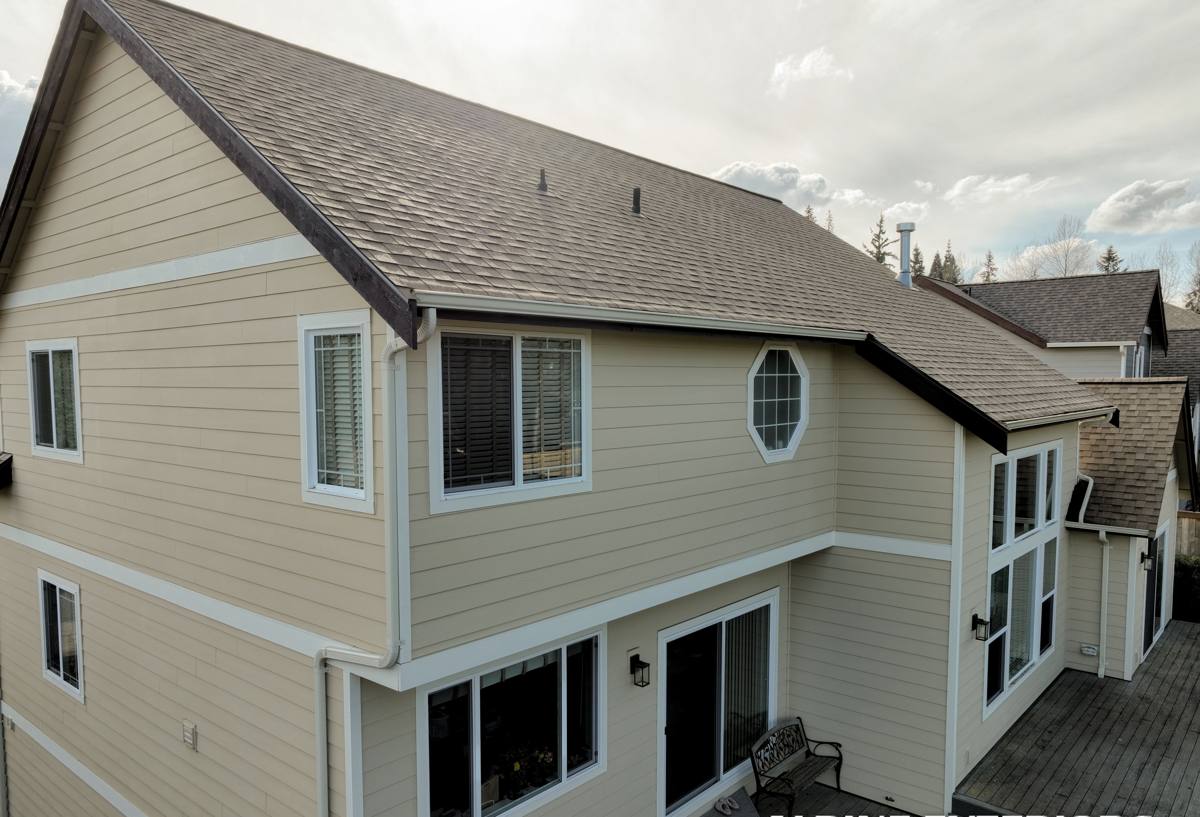
What Cemplank Gets Right
Cemplank, manufactured by Boral (now part of the Saint-Gobain family of building products), is a legitimate fiber cement siding. It's non-combustible, it doesn't attract woodpeckers or insects the way cedar can, and it holds paint better than wood clapboard. For a homeowner comparing it only to vinyl or untreated wood, it's a genuine step up in durability and fire resistance.
It also tends to price below Hardie in most markets, which is the main reason it shows up in bids at all. On paper, a lower price for a fiber cement board sounds like an easy win. The complications show up later, in the details that don't make it onto a quote sheet.
Where the Comparison Gets Real
The core material — Portland cement, sand, and cellulose fiber — isn't wildly different between manufacturers. What separates fiber cement products in the field is the factory finish, the climate-specific engineering, the consistency of supply, and the strength of the warranty standing behind the board once it's on your wall for twenty years.
| Factor | Cemplank | James Hardie |
|---|---|---|
| Base material | Fiber cement | Fiber cement |
| Factory finish option | Primed, field-paint typical | ColorPlus factory-baked finish available |
| Climate-specific engineering | General-purpose formulation | HZ5 / HZ10 zone-engineered lines |
| Regional availability | Inconsistent in the Pacific Northwest | Widely stocked, dedicated PNW distribution |
| Transferable warranty | Limited, varies by product | Long-term, transferable to new owners |
| Installer familiarity locally | Less common, fewer trained crews | Standard training and install specs available |
Factory Finish: The Detail That Matters Most in This Climate
Blaine sits right on the water, which means every wall on a house is dealing with salt-laden air, driving rain off the Strait, and long stretches of damp, low-light weather that keeps moss and algae growing on north-facing siding well into what would be "dry season" almost anywhere else. Paint film performance is not a cosmetic issue here — it's the first line of defense against moisture getting behind the board.
Field-applied paint, even good paint applied correctly, cures under whatever conditions exist on install day and bonds to a board that's already been through shipping, handling, and job-site exposure. A factory-applied finish like Hardie's ColorPlus is baked on in a controlled environment before the board ever leaves the plant, with a consistency you can't fully replicate with a paint sprayer in a driveway. Cemplank's standard offering leans more heavily on primed boards meant for field painting, which shifts more of the long-term finish performance onto the installer and the homeowner's repaint schedule.
What This Means for Maintenance
- A weaker or inconsistent finish shows fading and chalking sooner, especially on south and west elevations that get the most UV.
- Moss and mildew take hold faster on a finish that's absorbing moisture rather than shedding it, which matters directly for Whatcom County's wet-season siding.
- Repainting fiber cement isn't a weekend job — it means scaffolding, masking, and matching color across dozens of boards, often sooner than a homeowner budgeted for.
- A factory finish backed by a real warranty shifts that risk away from the homeowner instead of onto them.
Climate-Engineered Product Lines
One thing Hardie does that we haven't seen matched consistently across competing fiber cement brands is engineering specific product formulations for specific climate zones — HZ5 for areas with freeze-thaw cycles and moisture exposure, HZ10 for hot, dry regions, and so on. That's a meaningful distinction in a place like Blaine, where the siding on a bluff-side home is dealing with a very different moisture load than a house a few miles inland.
Cemplank's lineup is more general-purpose. That doesn't mean it fails in the Pacific Northwest, but it means the product wasn't specifically formulated with driving coastal rain and prolonged dampness as the design target. When we're putting siding on a home that's going to sit through forty or fifty years of Strait of Georgia weather, we'd rather install a board engineered for exactly that exposure than one engineered for "everywhere."
Availability and Installation Consistency
This is a practical issue as much as a technical one. James Hardie has built out distribution and installer training specifically for the Pacific Northwest, which means we can source specific profiles, colors, and trim consistently, and any crew working on a Hardie job is working from a well-documented install spec. Cemplank has a smaller footprint in this region — fewer local distributors carrying full color and profile runs, and fewer crews with deep, repeated experience installing it to spec.
Fiber cement is installation-sensitive no matter whose name is on the box. Improper fastening, wrong nailing patterns, insufficient clearance from grade, or poor flashing at butt joints will cause problems in five years regardless of which manufacturer made the board. But when a product is installed less often in a given region, the odds of a crew being genuinely fluent in its specific install requirements go down. We'd rather standardize our crews on one system we install constantly and know inside out than split our attention across two.
Installation Details That Actually Determine Longevity
- Minimum clearance between siding and grade, decks, or roof lines
- Correct fastener type, spacing, and penetration depth
- Proper flashing and weather barrier integration behind every board
- Field-cut edges sealed per manufacturer spec before installation
- Manufacturer-approved caulking and paint touch-up products at butt joints
Get any one of these wrong on either product and you'll see it eventually — usually as moisture staining, cracked caulk lines, or paint failure at the joints first.
The Warranty Question
A siding warranty is only as useful as the company standing behind it and the length of coverage on the parts a homeowner actually experiences — the finish, not just the substrate. Hardie's warranty structure on ColorPlus products covers the factory finish for an extended term and is transferable if the home is sold, which matters in a market where buyers increasingly ask about siding age and condition during inspection. Cemplank's warranty coverage is real but tends to be shorter and more narrowly scoped, particularly on field-painted boards where the paint itself often carries separate, weaker coverage than the substrate.
When something goes wrong with siding, it's rarely in year one or two — it's in year twelve or fifteen, right when a homeowner assumed the warranty clock had run out anyway. We'd rather stand behind installs backed by the stronger, longer, transferable coverage.
Why We Standardized on One Manufacturer
We could carry both products and let price point drive the conversation. Plenty of contractors do exactly that. We chose not to, for a simple reason: every crew we train, every install detail we've refined, and every warranty conversation we have with a homeowner is built around one system. That focus is what lets us guarantee the work rather than hedge it.
For homes on this stretch of the Washington coast — dealing with salt air, sideways rain, and moss that doesn't take a season off — we want siding that was engineered for this exposure, finished in a factory rather than a driveway, and backed by a warranty that still means something in year twenty. That's James Hardie, and it's the only fiber cement product we put on a house.
What to Ask Any Contractor Before You Decide
Whether you end up with us or someone else, these are the questions worth asking before signing a siding contract:
- Is the finish factory-applied or field-painted, and what does the finish warranty actually cover?
- Is this product engineered for a coastal, high-moisture climate, or is it a general-purpose formulation?
- How many jobs has this specific crew installed with this specific product in the last year?
- Is the warranty transferable if you sell the home?
- What's the manufacturer's minimum clearance spec from grade, decks, and roofline — and will the crew follow it?
If you're weighing siding options for a home in Blaine or elsewhere in Whatcom County, we're happy to walk through what we install, why, and what it would look like on your specific house. Reach out for a free, no-pressure estimate — there's no obligation, just a straight answer about what we'd recommend and why.