 Blaine Exterior
 Metal Roofing for Sumas Homes: Built for Whatcom County Weather
Sumas sits at the far edge of Whatcom County, close enough to the Canadian border that the weather patterns feel familiar to anyone who's spent a winter in this corner of Washington: long stretches of low cloud, rain that comes in sideways more often than straight down, and a damp that never fully leaves the air even when it isn't raining. Roofs here don't fail because of one bad storm. They fail slowly, from years of moisture finding the same weak points over and over. Metal roofing, installed correctly, is one of the more effective answers to that pattern — but "installed correctly" is doing a lot of work in that sentence, and it's the part most homeowners never get a straight answer on.
This page is about metal roofing specifically for homes in and around Sumas — what the local climate actually does to a roof over time, what a correct metal roof installation involves, and how to tell a contractor who knows this area from one who's just passing through.
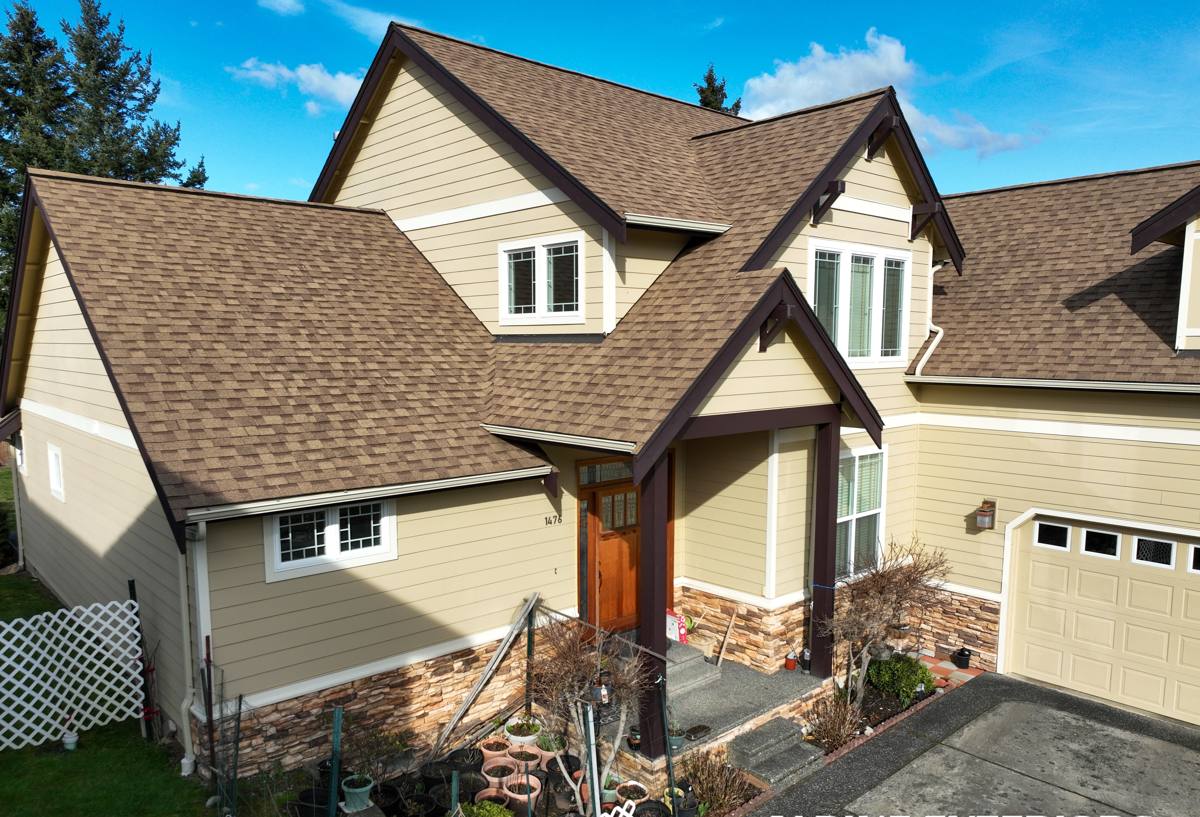
What Driving Rain and a Long Moss Season Do to a Roof
Wind-Driven Rain
Whatcom County doesn't just get a lot of rain — it gets a lot of rain pushed by wind, which is a different problem. Straight-down rain sheds off a roof the way it's supposed to. Wind-driven rain gets forced up under shingle tabs, into fastener holes, and along flashing edges where a roof was never designed to see water moving sideways or slightly uphill. Over a few winters, that's how you get soft decking around chimneys, valleys, and skylights long before the roof "looks" old from the ground.
Moss and Constant Moisture
The same conditions that make this part of Washington green also make it good growing conditions for moss, algae, and lichen on a roof. On asphalt shingles, moss roots into the granule surface and holds moisture against the mat, which shortens the life of the shingle from underneath — often faster than sun exposure ever would. Once moss gets established on a north-facing slope or a shaded section near trees, it tends to come back every year unless something about the roof surface itself changes.
This is one of the practical reasons metal roofing gets a serious look in communities like Sumas: moss and algae have a much harder time gripping a smooth, hard metal surface than a granular shingle mat, and a properly installed metal roof sheds wind-driven water instead of absorbing it.
Why Metal Roofing Fits This Climate
- Sheds water fast. Metal panels have almost no surface for water to cling to, so wind-driven rain runs off before it can work its way under seams — assuming the seams and flashing were done right in the first place.
- Resists moss and algae growth. A hard, non-porous surface gives moss far less to root into compared to shingles, which cuts down on the yearly cleaning cycle a lot of Whatcom County homeowners are used to.
- Handles freeze-thaw and heavy, wet snow loads. Metal doesn't absorb water the way organic shingle mats do, so it isn't as prone to the swelling and cracking that comes with repeated wet-freeze cycles.
- Long service life with the right coating. A quality painted or coated metal system, properly maintained, is designed to outlast several cycles of asphalt shingle replacement.
None of that means metal is automatically the right choice for every home or every budget — it's a bigger upfront investment than asphalt, and it comes with its own installation demands. It means that for a climate defined by driving rain and a long moss season, it's a system worth understanding in detail before you decide.
What a Correct Metal Roof Installation Actually Involves
Underlayment
Metal expands and contracts with temperature more than shingles do, and in a wet climate the underlayment beneath it is doing real work, not just serving as a backup. We use synthetic or self-adhered underlayment rated for the panel system going down, with extra protection at valleys, eaves, and anywhere water is likely to pool or back up.
Fastening and Panel Type
Exposed-fastener panels and concealed-fastener (standing seam) systems handle wind-driven rain differently, and the fastener choice — including washer type and spacing — affects how long the roof stays watertight. In a climate like this, fastener quality and placement matter as much as the panel itself.
Flashing and Penetrations
Nearly every metal roof leak we're called out to diagnose in Whatcom County traces back to flashing — around chimneys, vent pipes, skylights, and wall transitions — not the panels themselves. Flashing has to be custom-fit and properly lapped for the specific roof geometry, not stretched from a generic kit.
Ventilation
Metal roofs need proper attic and roof-deck ventilation to manage condensation, especially given how much moisture sits in the air here for months at a time. Skipping this step is one of the more common corners cut on rushed installs, and it shows up later as hidden moisture damage rather than an obvious leak.
Comparing Metal Roofing Options for a Sumas Home
| System Type | Best For | Maintenance | Relative Cost |
|---|---|---|---|
| Standing seam (concealed fastener) | Long-term, low-maintenance performance; clean, modern look | Very low — no exposed fasteners to fail | Higher upfront |
| Exposed-fastener metal panels | Budget-conscious upgrades from asphalt; outbuildings, additions | Moderate — fasteners and washers need periodic checks | Mid-range |
| Stone-coated steel | Homeowners who want a traditional shingle or tile look with metal's durability | Low to moderate | Mid to higher |
| Metal roof over existing shingles (where code allows) | Certain reroof situations to reduce tear-off cost | Depends on underlying deck condition | Variable |
We'll walk through which of these makes sense for your roof's slope, existing structure, and budget during the estimate — there's no one "right" system for every house, only the right system for your house and how it's built.
Our Process, Start to Finish
- On-site inspection. We look at the existing roof, decking condition, ventilation, and any problem areas — moss buildup, past leaks, soft spots — before recommending anything.
- Honest scope and estimate. You get a clear breakdown of panel type, underlayment, flashing work, and ventilation changes, with no pressure to upgrade beyond what your home actually needs.
- Deck prep. Any damaged or soft decking gets replaced before a single panel goes down — covering a bad deck with new metal just hides the problem.
- Underlayment and flashing installation. This is where most of the long-term performance is decided, and we don't rush it.
- Panel installation. Panels are installed to the manufacturer's specification for fastening, seaming, and expansion allowance.
- Final walkthrough. We review the completed roof with you, including what routine maintenance (if any) the system needs going forward.
Maintenance: What Actually Needs Doing
One of the appeals of metal roofing in a moss-prone climate is how little routine maintenance it needs compared to shingles — but "little" isn't "none."
- Clear debris (needles, leaves, branches) from valleys and gutters each fall before the wet season sets in.
- Do a visual check after major windstorms for lifted panels, loose fasteners, or damaged flashing.
- Watch shaded, north-facing slopes for early moss or algae growth and address it before it spreads.
- Keep gutters and downspouts clear so water isn't backing up under eave flashing.
- Have a professional look at any exposed-fastener system every few years to check washer condition.
Why Local Experience in Sumas Matters
Metal roofing rewards a contractor who understands the specific weather it's being installed against. A crew that mostly works drier climates can install a technically sound roof that still underperforms here, simply because the flashing and ventilation details that matter most in wind-driven, moss-prone conditions aren't the details they're used to prioritizing. Working across Whatcom County — from Blaine down through communities like Sumas — means seeing the same failure patterns repeatedly and building against them from the start, rather than learning them one callback at a time.
When you're vetting a metal roofing contractor for a home in this area, it's worth asking directly:
- Do they carry current WA state contractor licensing and insurance, and can they provide proof without hesitation?
- Do they specify underlayment and flashing details in writing, not just "metal roof installation" as a line item?
- Do they explain ventilation as part of the scope, or only mention it if you ask?
- Can they speak specifically to moss and wind-driven rain performance, not just general product benefits?
- Do they offer a written warranty that covers workmanship, not just the manufacturer's material warranty?
A roof that's right for Sumas isn't necessarily the same roof that's right for a drier part of the state, and a contractor who treats every job the same way will eventually get caught out by the details that matter here.
If you're weighing metal roofing for a home in Sumas — whether it's a full reroof, a repair, or you just want a straight answer on whether it's the right fit for your house — we're happy to take a look and walk you through it. Reach out for a free, no-pressure estimate using the form below.