 Blaine Exterior
 Decking Built for What Sumas Weather Actually Does to It
Sumas sits in the same stretch of Whatcom County as Blaine, and homes out here deal with the same marine-influenced weather that moves in off the Salish Sea — long stretches of driving rain, salt-tinged air on the wind, and a moss season that can run from early fall clear through spring. A deck built without that climate in mind will show it fast: soft spots in the wrong wood, corroding fasteners, and a slick green film that never fully goes away. Composite decking, installed correctly, is one of the more reliable answers to that combination when you want a deck that still looks and performs well ten and fifteen years out.
This page is about one job in one area: composite decking for homes in and around Sumas. Not a general decking overview — what this climate actually asks of a deck, what a correct build looks like, and what our process is when we do the work.
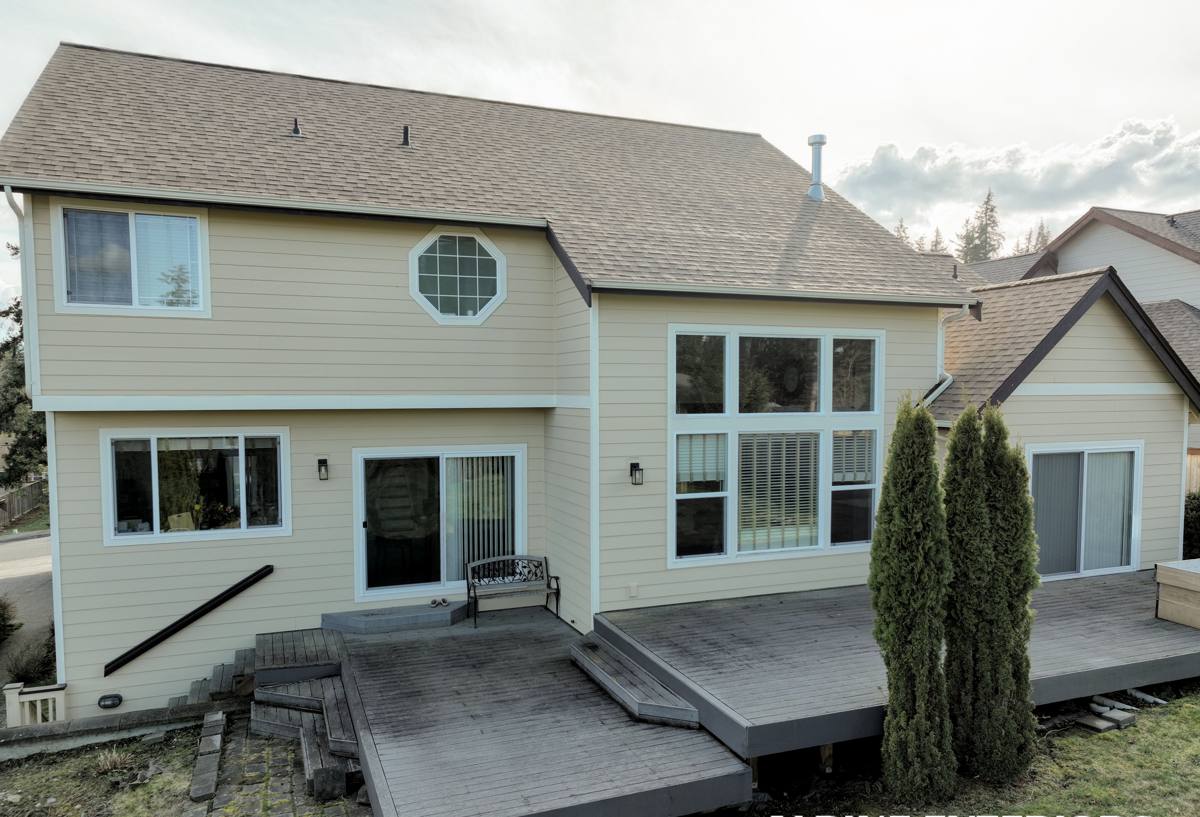
Why the Local Climate Changes the Decking Decision
Rain and standing moisture
Whatcom County gets a lot of wet weather spread across most of the year, not just a short rainy season. That means any decking material spends a large share of its life damp, not just occasionally rained on. Wood decking has to shed and dry that moisture repeatedly without cupping, splitting, or opening up at the fastener holes. Composite doesn't absorb water the way wood does, which is a real advantage here — but it still needs proper drainage underneath, or moisture just sits and causes problems somewhere else, like the framing.
Moss and organic buildup
A long moss season means anything horizontal and shaded will collect spores, and decks are exactly that — flat, often partially shaded by the house or trees, and rarely bone-dry for long. Moss and algae need a foothold to grip, and the texture and grain pattern of a decking product affects how easily that happens and how easily it comes back off. This is one of the bigger differences between decking products that homeowners don't find out about until a few winters in.
Salt-influenced air and hardware
Coastal Whatcom County air carries enough salt content to accelerate corrosion on lower-grade fasteners, brackets, and hidden hardware over time. It's rarely dramatic — it shows up as rust streaking near screw heads, weakened joist hangers, or fasteners that back out or fail years before they should. The board material gets most of the attention in a decking project, but the hardware underneath is just as much a climate decision.
Composite vs. Other Decking Materials for This Climate
There's no single "best" decking material for every situation — it depends on budget, how the deck will be used, and how much upkeep you actually want to do. Here's how the common options compare specifically against Sumas-area conditions.
| Material | How it handles rain & moisture | How it handles moss/algae | Upfront cost | Ongoing upkeep |
|---|---|---|---|---|
| Pressure-treated wood | Absorbs and releases moisture; needs sealing to control cupping/splitting | Moss grips readily in the grain; needs regular cleaning and re-sealing | Lowest | Highest — annual cleaning, periodic sealing/staining |
| Cedar or other natural wood | Better natural resistance than treated pine, but still absorbs water over time | Similar exposure to moss; grain still gives it somewhere to hold on | Mid-high | High — regular sealing to protect appearance and structure |
| Capped composite | Core doesn't absorb water like wood; cap sheds moisture | Smoother, less porous surface makes buildup easier to rinse or brush off | Mid-high | Low — periodic cleaning, no sealing or staining |
| PVC/vinyl decking | Fully moisture-resistant, doesn't take on water at all | Very smooth surface resists moss adhesion well | Highest | Lowest, but less wood-like appearance and feel underfoot |
For most Sumas homeowners weighing wood against composite, the real trade is upfront cost versus years of upkeep. Wood is cheaper the day it's installed and more expensive in labor and materials every year after, especially in a climate this wet and moss-prone.
What a Correct Composite Deck Build Involves
Composite boards get most of the marketing attention, but the board is only part of what makes a deck last in this climate. A rushed installation can undercut even a good product.
Substructure and framing
The framing underneath still has to be built for a wet climate regardless of what decking sits on top — proper joist spacing for the specific composite product (composite typically needs tighter spacing than wood, and the manufacturer's spec is the floor, not a suggestion), and treated or naturally durable lumber for anything that will stay damp longer than the surface boards.
Ventilation and drainage
Composite decking sheds surface water, but the space underneath the deck still needs to drain and breathe. Decks built low to grade, over poor drainage, or without enough airflow underneath trap moisture against the framing and hardware — which is exactly the corrosion and rot risk composite boards are supposed to help you avoid. Grading, gaps, and clearance under the joists matter as much as the boards themselves.
Fasteners and hardware
Given the salt content in the air here, we don't cut corners on hardware grade. Hidden fastener systems, brackets, and joist hangers rated for coastal/corrosive exposure cost more up front and hold up under conditions that will chew through standard-grade hardware over a decade or two.
Board layout and expansion gaps
Composite boards expand and contract with temperature more than most people expect, and correct gapping at butt joints, picture-frame borders, and against the house is what keeps a deck from buckling or gapping unevenly a few years in. This is a detail that's easy to get wrong on a first-time composite install and easy to get right when it's routine.
Our Installation Process
The work follows the same order on most Sumas decking projects:
- Site assessment — grading, drainage, sun/shade exposure, and condition of any existing structure being replaced.
- Framing and structural work — new or reinforced substructure built to the composite manufacturer's spacing and support requirements, not generic wood-deck spacing.
- Drainage and ventilation setup — grading and clearance under the deck so water moves away instead of sitting.
- Composite board installation — hidden fastener systems, correct gapping, and layout planned around the house before the first board goes down.
- Railing, stairs, and trim — matched to the decking system and finished to shed water at every horizontal surface.
- Final walkthrough — checking fastening, gapping, and drainage before we call it done.
Cost Factors to Plan For
Composite decking installed in this region commonly lands in a broad range depending on the project — rough industry ranges put installed composite decking somewhere in the neighborhood of $40 to $75 per square foot, though your actual number depends heavily on the factors below. We'll always give you a specific number for your project, not a generic estimate.
| Factor | Why it moves the price |
|---|---|
| Square footage and shape | More cuts, borders, and picture-framing add labor beyond raw board cost |
| Existing structure condition | Reusing sound framing costs less than removing and rebuilding a failed substructure |
| Height and grade | Elevated decks need more substructure, railing, and stair work than ground-level decks |
| Composite product tier | Capped composite and premium lines cost more than entry-level composite boards |
| Railing and hardware choice | Composite, aluminum, or cable railing all price differently than basic wood or standard baluster rail |
| Site access | Tight lots, slopes, or limited equipment access add labor time |
Keeping a Composite Deck Sound Through Moss Season
Composite decking cuts way down on upkeep compared to wood, but "low-maintenance" isn't "no-maintenance" in this climate. A short seasonal routine keeps a composite deck performing the way it's supposed to:
- Rinse or sweep the surface regularly through fall and winter to keep wet leaves and debris from sitting in one spot
- Scrub visible moss or algae with a soft-bristle brush and a mild cleaner made for composite — avoid pressure washers on close settings, which can damage the cap surface
- Keep gutters and downspouts near the deck clear so runoff isn't draining directly onto or under it
- Check railing posts, stair connections, and any visible hardware once a year for looseness or corrosion
- Confirm gaps between boards stay clear of debris so water keeps draining through instead of pooling
- Trim back overhanging branches or shrubs that keep sections of the deck shaded and slow to dry
Why Hiring a Crew That Already Works Sumas Matters
A lot of decking problems in this area don't come from bad materials — they come from installation decisions made by crews used to a drier climate, or by DIY builds that followed generic instructions instead of what this specific stretch of Whatcom County actually requires. Framing spacing, drainage grading, and hardware grade all need to account for rain, moss, and salt-tinged air as a matter of course, not as an afterthought. A crew that already builds decks in Blaine and Sumas has already worked out those details on real jobs in this exact climate, not a showroom or a spec sheet written for somewhere else.
If you're weighing composite decking for a home in Sumas, we're happy to walk the site, talk through material options honestly — including when wood or a different composite tier makes more sense for your budget — and give you a straightforward, no-pressure estimate. Use the form below to get started.