 Blaine Exterior
 Window Installation in Birch Bay: A Different Job Than It Looks Like Inland
Birch Bay sits on a directly exposed stretch of Whatcom County coastline just south of Blaine, close enough to open water that salt air, wind-driven rain, and a long moss season aren't occasional weather here — they're the baseline conditions every window on every house has to perform against, all year. The neighborhood is also a genuine mix of housing ages: older beach cottages and cabins built decades ago, many converted from seasonal use to full-time living, standing near newer construction built to current code. That mix matters for window installation specifically, because what a correct job looks like on an older cottage isn't quite the same as what it looks like on a newer build, even when the two sit a few hundred feet apart.
We install windows throughout this part of Whatcom County, and Birch Bay is regular territory for our crew, not a special trip. We also handle siding, roofing, and decks, and we treat window installation as connected to the rest of the exterior rather than a standalone swap — a window that isn't flashed correctly into the surrounding wall causes problems that show up in the siding and trim around it, not just in the window itself. This page focuses specifically on window installation as a service: what Birch Bay's climate demands from it, what a correct job actually involves, and how our process works.
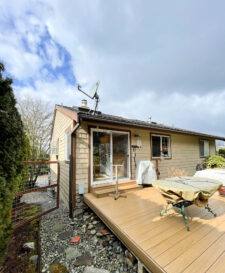
What Salt Air, Driving Rain, and Moss Actually Do to a Window Installation
Salt Air and Hardware
Homes this close to the water take a steady dose of salt-laden air, and that air is hard on anything metal — hinges, locks, cranks, and the corrosion-prone components inside a window's operating hardware. Lower-grade hardware that would last decades in a dry inland climate can start seizing, pitting, or failing years early out here. Hardware grade matters as much as glass quality when we're speccing a window for a Birch Bay property.
Wind-Driven Rain and the Flashing It Tests
Storms coming off the water don't drop straight down — wind pushes rain sideways into wall assemblies and window openings, and that sideways force finds gaps a calmer, drier climate would never expose. A window installation that would hold up fine a few miles inland can leak here within a season or two if the flashing sequence wasn't built for wind-driven rain specifically. This is the single biggest factor separating a Birch Bay window installation that lasts decades from one that needs attention again in a few years.
A Long Moss Season on Sills and Trim
Mild temperatures and near-constant moisture keep moss and mildew active across most of the year in this part of Whatcom County, and window sills, trim, and the framing around older wood windows are common places it takes hold first. Anywhere water sits instead of draining — a sill without enough slope, a trim detail that traps moisture — becomes a growth surface over time. Shaded, north-facing elevations tend to show it earliest.
Full-Frame vs. Insert Replacement: Getting the Right Call
One of the first decisions on any Birch Bay window project is whether to do a full-frame replacement, which removes the window down to the rough opening, or an insert (pocket) replacement, which fits a new window inside the existing frame. Both are legitimate approaches. The right one depends on the condition of what's already there, not on which is faster or cheaper to sell.
| Factor | Full-Frame Replacement | Insert Replacement |
|---|---|---|
| What it involves | Removes the window down to the rough opening and framing | Fits a new window inside the existing frame, which stays in place |
| Access to hidden damage | Exposes framing and old flashing so any moisture damage is found and fixed | Leaves existing framing and flashing covered and unverified |
| Flashing renewal | Full flashing system installed fresh | Depends on the existing flashing already being sound |
| Labor and cost | More labor, generally higher cost | Faster installation, generally lower cost |
| Best fit in Birch Bay | Older cottages with unknown moisture history or visible frame damage | Newer homes with confirmed sound framing, seeking an efficiency upgrade |
On the older cottages in Birch Bay that have been converted from seasonal to year-round living, we lean toward full-frame replacement more often than we would in a newer neighborhood, simply because it's common to find framing or flashing that was never built for constant coastal exposure and full-time occupancy. An insert replacement placed over a hidden problem doesn't fix it — it covers it up until it shows itself somewhere else on the wall.
What a Correct Installation Involves in This Climate
Sill Pan Flashing
A sill pan creates a sloped, waterproof pan under the window opening so any water that does get past the window sheds back outside instead of soaking into the framing below. It's inexpensive relative to the rest of the job and one of the most consistently skipped details on a rushed installation — and skipping it somewhere that gets this much wind-driven rain is asking for a slow leak that won't show up until the framing underneath is already compromised.
Flashing and Housewrap Sequence
Every layer around a window opening has to lap the one below it, shingle-style, so water is always directed outward and down rather than trapped behind a layer that holds it against the wall. Head flashing goes last, over the housewrap above the window, never tucked underneath it. Getting that sequence backward is a common shortcut that looks fine on install day and fails quietly over the following winters.
Sealant Backs Up Flashing — It Doesn't Replace It
Caulk and sealant have a real job around a window installation, but that job is to back up mechanical flashing, not substitute for it. Sealant alone breaks down, cracks, and shrinks over time, and somewhere with this much sustained moisture exposure, a window that's sealed instead of properly flashed is on borrowed time.
Air Sealing and Insulation at the Frame
The gap between a new window frame and the rough opening needs to be insulated and air-sealed correctly — not overpacked with expanding foam that can bow the frame, and not left with gaps that let cold, damp air track in around the edges. Done right, this step also cuts down on the drafts and condensation Birch Bay homeowners tend to notice most on cold, wet mornings.
Practical Checklist for Any Birch Bay Window Job
- Confirm whether the job is being scoped as full-frame or insert replacement, and why
- Ask specifically about sill pan flashing — it should be standard, not an upsell
- Ask how flashing laps into the existing siding and housewrap around each opening
- Get a written scope that separates the window's product warranty from the installer's labor warranty
- Confirm realistic lead time, since window orders can run several weeks depending on size
- Ask what happens if hidden moisture damage is found once the old window comes out
Frame Material and Glazing for a Water-Exposed Property
Frame material choice matters more here than in a sheltered inland setting, since more direct exposure means more years of salt air and sustained moisture working against whatever gets installed. We install vinyl and fiberglass window systems suited to this climate rather than defaulting to whatever's fastest to source, and we'll walk through the honest trade-offs for a specific opening rather than pushing one option as the only right answer.
- Vinyl frames: Resist rot and hold up well to sustained coastal moisture, generally at a lower cost than fiberglass, though color options are more limited once installed.
- Fiberglass frames: More dimensionally stable across temperature swings and can be painted, which matters on homes where color flexibility is part of the design plan.
- Glazing package: Double or triple-pane glass with a low-E coating helps with both energy performance and interior condensation, which is a common complaint on cold, damp Birch Bay mornings.
- Hardware grade: Corrosion-resistant hardware is worth the upgrade on any window facing the water directly, given how much faster standard-grade hardware wears out in salt air.
Signs a Birch Bay Window Needs Full Replacement, Not Just a Patch
- Fogging or visible moisture trapped between the panes of a double-pane window
- Drafts or cold spots at the frame even when the window is fully closed and locked
- Sill or trim wood that feels soft, looks discolored, or shows visible rot
- Hardware that's stiff, corroded, or difficult to operate compared to how it used to work
- Visible daylight or gaps where the frame meets the surrounding siding
- Paint or finish peeling or chalking noticeably faster on shaded or water-facing walls
Our Installation Process
- On-site assessment — we check frame condition, hardware function, and how the current flashing ties into the siding around each opening
- Honest recommendation — full-frame or insert replacement, explained with the reasoning specific to that opening
- Ordering and lead time — a realistic timeline before committing to a schedule, since sizes and configurations affect availability
- Careful removal — the old unit comes out cleanly, with the opening inspected for hidden moisture or framing damage before anything new goes in
- Sill pan and flashing installation — built to the sequence this climate requires, not a generic template
- Setting, shimming, and air sealing — the new unit is leveled, secured, and insulated correctly at the frame
- Trim and finish integration — exterior trim is tied back into the surrounding siding so the result reads as finished, not patched
Cost Factors for Window Installation in Birch Bay
| Factor | What Drives It | Coastal Consideration |
|---|---|---|
| Replacement type | Full-frame vs. insert, based on existing condition | Older, water-exposed homes more often need full-frame work |
| Number and size of openings | More or larger windows mean more labor and material | Larger units have more perimeter to flash correctly |
| Frame material and glazing | Vinyl vs. fiberglass, glazing package selected | Corrosion resistance and condensation performance matter more here |
| Hidden damage found on removal | Framing or sheathing repair once the old window is out | More common on older, long-exposed coastal openings |
| Site access | Ease of reaching each opening for the crew | Not usually a major factor, but varies by lot |
These are general drivers, not a quote. Every home in Birch Bay carries a different amount of prior exposure and prior workmanship behind its existing windows, so we look at the actual openings before putting a real number on the work rather than pricing over the phone.
Why a Crew That Already Works Birch Bay Matters
Manufacturer installation guidance is written for average conditions in a moderate climate, and Birch Bay's direct water exposure doesn't match that description most of the year. A crew that installs windows on this stretch of coastline regularly knows which parts of that guidance are non-negotiable here — a sill pan on every opening, a flashing lap sequence that assumes wind-driven rain rather than straight-down rain, hardware specified for salt air rather than a mild inland setting. Those are decisions that don't come up in a sales conversation, but they're what decide whether a window installation is still performing cleanly in fifteen years or showing drafts and soft trim in five.
If you're planning a window replacement on a Birch Bay home, whether it's one drafty window or a full house of aging originals, it's worth having someone look at the actual openings before pricing anything. We offer free, no-pressure estimates for window installation in Birch Bay and the surrounding area — use the form below to get a time on the schedule.