 Blaine Exterior
 What California Creek Asks of a Home's Siding
Homes near California Creek sit in one of the more demanding pockets of Whatcom County for exterior materials. You're close enough to the water for salt-laden air to reach painted and wood-based surfaces year-round, you're in a stretch of the Pacific Northwest that sees long stretches of driving rain off the Strait, and the combination of shade, moisture, and mild temperatures gives moss and algae a long growing season on north-facing walls and anything that stays damp too long. None of that is unusual for Blaine. But it does mean siding here has to do more work than siding in a drier inland town, and it has to be installed with that reality in mind from the first course to the last piece of trim.
This page is about one thing: installing James Hardie fiber cement siding correctly on a California Creek home, in a climate that will find every shortcut a crew takes.
Why the Local Climate Wears Out the Wrong Siding Faster
Salt Air and Painted or Engineered Surfaces
Airborne salt is corrosive to metal fasteners and flashing, and it accelerates the breakdown of paint films on wood and engineered wood siding. Homes closer to the water tend to show chalking, peeling, and edge swelling on painted products years before the same products fail on an inland home. Fiber cement doesn't stop salt exposure from happening, but it changes what salt exposure does to the wall: cement board doesn't rot, and a factory-applied finish holds up to UV and salt exposure far longer than field-applied paint.
Driving Rain and Wind-Driven Moisture
Rain in this part of Whatcom County doesn't always fall straight down. Wind off the water pushes it sideways into walls, which means siding, flashing, and the water-resistive barrier behind the siding all have to work together, not just the siding alone. A siding product that performs fine in a lab test can still fail on a real wall if the installation doesn't account for wind-driven rain finding every gap, seam, and fastener hole.
Moss, Algae, and Shade
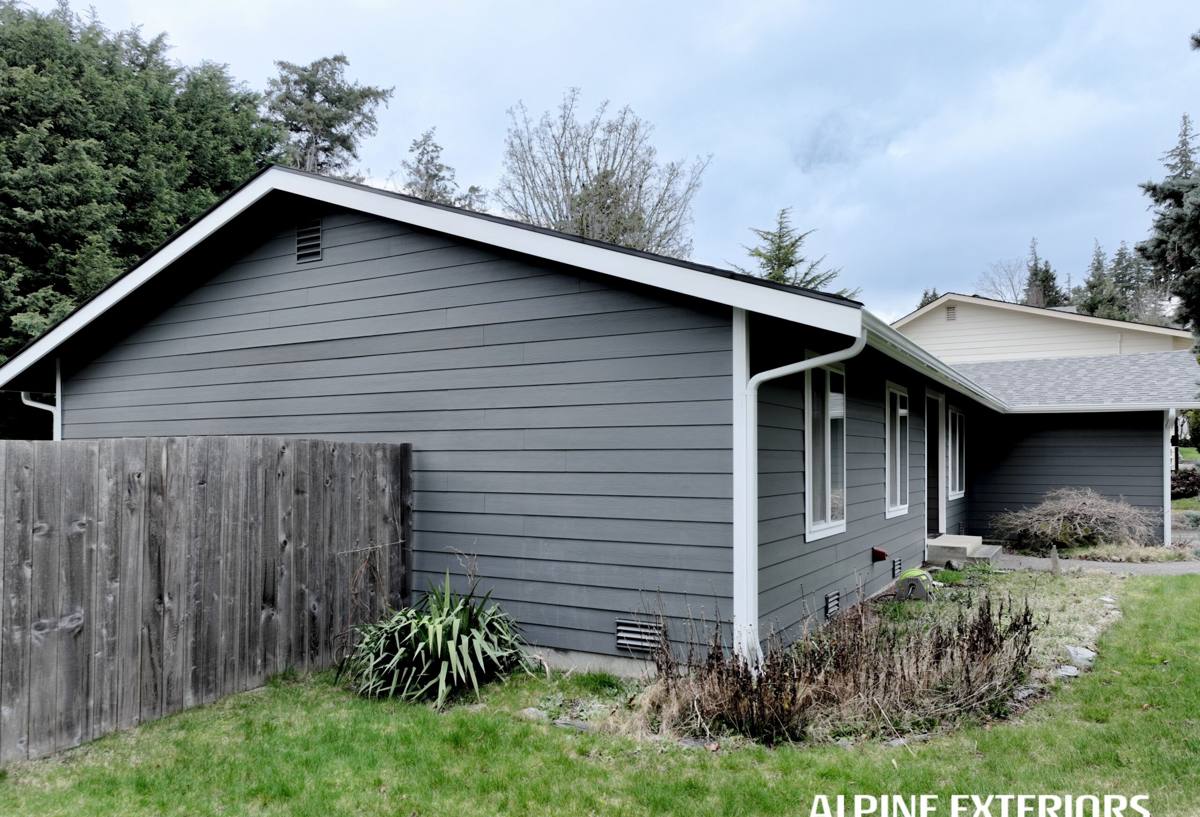
Trees, fences, and neighboring structures around California Creek properties create shaded, slow-to-dry wall sections, especially on north and east elevations. Moss and algae need moisture and low light to establish, and once they take hold on a porous or textured surface they hold water against the wall even longer, extending the problem instead of just sitting on top of it. This is one of the areas where the siding material itself matters: some products give moss more to grip onto than others.
Why We Install Only James Hardie Fiber Cement
Blaine Exterior Co doesn't install LP SmartSide, vinyl siding, Cemplank, Allura, or primed spruce or cedar siding. That's a deliberate standard, not a lack of options. Each of those products has real strengths and a legitimate place in the market. But for the climate we work in — salt air, sustained rain, and long wet seasons — we've found that James Hardie's fiber cement system gives us the most predictable, longest-lasting result when it's installed to spec, and a warranty structure that backs that up.
Vinyl siding is affordable and low-maintenance, but it's a thin, flexible material that can warp in temperature swings and doesn't hold paint if a homeowner ever wants to change the color. Engineered wood products like LP SmartSide use a wood-strand core, which means the entire performance of the product depends on an intact factory coating and correctly sealed cut edges and seams — a hard standard to maintain forever on a home exposed to this much rain. Cemplank and Allura are also fiber cement, and both are legitimate products; we don't install them because we've standardized our crews, training, fastening schedules, and warranty relationship around one manufacturer's system rather than splitting our expertise across several. Primed spruce and cedar are beautiful and traditional for this region, but raw wood siding asks for a maintenance commitment — regular repainting or restaining, caulk inspection, and moisture vigilance — that most homeowners underestimate until the first signs of rot show up at butt joints and corners.
James Hardie fiber cement is non-combustible, dimensionally stable in wet and dry cycles, and available with a factory-applied ColorPlus finish that's baked on and warrantied against fading and peeling far beyond what field-applied paint can promise. For a property near the water in Blaine, that combination is what we're willing to put our name behind.
What Correct Installation Involves in This Climate
The Drainage Plane Behind the Siding
Good fiber cement siding starts with what you don't see. A properly lapped water-resistive barrier, correctly flashed penetrations, and a drainage gap behind the siding give any wind-driven moisture that gets past the cladding a way out instead of a place to sit. On a California Creek home, we treat this layer as non-negotiable — it's the difference between siding that sheds an occasional wind-driven rain event and a wall assembly that traps moisture against the sheathing.
Flashing, Fasteners, and Gaps
James Hardie publishes specific fastening patterns, gap requirements at butt joints and trim, and flashing details for a reason: the product performs the way it's warrantied to perform only when those details are followed. That means corrosion-resistant fasteners driven to the correct depth and spacing, proper clearance between siding and grade, roofing, decks, and any horizontal surface, and flashing at every window, door, and penetration that directs water out and down, never back into the wall.
Caulking and Joint Treatment
Caulk is a maintenance item, not a permanent seal, and we install with that understanding. Panel and trim joints are detailed so that if a bead of caulk eventually fails, the assembly behind it is still protected by the flashing and drainage plane underneath — not relying on caulk as the only line of defense against Blaine's rain.
Choosing the Right Hardie Product Line for a Water-Adjacent Property
James Hardie engineers its siding by climate zone, and homes in western Washington are typically specified with the company's HZ5 product line, built for regions with damp, temperature-variable weather rather than the hot, humid HZ10 line meant for the Gulf Coast and Southeast. For California Creek specifically, we usually walk homeowners through:
- HardiePlank lap siding — the most common choice, available in several exposure widths and a range of factory ColorPlus colors, with a proven track record on coastal and rain-heavy homes.
- HardiePanel vertical siding — often used as an accent on gables, dormers, or entry features rather than the whole home.
- HardieTrim boards — matched fiber cement trim at corners, windows, and fascia so the whole exterior is fighting moisture the same way, not mixing wood trim with cement board field siding.
- Smooth versus cedar-textured finishes — texture is mostly an aesthetic choice, though a smooth finish can be marginally easier to keep clear of algae film on deeply shaded elevations.
Color selection matters here too. Darker ColorPlus finishes hold up fine structurally, but on shaded, moisture-prone walls a lighter or mid-tone color can make early moss and algae growth easier to spot and address before it spreads.
How Fiber Cement Compares for a Home Like This
Every siding material has trade-offs. For a property exposed to salt air, sustained rain, and shaded wet cycles, here's how the common options compare on the factors that matter most in that environment:
| Material | Moisture & Salt-Air Behavior | Maintenance Burden | Finish Longevity |
|---|---|---|---|
| James Hardie fiber cement | Non-combustible, dimensionally stable, doesn't rot | Occasional wash and caulk check | Factory ColorPlus finish, long warranty against fading/peeling |
| Vinyl siding | Won't rot but can warp with temperature swings; seams can allow water behind panels | Low, but limited repair options if damaged | Color is baked into the material but can't be repainted if it fades |
| Engineered wood (LP SmartSide) | Performance depends on intact coating and sealed cut edges; vulnerable if seams open | Regular inspection of joints and coating condition | Factory finish, but wood-strand core is at risk if moisture gets in |
| Primed spruce or cedar | Natural material, absorbs and releases moisture, prone to rot without upkeep | High — repainting or restaining on a regular cycle | Field-applied finish wears fastest of the group |
Our Process for a California Creek Project
- On-site evaluation: we walk the home, note shaded and wind-exposed elevations, existing moisture damage, and any trim or flashing that needs attention beyond the siding itself.
- Tear-off and sheathing check: once old siding is off, we inspect the sheathing and framing underneath for hidden rot or moisture damage before anything new goes up — a step that matters more on older Whatcom County homes than newer construction.
- Water-resistive barrier and flashing: we install or repair the drainage plane and flash every penetration before the first piece of Hardie siding goes on.
- Siding and trim installation: installed to James Hardie's published fastening, gapping, and clearance specifications, not shortcuts that happen to look fine from the ground.
- Final detailing and cleanup: caulking, touch-up, and a walkthrough so you know what was done and why.
Keeping Fiber Cement Siding Performing Near the Water
Correctly installed James Hardie siding is low-maintenance, not no-maintenance. A short annual routine goes a long way in a climate like this one:
- Rinse the siding once or twice a year, focusing on shaded, north-facing walls where moss and algae take hold first.
- Walk the exterior after major storms and check that gutters, downspouts, and grade slope are still directing water away from the walls.
- Inspect caulk lines at trim and penetrations every year or two, and re-caulk any joints that have cracked or pulled away.
- Keep vegetation trimmed back from siding so walls can dry between rain events instead of staying damp.
- Address any impact damage or cracked boards promptly — a small gap in the surface is how moisture gets a path to the layers underneath.
Why Hiring a Crew That Already Works This Area Matters
A siding crew that mostly works drier, inland jobs can install a technically fine product and still get the details wrong for a home near California Creek — because the details that matter here (drainage planes, wind-driven rain flashing, shaded-wall moss prevention) aren't the details that matter everywhere. A crew that regularly works Blaine and the surrounding Whatcom County coastline already knows which elevations take the worst weather, how local moisture patterns behave against a wall, and what the county's permitting and inspection process expects for a siding replacement. That local familiarity shows up in fewer surprises during the job and a better result once the weather starts testing it.
If you're weighing a siding replacement or repair on a California Creek property, we're glad to take a look and give you a straightforward, no-pressure estimate — no obligation, just an honest read on what your home needs.