 Blaine Exterior
 Why California Creek Roofs Wear Differently
California Creek sits in one of the wettest, saltiest corners of Whatcom County. Homes here don't just deal with rain — they deal with rain that comes sideways off the water, salt-laden air that never really stops working on exposed metal and wood, and a moss season that can run eight months or longer in a wet year. A roof system that would hold up fine forty miles inland can start failing early out here if it wasn't built, or replaced, with this specific climate in mind.
That's the difference between a generic roof replacement and one done for California Creek. The materials, the fastener choices, the ventilation layout, and even the timing of the job all need to account for what this neighborhood actually experiences year-round, not what a manufacturer's spec sheet assumes for an average U.S. home.
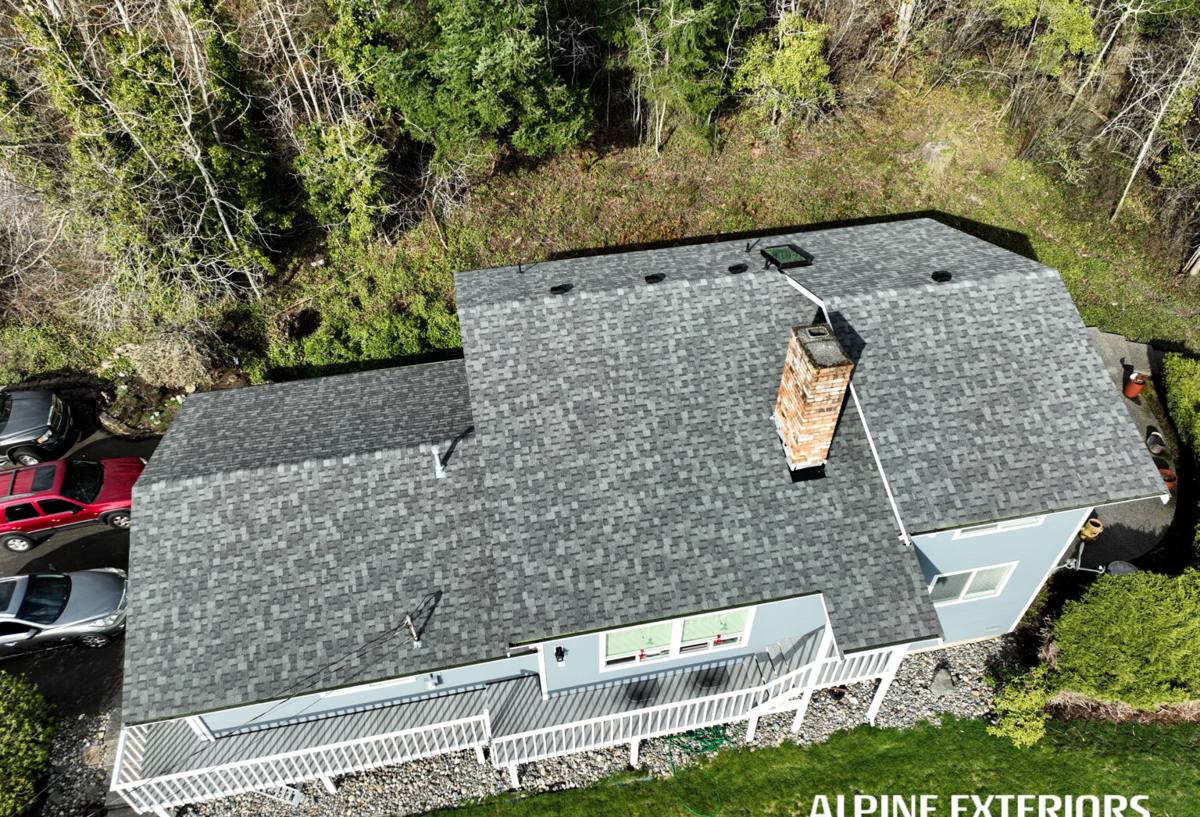
What Salt Air, Driving Rain, and Moss Actually Do to a Roof
Salt Air
Airborne salt accelerates corrosion on any exposed metal — nail heads, flashing, valley metal, gutter hardware. Over years, this shows up as rust streaking, pitted fasteners, and flashing that fails at the seams well before the shingles around it are due for replacement. It's one of the most common reasons we find a roof with plenty of shingle life left that's still leaking — the metal failed first.
Driving Rain
Wind-driven rain doesn't behave like a straight vertical downpour. It gets pushed up under shingle tabs, into open valleys, and around flashing edges that would be perfectly fine in calmer weather. This is why underlayment quality, flashing detail, and proper shingle sealing matter more here than in drier, calmer parts of the state — the margin for a sloppy detail is much thinner.
Moss and Prolonged Moisture
Blaine's long damp season keeps roof surfaces wet for extended stretches, especially on north-facing slopes and anywhere shaded by trees. Moss takes hold in that moisture, and once established it lifts shingle edges, holds water against the roof deck, and accelerates granule loss. A roof that isn't detailed and ventilated to dry out between storms will grow moss faster and age faster, no matter how good the shingle brand is.
Signs a California Creek Roof Needs Replacement, Not Another Repair
Not every issue means a full tear-off. But there's a point where patching stops making financial sense and a full replacement becomes the honest recommendation. Common signs we look for on homes in this area:
- Granule loss heavy enough that shingles look patchy or bald in spots, especially on rain-facing slopes
- Moss coverage that's returned repeatedly despite cleaning, particularly on shaded or north-facing sections
- Soft or spongy decking felt underfoot during inspection — a sign moisture has reached the sheathing
- Rusted or failing flashing around chimneys, vents, and valleys, even if the shingles nearby still look decent
- Multiple past repairs in different areas of the same roof, suggesting the underlying system is wearing out uniformly
- Daylight visible through the attic decking, or consistent staining on attic rafters and insulation
If a roof is showing two or more of these, replacement is usually the more cost-effective path than continuing to chase individual repairs.
Roofing Materials for a Marine, High-Moisture Climate
There's no single "best" roofing material for every home — it depends on budget, roof pitch, HOA or design goals, and how much long-term maintenance a homeowner wants to take on. Here's how the common options actually perform in California Creek's conditions:
| Material | Salt Air / Corrosion Resistance | Moss Resistance | Typical Lifespan | Maintenance Load |
|---|---|---|---|---|
| Architectural asphalt shingle | Good, if flashing and fasteners are corrosion-resistant grade | Moderate — benefits from algae-resistant granules | 25–30 years | Periodic moss/debris cleaning |
| Standing seam metal | Very good with proper coating and fastener selection | High — sheds moisture quickly, little for moss to grip | 40–50+ years | Low, occasional fastener/seam check |
| Cedar shake | Moderate — natural wood weathers but needs upkeep near salt air | Low without regular treatment | 20–30 years with maintenance | High — cleaning, treatment, moisture monitoring |
| Synthetic/composite shingle | Good — resists corrosion and moisture absorption | Moderate to good depending on product | 30–50 years | Low to moderate |
Our default recommendation for most California Creek homes is a well-detailed architectural asphalt or standing seam metal system, paired with corrosion-resistant flashing and fasteners regardless of which material sits on top. Cedar shake can look great, but we're upfront with clients that it demands a real ongoing maintenance commitment in this climate — we'll install it if that's the right fit for a home, but we won't oversell it as low-maintenance, because it isn't here.
What a Correct Roof Replacement Actually Involves
A roof is a system, not a single layer of shingles. Skipping or shortcutting any of the following is where premature failures come from in this climate:
Full Tear-Off and Deck Inspection
We remove the old roofing down to the deck rather than layering over it. This lets us actually see and address any soft, rotted, or delaminated sheathing — something you can't evaluate or fix with an overlay.
Ice-and-Water or High-Performance Underlayment at Vulnerable Points
Valleys, eaves, and roof-to-wall transitions get self-adhering underlayment as a second line of defense against wind-driven rain, in addition to standard synthetic underlayment across the full field.
Corrosion-Resistant Flashing and Fasteners
Given the salt air, we use flashing and fastener grades chosen to resist corrosion, not the minimum the manufacturer allows. This is a small cost difference at install time and a significant difference in how long the flashing actually lasts.
Balanced Attic Ventilation
Intake at the eaves and exhaust at the ridge, sized correctly for the attic volume. Good ventilation lets the roof deck dry out between rain events, which directly slows moss regrowth and reduces the risk of trapped moisture rotting the sheathing from underneath.
Correct Nailing and Sealing for High-Wind Exposure
Shingles fastened and sealed to the pattern the manufacturer specifies for high-wind zones, since exposed and waterfront-adjacent lots in this area see stronger gusts than more sheltered inland streets.
Our Roof Replacement Process
- On-site inspection — We walk the roof and attic, check the deck condition, flashing, ventilation, and drainage, and take photos to review with you.
- Written estimate — A clear scope and price, with material options explained honestly, including trade-offs, not just upsells.
- Scheduling around the weather — We plan installs for realistic dry windows given Blaine's wet stretches, and we don't leave a deck exposed longer than necessary.
- Tear-off and deck repair — Full removal of old roofing, with any damaged decking replaced before anything new goes down.
- Underlayment, flashing, and ventilation install — The system components that do the real long-term work, installed to spec.
- Roofing material installation — Shingles, metal, or shakes installed with correct fastening and sealing for this climate.
- Final walkthrough — We review the completed roof with you, including attic ventilation and any warranty paperwork.
Why Local Experience in California Creek Matters
A crew that mostly works drier, calmer regions can install a roof that looks correct and still underperforms here, because the details that matter in a marine climate — flashing grade, valley protection, ventilation balance — aren't always the details that matter elsewhere. Working regularly in Blaine and the surrounding Whatcom County coastline means we're accounting for salt exposure and driving rain as a baseline, not an afterthought.
It also means we've seen how roofs in this specific area age over time — which slopes moss comes back on fastest, which flashing details tend to fail first, and which material choices hold up versus which ones create a maintenance burden homeowners didn't sign up for. That local pattern recognition is hard to replace with a spec sheet.
Roof Replacement Checklist for California Creek Homeowners
- Get a full attic and deck inspection, not just a look at the shingles from the ground
- Ask what flashing and fastener grade will be used — this matters more here than almost anywhere else in the county
- Confirm intake and exhaust ventilation will be balanced, not just "a ridge vent added"
- Ask how valleys and roof-to-wall transitions will be protected against wind-driven rain
- Get the material trade-offs explained honestly, including maintenance expectations, not just cost
- Confirm the contractor carries proper licensing and insurance, and get the scope in writing
- Ask how the crew handles weather delays and deck protection if rain moves in mid-project
Ready for a Straight Answer on Your Roof
If your California Creek home has moss coming back no matter how often it's cleaned, flashing that's rusting faster than the shingles are wearing, or you're just past due for an honest look at what's up there, we're glad to come take a look. We'll give you a clear, no-pressure estimate and tell you plainly whether you need a full replacement or if a repair will genuinely get you more years — use the form below to get started.