 Blaine Exterior
 Blaine Harbor Homes Face a Different Set of Conditions
Blaine Harbor sits right where Drayton Harbor meets the open water near the Canadian border, and that location comes with a specific combination of stresses on exterior siding: salt-laden air blowing off the water, long stretches of driving rain, and a moss season that can run most of the year in the shaded, damp corners of a property. Siding here doesn't just need to look good on installation day. It needs to hold up to repeated wetting and drying cycles, resist the slow corrosive effect of salt air on fasteners and trim, and shed moss and mildew instead of feeding it.
We install James Hardie fiber cement siding exclusively, and Blaine Harbor is a good example of why. This page focuses specifically on what that product and a correct installation look like for homes in this part of Whatcom County, not siding in general.
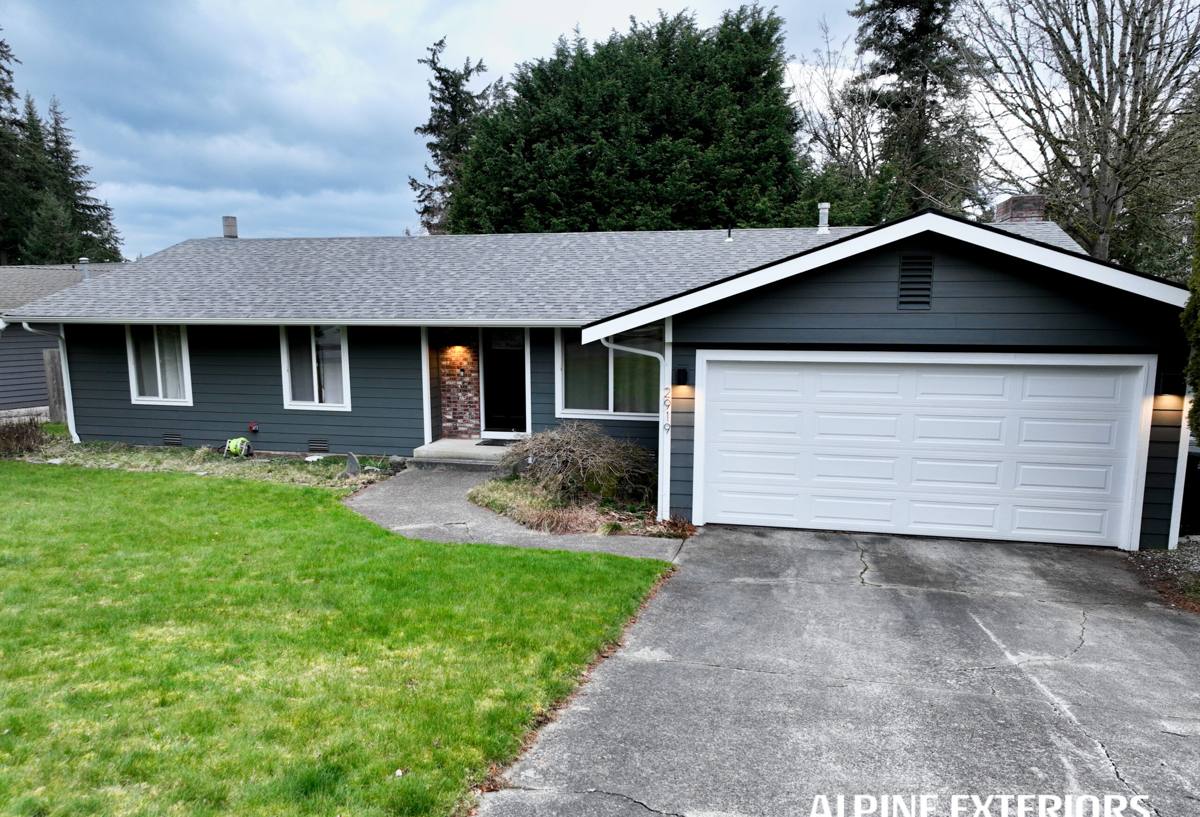
What Salt Air, Rain, and Moss Actually Do to Siding Over Time
It helps to understand the failure modes before talking about the fix. Three things drive most of the siding problems we see on harbor-facing and near-water homes:
- Salt air: Airborne salt accelerates corrosion on exposed fasteners, metal flashing, and trim connectors. It also settles into porous or poorly sealed siding surfaces and can contribute to premature finish breakdown.
- Driving rain: Wind-driven rain off the water doesn't fall straight down — it gets pushed sideways into laps, seams, and butt joints. Siding systems that rely on caulk alone at horizontal joints, rather than proper flashing and drainage, tend to let water in over time.
- Moss and mildew: Shaded north and west-facing walls near mature trees or tight lot lines stay damp for extended periods. Any siding material that absorbs moisture or has a rough, porous surface gives moss and algae something to grip and grow on.
None of these problems show up immediately. They show up two, five, or ten years in, as swelling, soft spots, peeling paint, streaking, or fastener rust bleeding down the face of a wall. The materials and details chosen at installation are what determine whether a home ages well through a few decades of Whatcom County winters or starts showing damage early.
Why James Hardie Fiber Cement Fits This Environment
James Hardie fiber cement is engineered from cement, sand, and cellulose fiber — a composition that does not absorb water the way wood-based or wood-fiber siding products do, and does not corrode the way raw metal siding can. For a harbor environment, that matters in a few concrete ways:
- Non-combustible core: Fiber cement doesn't burn, which matters in the Pacific Northwest's increasingly active wildfire seasons even in coastal areas.
- Dimensional stability: It doesn't swell, cup, or split from repeated wet-dry cycling the way wood and wood-composite products can over time.
- ColorPlus factory finish: Rather than field-painted, ColorPlus color is baked on in a controlled factory process, which holds up better against UV, salt exposure, and moisture than a job-site paint job — and it comes with its own finish warranty.
- Climate-engineered HZ lines: James Hardie makes region-specific formulations. For the Pacific Northwest, that means a product line built around this region's moisture exposure rather than a one-size-fits-all national product.
We standardized on James Hardie because it's the fiber cement system that consistently performs in exactly these conditions when installed correctly — and because it carries a strong, transferable warranty that backs that performance up.
What a Correct Installation Involves Here
The material is only half the equation. Most siding failures we get called out to inspect — regardless of brand — trace back to installation shortcuts, not the product itself. In a harbor environment, a handful of details matter more than usual:
| Detail | Why it matters in Blaine Harbor |
|---|---|
| Proper clearance from grade, decks, and roof lines | Keeps the bottom edge of the siding away from splash-back and standing moisture that salt air and rain both make worse |
| Correct flashing at windows, doors, and horizontal joints | Directs wind-driven rain back out instead of relying on caulk, which degrades faster in salt air and UV exposure |
| Fastener type and placement per manufacturer spec | Corrosion-resistant fasteners set correctly reduce the rust streaking and loosening that salt air accelerates |
| Rainscreen or drainage gap where appropriate | Gives moisture that does get behind the cladding a path to drain and dry instead of sitting against the wall |
| Factory-cut edges kept factory-sealed, field cuts sealed per spec | Unsealed cut edges are the most common entry point for moisture on any fiber cement job |
Every one of these is spelled out in James Hardie's own installation instructions, and every one of them is also the detail that gets skipped when a crew is moving fast or unfamiliar with fiber cement. Correct installation is what makes the difference between a 30-plus year siding job and one that needs attention in year eight.
Moss and Algae Resistance in Practice
James Hardie's factory finish and dense, engineered surface give moss and algae far less to hold onto than porous or wood-based sidings, but no exterior surface is completely immune in a climate this wet and shaded. A properly detailed installation — with correct clearances, drainage, and gutter/downspout coordination — reduces the standing moisture that feeds moss growth in the first place, which does more for long-term appearance than any surface treatment applied after the fact.
Choosing the Right Hardie Line and Look for a Harbor-Facing Home
James Hardie offers several product lines, and the right choice depends on the home's style and exposure, not just personal preference:
| Product | Typical use | Good fit when |
|---|---|---|
| HardiePlank lap siding | Traditional horizontal lap look | Most common choice for classic and craftsman-style homes throughout Whatcom County |
| HardiePanel vertical siding | Board-and-batten or modern vertical look | Homes wanting a more contemporary elevation or accent walls |
| HardieShingle | Staggered or straight shingle profile | Cottage or shingle-style homes common near the water |
| HardieTrim | Corners, fascia, window and door trim | Used alongside any of the above for a fully fiber-cement exterior with no wood trim left exposed to rot |
Color choice matters too. Darker ColorPlus finishes absorb more heat and can show dust or salt film differently than lighter tones, while lighter finishes tend to show less streaking near the water. There's no universally "correct" color — it's a conversation about the specific home, its orientation, and how much upkeep the owner wants to do.
How Our Process Works
- On-site inspection: We walk the exterior, check current siding condition, look at drainage, grade, and any moisture damage already present.
- Product and color selection: We go through HardiePlank, Panel, and Shingle options along with ColorPlus color choices suited to the home's exposure.
- Written estimate: A clear scope covering tear-off (if applicable), house wrap or drainage plane, flashing details, and the specific Hardie products specified.
- Installation to manufacturer spec: Correct fastening, flashing, clearances, and sealed cut edges — the details covered above, done as standard practice, not an upsell.
- Final walkthrough: We review the finished job with the homeowner before calling it complete.
Why Local Experience in Blaine Harbor Specifically Matters
A crew that only occasionally works this close to the water can miss things that a crew working Whatcom County's coastal properties regularly won't. Wind exposure, salt drift patterns, and moisture behavior on harbor-facing walls are different from a siding job a few miles inland. Before hiring anyone for a siding project in this area, it's worth asking:
- Have you installed James Hardie on homes with direct or near-direct water exposure before, and can you explain your flashing and drainage approach?
- Are your installers factory-trained or certified on James Hardie products specifically?
- What fastener type and clearance details will you use, and why?
- Is the manufacturer's product warranty and your workmanship warranty both provided in writing?
- Can you walk me through how you'll handle grade clearance and drainage on this specific lot?
A contractor who can answer these clearly, without vague reassurances, is one who actually understands what this environment does to an exterior over time.
What This Means for Your Home
If your current siding is wood, vinyl, or an older fiber cement product showing wear near the water, replacement with correctly installed James Hardie siding addresses the root causes — moisture intrusion, fastener corrosion, and surface degradation — rather than just refreshing the appearance for a few years. It's a bigger project than a paint job, but it's also one that's meant to last decades when done right, in a climate that doesn't forgive shortcuts.
If you're weighing a siding replacement or new install for a home in Blaine Harbor, we're happy to take a look and walk through what your specific home needs. The estimate is free, there's no pressure, and you'll get a straight answer about what condition your current siding is in and what a correct James Hardie installation would involve — just fill out the form below to get started.