 Blaine Exterior
 Grandview is a residential pocket of the Blaine area, and like the rest of this stretch of Whatcom County, its homes sit in a climate that doesn't leave much room for the wrong siding choice. Salt air off the water, rain that comes in sideways during winter storms, and a moss season that can run most of the year all wear on an exterior faster here than they would somewhere inland. This page focuses on one thing: what James Hardie fiber cement siding needs to do right on a Grandview home, and what it takes for us to install it correctly.
We don't install every siding product on the market. We install James Hardie, exclusively, and we explain why on pages like this one rather than leaving it as an unexplained house rule. In a neighborhood like Grandview, where the climate stresses siding harder than average, the reasoning behind that choice matters more than it would somewhere milder.
What Grandview's Climate Asks of Siding
Salt Air
Blaine's proximity to the water means salt-laden air reaches homes well beyond the properties with a direct view of it, and Grandview is no exception. Salt accelerates corrosion on fasteners, flashing, and any exposed metal trim, and it breaks down lower-grade paints and coatings faster than a dry inland climate would. Siding that isn't dimensionally stable or properly finished shows the effects of that exposure earlier than it should.
Driving Rain
Storm systems moving through this part of Whatcom County don't just drop rain straight down — wind pushes it sideways into wall assemblies, seams, and trim joints. That kind of wind-driven rain finds gaps a calmer, drier climate would never test. A siding system that depends on caulk and paint alone to keep water out tends to fail faster under these conditions than one designed and installed with drainage in mind.
A Long Moss Season
Mild temperatures paired with near-constant moisture give moss and mildew a long growing season on shaded and north-facing walls. Any siding material with surface porosity becomes a growth surface over time, and once moss establishes itself, it holds moisture against the wall even longer. Grandview homes with tree cover or limited direct sun on one side tend to see this show up earliest.
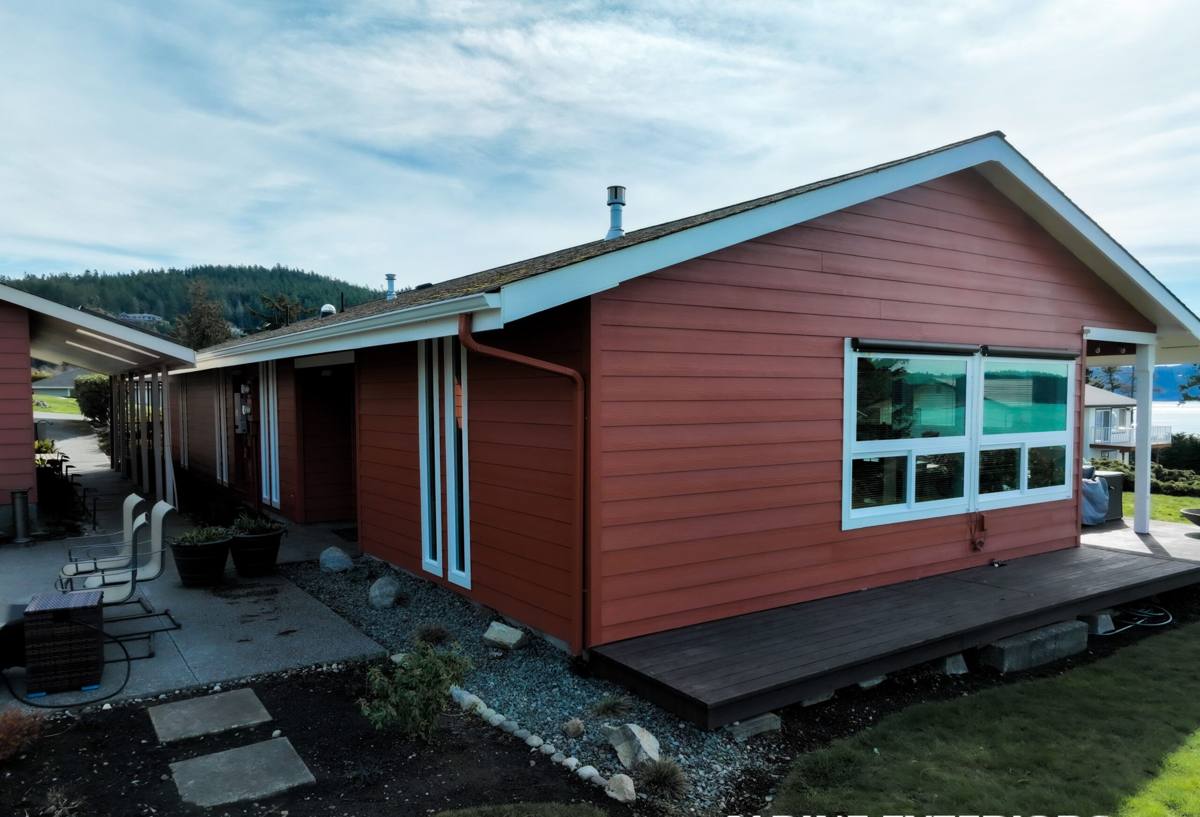
Why James Hardie Is the Only Siding We Install Here
We used to work with a broader range of siding products. What changed our approach was what we kept finding on tear-offs and service calls in coastal, high-moisture parts of Whatcom County — not a supplier relationship or a marketing push. In a place like Grandview, where salt air and driving rain are close to constant, the differences between siding products stop being theoretical.
- Non-combustible core: Fiber cement doesn't feed a fire the way wood-based siding products can, which matters for both safety and insurance considerations.
- Factory-applied ColorPlus finish: The color is baked on under controlled factory conditions instead of brushed on in the field, so it resists fading, chalking, and moisture wear longer than a field-applied coating.
- Climate-engineered HZ formulation: Hardie's HZ5 product line is built for regions with sustained moisture and freeze-thaw cycling, which describes coastal Whatcom County well.
- Dimensional stability: Fiber cement doesn't swell, cup, or warp the way engineered wood products can after repeated exposure to wet weather.
- Strong transferable warranty: Hardie backs the product with one of the stronger warranty structures in the industry, provided the installation follows their spec.
We won't install LP SmartSide, vinyl siding, Cemplank, Allura, primed spruce, or cedar. Each has a place in the market, and homeowners who choose them have their own reasons. But for a Grandview home taking on salt air and driving rain year-round, we've made a professional call to install one system we fully stand behind rather than offer something cheaper that quietly shifts maintenance risk onto the homeowner down the road.
Choosing the Right Hardie Line for a Grandview Home
James Hardie makes several distinct siding profiles, and the right one depends on the home's style and how much of the exterior needs replacing versus repairing.
| Product Line | Look | Common Use |
|---|---|---|
| HardiePlank lap siding | Traditional horizontal lap | Most common choice for full re-sides on standard home styles |
| HardiePanel vertical siding | Vertical panel, often with battens | Modern or farmhouse-style exteriors, accent walls |
| HardieShingle | Staggered or straight-edge shingle profile | Craftsman and cottage-style homes |
| HardieTrim | Trim boards for corners, fascia, and window surrounds | Finishing detail on any of the above |
Color selection matters too. ColorPlus finishes come in a factory palette engineered to hold up against fading and moisture, and we'll walk through which shades and sheens tend to perform best against Grandview's specific mix of sun exposure, shade, and salt air on your particular home.
What a Correct Installation Involves
Hardie siding performs the way it's designed to only when the installation follows the manufacturer's spec, and in a climate like this one, the details matter more than they would somewhere drier. A few of the basics we won't skip on any Grandview project:
- Rain screen gap: A small drainage cavity behind the siding lets any moisture that gets past the exterior surface drain and evaporate instead of sitting against the wall sheathing.
- Correct fastener spacing and type: Hardie specifies fastener placement and corrosion-resistant fastener types for a reason; loose spacing or the wrong fastener is one of the more common causes of early siding failure we find on tear-offs.
- Properly lapped house wrap and flashing: Every seam and penetration needs to shed water downward and outward, especially on walls that catch wind-driven rain directly.
- Sealed butt joints and trim transitions: Open or poorly sealed joints are where salt-laden moisture finds its way behind the siding first.
- Proper clearance at grade and roof lines: Siding installed too close to the ground or to a roofline traps moisture against the bottom edge, which is a common failure point we see on older installs.
None of this is exotic. It's the manufacturer's own installation spec, followed consistently rather than shortcut on the parts that are harder to see once the job is finished.
Signs a Grandview Home's Siding Needs Attention
- Moss or dark staining that returns quickly after cleaning, especially on shaded or north-facing walls
- Soft or spongy siding, especially low on the wall or around window and door trim
- Rust staining or corroded fasteners and trim, more noticeable this close to the water
- Peeling paint, chalking, or visible fading on a wall's finish
- Warping, cupping, or bowing boards, particularly on engineered wood or older wood siding
- Gaps opening up at butt joints, corners, or trim transitions
- A musty smell or visible staining on interior walls that backs onto an exterior wall
Our Process for a Grandview Siding Project
- On-site assessment — we walk the property, check the existing siding and substrate condition, and look for any signs of moisture that's already gotten behind the wall.
- Honest scope and product recommendation — which Hardie line fits the home, what needs full replacement versus repair, and why.
- Written estimate — a clear scope of work rather than a rough phone quote, since every home's substrate condition and trim complexity is a little different.
- Tear-off and substrate repair — old siding comes off, and any water-damaged sheathing or framing gets addressed before new material goes on, not covered over.
- Installation to spec — rain screen, fastening, flashing, and joint sealing follow Hardie's published installation requirements, not a shortcut version of them.
- Final walkthrough — we review the finished work with the homeowner before calling the job done.
Cost Factors for James Hardie Siding in Grandview
| Factor | What Drives It | Coastal Climate Consideration |
|---|---|---|
| Home size and complexity | Square footage, number of stories, roofline complexity | More trim and transition points mean more flashing detail work |
| Tear-off vs. overlay | Whether existing siding comes off or new siding goes over it | We generally recommend tear-off here so hidden moisture damage doesn't get sealed in |
| Substrate condition | Whether sheathing or framing needs repair once old siding is removed | More likely on older homes that have taken on years of wind-driven rain |
| Product line and trim | Lap, panel, or shingle profile; amount of custom trim work | No added cost from climate, but trim-heavy homes take longer to detail correctly |
| Color and finish | Standard ColorPlus palette vs. custom color match | Factory finish holds up better against salt air and UV than a field-applied repaint would |
These are general drivers, not a quote. Every Grandview home has a slightly different mix of sun exposure, tree cover, and existing wall condition, so we walk the property before putting a real number on the work. What looks like a straightforward re-side from the driveway sometimes turns into a substrate repair conversation once old siding actually comes off, which is also why we're cautious about estimates given without seeing the house in person.
Why a Crew That Already Works Grandview Matters
A crew that installs Hardie siding across Blaine and the surrounding Whatcom County coastline sees how salt air, driving rain, and moss actually behave on real houses over a full year, not just how a product performs on a spec sheet. That experience shapes decisions on install day — where extra flashing attention pays off, which walls stay wet the longest after a storm, and which fastener and clearance details are worth the extra time so a homeowner isn't dealing with a callback after the next winter. Grandview's exposure isn't identical to every neighborhood in the area, and a crew that has actually worked here builds accordingly instead of applying a generic approach pulled from a milder climate.
If your Grandview home needs new siding, or you're not sure whether what's on the walls now is holding up the way it should, we're glad to take a look and give you a straightforward, honest assessment — no pressure, no upsell script. Use the form below to schedule a free estimate.