 Blaine Exterior
 Roofing in Everson Has Its Own Set of Problems
Everson sits in a part of Whatcom County where the weather doesn't let up on a roof for long. Between the driving rain that blows in off the water, the damp air that never fully clears through the fall and winter, and the moss that finds a home on every north-facing slope, roofs here age differently than they would in a drier climate. A repair that would hold up fine in Eastern Washington can fail in two seasons out here if it isn't done with local conditions in mind.
We work on homes throughout the Blaine area and out into communities like Everson, and the roofs we get called out to almost always show the same pattern: small, ignorable problems that sat through one too many wet seasons and turned into active leaks. Roof repair done right in this region isn't just about patching a hole — it's about understanding why that spot failed in the first place and making sure it doesn't happen again a few feet over.
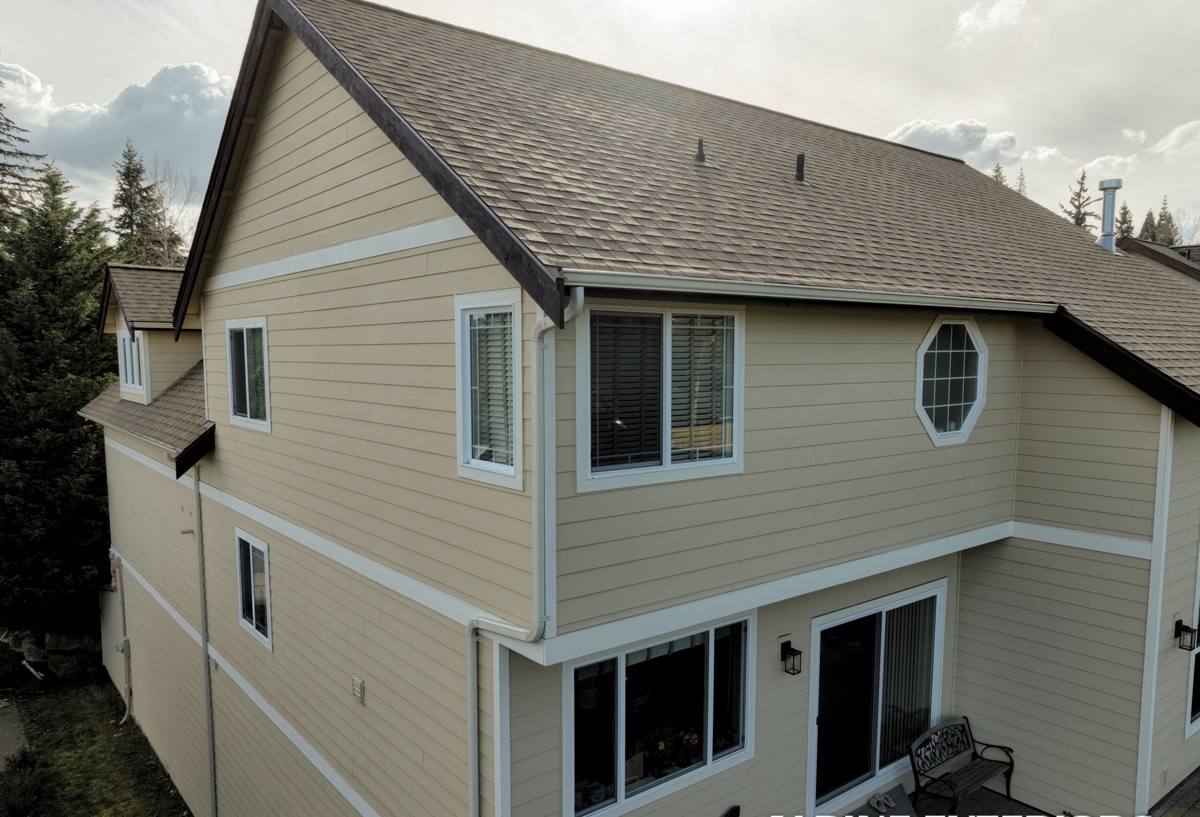
What the Climate Does to a Roof Over Time
Three things drive most of the repair calls we get in this part of the county:
- Persistent moisture. Long stretches of overcast, damp weather keep roof surfaces wet longer than they'd like to be, which speeds up granule loss on asphalt shingles and gives moss and algae time to establish.
- Wind-driven rain. Storms coming through often push rain sideways rather than straight down, which finds weak points at flashing, fascia, and anywhere a seal has started to lift — spots that would stay dry in a calmer climate.
- Moss and organic growth. A long moss season means shaded and low-slope sections of roof stay damp under a layer of growth for months at a time, which holds water against the roofing material and works into laps, nail heads, and valleys.
None of these are unusual for this part of Washington — they're just the baseline. A roof that's built and maintained with that baseline in mind lasts. One that isn't tends to develop problems faster than the homeowner expects.
Signs a Repair Is Overdue
Most roof damage doesn't announce itself with a dramatic leak on day one. It shows up in smaller ways first, and catching it at that stage is almost always cheaper and less disruptive than waiting.
- Water stains on ceilings or in the attic, even faint ones that come and go with the weather
- Shingles that are curling, cracked, or missing granules in patches
- Moss buildup thick enough to hold a green tint through dry stretches
- Soft or discolored fascia boards, especially near gutters
- Flashing around chimneys, vents, or skylights that looks lifted, rusted, or gapped
- Daylight visible through the roof deck from inside the attic
- Granules collecting in gutters or at the base of downspouts
If more than one of these shows up at once, it's usually a sign the roof has been dealing with moisture longer than it should have.
What a Correct Roof Repair Actually Involves
A lot of roof repair work in this region gets done as a surface patch — a bead of sealant over a visible gap, a shingle laid over a soft spot. That kind of fix can hide a problem for a season, but it rarely solves it, because the moisture that caused the damage is usually still getting in somewhere nearby.
Finding the Real Source
Water doesn't always show up where it enters. It can travel along the underlayment or a rafter before showing as a stain somewhere else in the attic. A proper repair starts with tracing the path back to the actual entry point — often a failed flashing seam, a cracked pipe boot, or a spot where wind has worked shingles loose — rather than just treating the spot where the damage is visible.
Matching Materials and Method
Repairs need to match the existing roofing system, not just in appearance but in how the pieces integrate. Shingles need to be woven in with correct overlap and nailing pattern. Flashing needs to be replaced, not just resealed, if it's rusted or bent. Underlayment that's been compromised needs to come out, not get covered over.
Addressing the Cause, Not Just the Symptom
If moss caused the failure, the repair should include clearing growth from the surrounding area and addressing drainage so water isn't sitting there again next season. If wind lifted shingles, the repair should reinforce the surrounding field, not just the one section that tore loose. A repair that ignores the cause is a repair that comes back.
How We Approach a Repair Call in Everson
- Inspection. We get on the roof (not just a look from the ladder) to check the full field, not only the spot the homeowner flagged. Damage often extends beyond what's visible from the ground or the attic.
- Honest assessment. We tell you what we find, including whether it's a straightforward repair, a larger repair, or a case where repair isn't the better long-term call. We're not going to talk you into a bigger job than the roof needs.
- Scope and estimate. You get a clear explanation of what's being fixed and why, before any work starts.
- The repair itself. Matching materials, correct flashing and underlayment work, and attention to drainage and moss-prone areas as part of the fix.
- Final check. We confirm the repair area sheds water correctly and walk you through what we did.
Repair Costs Vary by What's Actually Wrong
There's no single price for roof repair because the cause and scope vary so much from one roof to the next. What we can offer is a sense of the factors that move the cost up or down.
| Factor | Why It Matters |
|---|---|
| Size of the damaged area | A single flashing leak costs far less to fix than a section with widespread shingle failure |
| Roof pitch and access | Steeper roofs and harder-to-reach sections take longer and require more safety setup |
| Underlying deck condition | If moisture has reached the plywood deck, that material may need to be replaced before new roofing goes on |
| Material match | Older or discontinued shingle styles can be harder to match, sometimes requiring a broader repair area |
| Underlying cause | A repair that also addresses drainage, moss, or ventilation issues involves more work than a patch alone |
We'd rather walk your roof and give you a number based on what's actually there than quote a range that doesn't mean much either way.
Repair or Replace? How to Think About It
Not every roofing problem calls for a repair, and not every problem calls for a full replacement. The right call usually comes down to a few honest questions.
| Repair usually makes sense when | Replacement usually makes sense when |
|---|---|
| Damage is isolated to one area or system (flashing, a vent boot, a wind-damaged section) | Damage is spread across multiple areas of the roof |
| The roof is under, or reasonably close to, its expected service life | The roof is well past its expected lifespan for the material |
| The deck underneath is sound | Moisture has compromised the deck in multiple spots |
| Granule loss and wear are moderate, not roof-wide | Shingles are uniformly worn, brittle, or curling across the whole roof |
We won't recommend a full replacement when a repair will genuinely hold, and we won't recommend a repair when we don't think it will last through the next few wet seasons. That call gets made on the roof, not from a sales script.
Staying Ahead of Moss and Moisture
Given how long the moss season runs here, ongoing maintenance matters as much as the repair itself. A few habits go a long way toward keeping a repaired roof performing:
- Keep gutters clear so water isn't backing up under the roof edge
- Trim back branches that shade north-facing slopes and keep them damp
- Have moss physically removed rather than left to build up, especially before it spreads into valleys
- Check flashing and pipe boots yearly — these are usually the first parts to fail, well before the shingles themselves
- Have the roof looked at after any major windstorm, even if nothing looks obviously wrong from the ground
Why It Matters That We Already Work in This Area
A roof repair crew that mostly works in a drier climate, or one that's never dealt with the specific way wind and rain move through Whatcom County, is more likely to miss the details that matter here — the flashing details that hold up against wind-driven rain, the drainage habits that keep moss from taking over a north slope, the material choices that actually perform in a maritime climate rather than just on paper. We work these conditions regularly, on homes throughout the Blaine area and out to communities like Everson, and that familiarity shows up in repairs that are built for what this roof will actually face, not a generic checklist.
If you've got a leak, a soft spot, or just a roof that's overdue for a look, we're happy to come out, walk it, and give you a straight answer about what it needs. The estimate is free, there's no pressure attached to it, and you can use the form below to get in touch.