 Blaine Exterior
 Why Birch Point Roofs Wear Differently
Birch Point sits close enough to the water that homes there take a different kind of beating than roofs a few miles inland. Salt-laden air moves through constantly, wind-driven rain comes in sideways during winter storms, and the tree cover that gives the area its character also means shaded roof sections stay damp for days after a storm passes. None of this is dramatic on its own, but stacked together over years it shortens roof life in ways that surprise homeowners who assume a roof should simply last as long as the shingle warranty says it will.
A roof replacement done right in this part of Whatcom County accounts for all three factors from the start — not as an afterthought, but in the choice of materials, the fastener hardware, the underlayment, and the flashing details. That's the difference between a roof that looks fine on install day and one that's still performing in year fifteen.
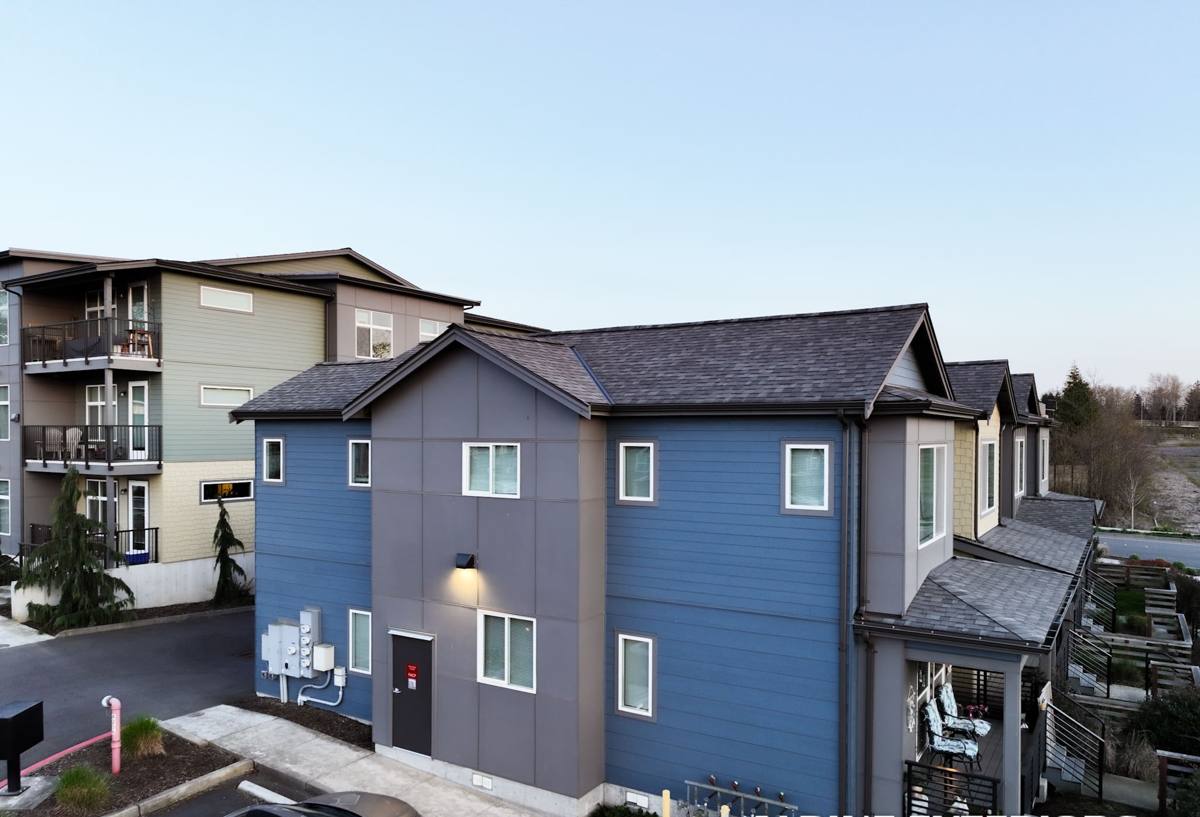
What Blaine's Climate Actually Does to a Roof
Salt Air and Corrosion
Salt air doesn't just affect boats and railings. It accelerates corrosion on exposed metal — flashing, fasteners, vent caps, gutter hardware — well before the shingles themselves are worn out. A roof where the metal components were spec'd for a generic inland install often shows rust streaks and failing flashing seams years ahead of schedule, even though the shingle field still looks reasonable from the ground.
Wind-Driven Rain
Blaine gets plenty of straight-down rain, but the storms that do the most damage come off the water at an angle, driving moisture up under shingle tabs and around penetrations that would stay dry in a calmer climate. This is a underlayment and flashing problem more than a shingle problem — the visible roofing material can be intact while water is still finding its way in at a poorly lapped valley or an under-flashed pipe boot.
Moss and Extended Shade
Whatcom County's moss season runs long, and wooded or partially shaded lots — common around Birch Point — hold moisture and organic debris longer than open, sun-exposed roofs. Moss isn't just cosmetic. As it establishes, it lifts shingle edges, holds water against the roof deck, and works its way into fastener holes. Left unchecked for a few seasons, moss growth turns a roof that had years of life left into one that needs replacing early.
Signs a Birch Point Roof Needs Replacement, Not Just Repair
Repair makes sense when the damage is localized — a cracked pipe boot, a handful of lifted shingles after a windstorm. Replacement becomes the honest recommendation when the problems are spread across the roof or point to failure of the underlying systems rather than just the surface. Homeowners in this area should watch for:
- Granule loss heavy enough that you can see bare, shiny patches on multiple slopes, not just one spot
- Moss or algae established across large sections rather than a corner or two
- Rusted or visibly corroded flashing around chimneys, vents, and valleys
- Soft spots or sagging when walked, which usually means deck damage underneath
- Daylight visible through the roof deck from the attic, or water staining on attic sheathing
- A roof that's 20+ years old and has never had underlayment or flashing upgraded
- Shingles that are curling, cupping, or cracking across the field, not just at edges
If only one or two of these apply and they're isolated, a repair or a partial section replacement is often the right call — we'll tell you that directly rather than push a full tear-off you don't need yet.
Choosing the Right Roofing System for This Site
There's no single "best" roofing material for every home — it depends on your home's exposure, your budget, and how much long-term maintenance you're willing to do. For a Birch Point property, here's how the common options compare against the conditions that matter most here:
| Material | Salt Air / Corrosion Resistance | Moss Resistance | Wind Performance | Typical Lifespan |
|---|---|---|---|---|
| Standard 3-tab asphalt shingle | Fair — depends on flashing hardware used | Low unless treated | Moderate | 15–20 years |
| Architectural (laminate) asphalt shingle | Good with proper flashing package | Better with algae-resistant granules | Good, higher wind ratings available | 25–30 years |
| Standing seam metal | Excellent with coastal-rated coatings and fasteners | Excellent — sheds moisture, little for moss to grip | Excellent | 40–50+ years |
| Synthetic/composite shake or slate | Good, non-corroding material body | Good, but fastener hardware still matters | Good | 30–50 years |
For homes right up against the salt air exposure of Birch Point, we generally steer clients toward architectural shingles with algae-resistant granules at minimum, and toward metal for homes with heavy tree shade or a longer-term ownership horizon. The upfront cost difference is real, but so is the difference in how often you're back up on the roof dealing with moss or corrosion. We'll walk through the trade-offs for your specific home rather than push one option across the board.
What a Correct Tear-Off and Replacement Involves
Tear-Off and Deck Inspection
A proper replacement starts with a full tear-off down to the deck — not a layover — so we can actually see the sheathing. This is where hidden damage from years of wind-driven rain and moss moisture usually shows up: soft plywood, rot around old flashing, or fastener holes that have widened over time. Any damaged decking gets replaced before anything new goes down; skipping this step is one of the most common ways a "new roof" fails early.
Underlayment and Flashing Built for This Exposure
Given how much wind-driven rain this area sees, we don't treat underlayment as a formality. A synthetic underlayment with proper lapping, plus self-adhered ice-and-water membrane at valleys, eaves, and penetrations, is what actually keeps water out when rain is coming in sideways rather than straight down. Flashing hardware — step flashing, counter-flashing, pipe boots, drip edge — gets specified in corrosion-resistant materials, since this is the hardware that takes the brunt of the salt air over time.
Ventilation
Good intake and exhaust ventilation keeps the attic dry and temperature-balanced, which matters twice over here: it reduces condensation risk from our damp climate, and it helps the roof deck dry out faster after the area's frequent rain events. A roof replacement is the right time to correct ventilation problems, since the deck and vents are already exposed.
Our Process for a Birch Point Roof Replacement
Inspection and Estimate
We start with an on-site inspection — deck condition, flashing points, ventilation, and how your specific lot's exposure and tree cover should factor into material choice. You get a written estimate with the reasoning behind the recommendation, not just a price.
Material Selection
We go through the trade-offs above in the context of your home and budget, and help you land on a system that fits how long you plan to own the home and how much maintenance you want to do.
Install Day
Tear-off, deck inspection and repair, underlayment, flashing, and the roofing material itself, done in sequence with the site kept as clean and safe as we can manage — magnetic sweeps for nails, tarps over landscaping, and daily cleanup rather than one big mess at the end.
Final Walkthrough
We walk the finished roof and the property with you before we call the job done, and go over basic care — what to watch for, and when it makes sense to have gutters and roof surfaces checked again.
Why a Crew That Already Works Birch Point Matters
Roofing crews who mostly work drier, inland areas sometimes under-spec flashing hardware or skip algae-resistant shingles because it's not something they think about daily. A crew that regularly works properties near the water in Blaine treats salt-air-rated fasteners and moss-resistant materials as the default, not an upsell. There's also a practical side to local familiarity — knowing how narrow or waterfront-adjacent access on some Birch Point lots affects staging and equipment, and having a realistic sense of how the area's rain patterns should shape scheduling around a tear-off, so your home isn't sitting open to weather longer than it needs to be.
Maintenance After Your New Roof Goes On
A correctly installed roof still benefits from some upkeep in this climate. Keep gutters clear so water isn't backing up under the eaves, especially under trees that drop needles and debris. Have moss growth addressed early rather than left to establish — a light treatment or manual removal is far cheaper than dealing with lifted shingles later. And have flashing and penetrations glanced at every couple of years, since that's where small problems show up first, long before they'd be visible from the ground.
If your Birch Point roof is showing its age, or you just want a straight answer about whether it's a repair or a replacement situation, we're glad to come take a look. The estimate is free, there's no pressure attached to it, and you'll get a plain explanation of what we see and why — use the form below to get started.