 Blaine Exterior
 Why Birch Point Siding Wears Differently Than Homes Farther Inland
Birch Point sits close enough to the water that its siding lives a harder life than siding on a home just a few miles inland. Salt-laden air moves off the water and settles on exterior walls day after day, slowly breaking down finishes, corroding fasteners, and working into any seam or crack that isn't sealed correctly. Add Whatcom County's long, wet winters and the driving rain that comes with west-facing exposure, and you have a climate that finds every weakness in a siding system within a few years, not a few decades.
Then there's moss. Blaine's moss season isn't a few weeks — it's most of the year on shaded, north-facing, or tree-lined walls. Moss and algae hold moisture against the siding surface far longer than open air would, which matters more than most homeowners realize. Wood-based and fiber cement products alike can tolerate occasional wetting. What causes damage is prolonged wetting, and moss is one of the most effective ways to keep a wall surface damp for days at a stretch.
None of this means Birch Point homes are doomed to constant repairs. It means the repair work has to account for salt exposure, wind-driven rain, and moss retention specifically — not just patch the visible problem and move on.
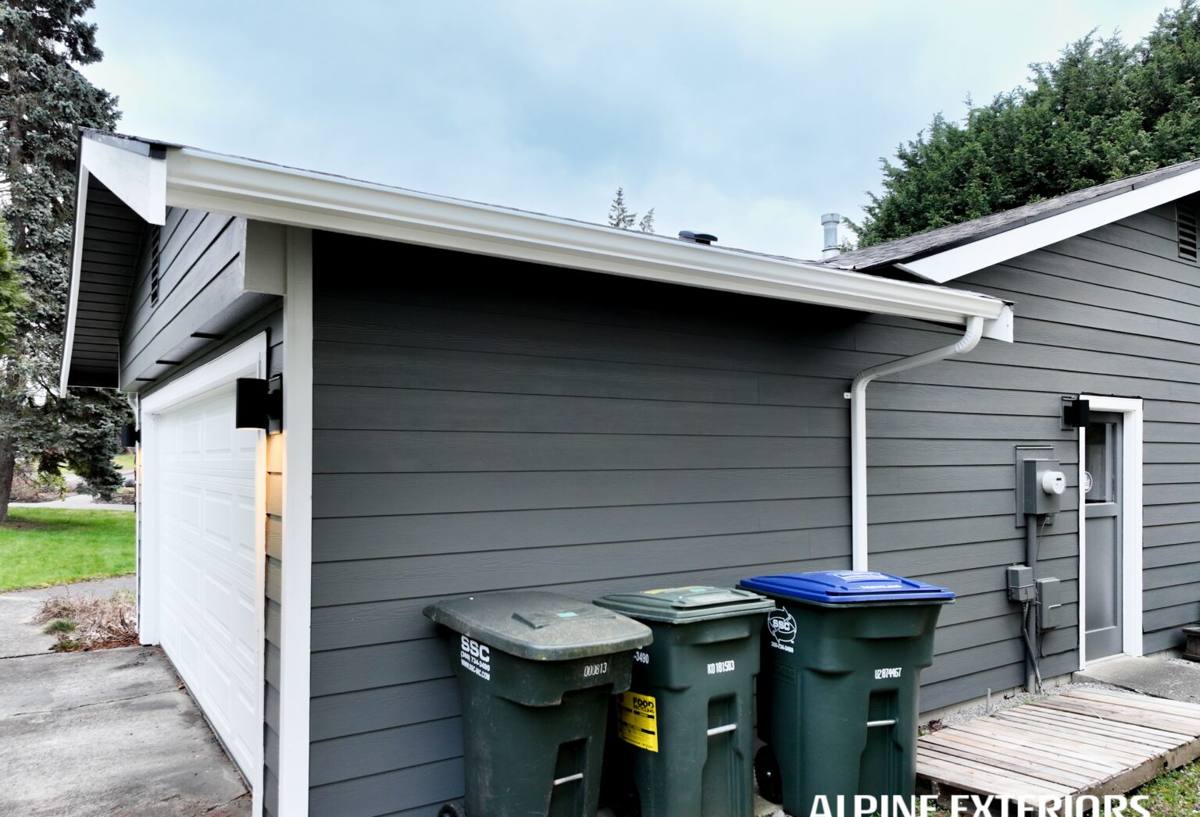
Common Siding Problems We See on Birch Point Homes
Salt Air and Fastener Corrosion
Steel fasteners and unprotected trim hardware corrode faster this close to the water. Rust streaking below nail heads or screws is often the first visible sign, and it usually means the fastener itself is failing, not just staining the surface.
Moisture Intrusion Behind the Siding
Wind-driven rain doesn't fall straight down — it gets pushed sideways into laps, corner joints, and anywhere flashing is missing or was never installed correctly. Damage from this kind of intrusion often shows up as soft spots, staining, or bubbling paint well below where the actual entry point is, which is why a proper repair always starts with finding the source, not just the symptom.
Moss and Algae Staining
Beyond the cosmetic green-black streaking, moss holds water against the wall assembly. On wood-based siding this accelerates rot. On any siding, it accelerates finish breakdown and can mask cracks or gaps until they've let in real moisture.
Cracked, Warped, or Delaminating Panels
Older wood-based or composite siding products are especially prone to swelling, cupping, and delamination once moisture gets past the paint film. This is the category of damage where "repair" and "replace" decisions get made — and where being honest with a homeowner matters most.
Repair or Replace? How We Make That Call
Not every damaged section needs to come off the house. But not every problem should be patched, either. The right call depends on how far the damage has spread, what's causing it, and what the siding is made of.
| Situation | Usually Repairable | Usually Needs Replacement |
|---|---|---|
| Isolated impact damage (one or two boards) | Yes, if matching material is available | — |
| Fastener corrosion, surface only | Yes — re-fastened with corrosion-resistant hardware | — |
| Moisture staining with soft or spongy substrate | Only the confirmed damaged section | If rot has spread along the wall plane |
| Widespread cupping, cracking, or delamination | — | Yes — patchwork won't hold on failing material |
| Original siding is discontinued or unmatched | Rarely — visible patch mismatch | Often, for that wall section or elevation |
| Repeated failures in the same area over several years | — | Yes — points to a systemic moisture or design issue |
When repair is the right answer, we do the repair. We don't push a full re-side on a homeowner who has a legitimate, isolated problem. When the damage tells a different story — spreading moisture, failing material, or a pattern of recurring issues — we say so plainly and explain why.
What a Correct Repair Actually Involves
A siding repair that only addresses what's visible from the ground is a repair that's likely to fail again. Ours starts with diagnosis, not demolition.
- Moisture and source inspection. We trace staining or soft spots back to their actual entry point — often a flashing gap, a caulk failure, or a penetration (vent, light fixture, hose bib) that was never properly sealed.
- Removal of damaged material only. We pull back only what's necessary to expose the affected area, checking the water-resistive barrier and sheathing underneath for hidden damage before closing anything back up.
- Correcting the underlying cause. A repair that replaces the board but ignores the missing flashing or gap that let water in will fail again — usually faster the second time.
- Matched or appropriate replacement material. Where we're repairing an existing non-Hardie product, we're upfront about the limits of matching older material. Where the wall is a good candidate, we'll talk through the option of moving that section — or the whole elevation — to Hardie fiber cement instead.
- Correct fastening and sealant, rated for coastal exposure. Fastener choice and sealant selection matter more here than they would twenty miles inland.
- Finish and paint-line matching. A repair should be close to invisible from the street, not a patchwork quilt.
Why Material Matters When You're Repairing, Not Just Replacing
Most of the repair calls we get on older Birch Point homes involve vinyl, LP SmartSide, cedar, or primed spruce siding — not James Hardie. That's simply what was available or standard when many of these homes were built or last re-sided. Repairing those products has real limits worth knowing about upfront:
- Vinyl fades unevenly over time, so a repaired section — even with an exact matching profile — often reads as a slightly different shade within a year or two.
- LP SmartSide and other wood-strand composites are especially sensitive to edge and cut-end moisture exposure; a repair that doesn't fully seal every new cut edge is prone to swelling again.
- Cedar and primed spruce depend heavily on maintained paint film. If the surrounding wall's finish is already aging, a fresh repair section will weather differently until the whole wall gets repainted.
We'll still do the repair, and we'll do it correctly. But we're not going to pretend a patched section of 15-year-old vinyl or wood composite will look or perform like new — that's not an honest answer, and Birch Point homeowners dealing with salt air and moss don't need us adding to the maintenance list. In some cases, once we're already open to the wall to do a legitimate repair, it's worth talking about converting that section — or eventually the whole elevation — to James Hardie fiber cement, which is what we install as new siding and stand behind long-term. That's a homeowner's call to make with real numbers in front of them, not something we push.
Our Process for Birch Point Repair Calls
Because this stretch of coastline has its own moisture and wind patterns, we approach repair calls here the same way every time:
- On-site inspection of the damaged area and the surrounding wall assembly, not just the spot you called about
- Moisture readings where staining or softness suggests water has already gotten behind the siding
- A plain-language explanation of what's causing the damage, before we talk about fixing it
- A written scope covering exactly what's being repaired, what material will be used, and what's excluded
- Honest flagging of any area we think is a replacement candidate rather than a repair candidate, with our reasoning
- A cleanup and finish match that leaves the repair as close to unnoticeable as the existing material allows
Maintenance That Actually Helps Between Repairs
A good repair buys you time — but Birch Point's climate keeps working on your siding every day after we leave. A few habits make a real difference in how long a repair, or any siding, lasts out here:
- Rinse salt residue off exterior walls a few times a year, especially after storms with onshore wind
- Keep gutters and downspouts clear so water isn't sheeting down wall surfaces
- Trim back vegetation and branches that shade walls and keep them damp, since that's where moss takes hold fastest
- Treat moss and algae growth early rather than letting it establish — it's far easier to remove a light film than a thick mat
- Inspect caulking around windows, doors, and penetrations annually; failed sealant is one of the most common repair triggers we see
- Walk the exterior after major windstorms specifically looking for lifted or cracked panels near corners and eaves
Why It Matters to Hire a Crew That Already Works This Area
Siding repair looks straightforward from a distance, but coastal Whatcom County conditions punish shortcuts. A crew that mostly works inland jobs may not think to check for salt-driven fastener corrosion, may under-seal for wind-driven rain, or may not recognize how much moss retention is actually contributing to a moisture problem. A crew that already works Birch Point and nearby Blaine properties has already seen how these homes fail, which means the diagnosis is faster and the fix is more likely to hold.
It also means fewer surprises on cost and timeline. We know what permitting looks like locally, we know what weather windows are realistic for repair work in this part of the county, and we know which failure patterns are worth flagging before they become bigger problems.
Get an Honest Look at Your Siding
If you're seeing staining, soft spots, cracked panels, or heavy moss buildup on your Birch Point home, it's worth having someone look at it before the next round of fall storms. We'll give you a straight answer on what needs repair, what can wait, and what's actually a replacement candidate — with no pressure either way. Reach out for a free, no-obligation estimate and we'll walk the property with you.