 Blaine Exterior
 Why Birch Bay Siding Takes a Different Kind of Beating
Birch Bay sits close enough to the water that homes here deal with a combination most inland Whatcom County properties never see: salt-laden air rolling off the bay, wind-driven rain that hits walls sideways instead of falling straight down, and a long gray stretch of the year where anything shaded stays damp for weeks at a time. None of that is dramatic on its own. It's the combination, repeated year after year, that wears siding down faster than homeowners expect.
Salt air is corrosive to exposed metal fasteners and trim, and it also holds moisture against exterior surfaces longer than dry inland air does. Add driving rain that gets pushed up under laps and around corners by wind, and you have a wall assembly that needs real moisture management, not just a weather-resistant surface. Add Whatcom County's mossy, low-sun winters, and you get organic growth that holds even more moisture against whatever siding is underneath it.
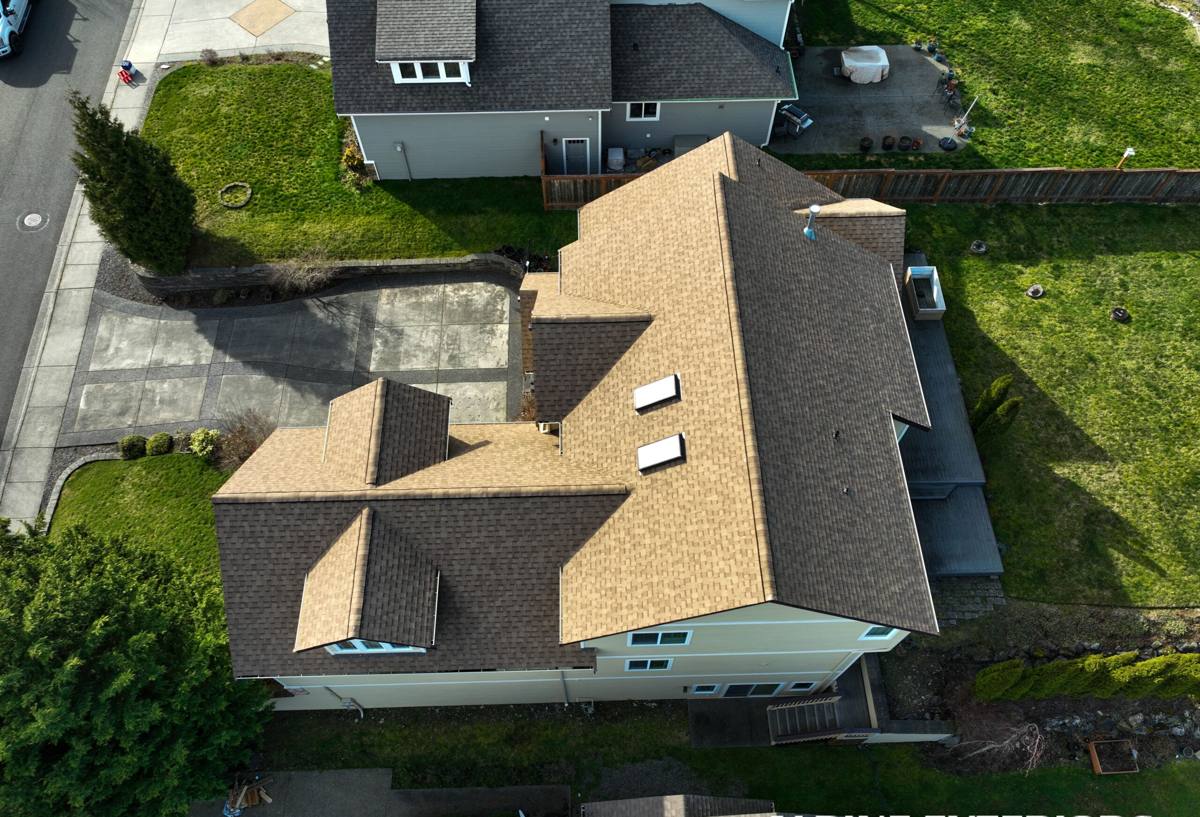
What This Climate Does to Ordinary Siding Over Time
Wood-based and lower-grade composite siding products struggle here in predictable ways. Moisture that gets past caulk joints or behind poorly lapped boards doesn't dry out quickly in a marine climate with short summers and long wet seasons. That leads to swelling, delamination, and rot at butt joints, corners, and anywhere fasteners have backed out or corroded.
Paint film on wood or lesser composite siding also breaks down faster near the water. Salt residue combines with UV exposure and constant damp-dry cycling to chalk and crack finishes years ahead of schedule, which usually means a repaint (and eventually a re-side) long before a homeowner budgeted for one. Moss and algae add another layer — they hold water against the surface, and pressure-washing them off repeatedly is hard on painted wood and can force water into seams that were never meant to get wet.
The Common Failure Points We See
- Butt joints and corners where caulk has failed and water has tracked behind the siding
- Fastener corrosion or backing-out on the ocean-facing and wind-exposed walls
- Paint failure and chalking on south- and west-facing elevations first
- Moss buildup on shaded, north-facing walls holding moisture year-round
- Soft or delaminating material low on the wall, near grade, downspouts, or splashback zones
Why We Install James Hardie and Nothing Else
We made a decision a while back to install James Hardie fiber cement exclusively — not vinyl, not LP SmartSide, not Cemplank or Allura, not primed spruce or cedar. That's not a marketing angle; it's a standard we hold ourselves to because of what we see coastal Whatcom County homes go through. Hardie's fiber cement composition doesn't feed moisture-driven rot the way wood-based products can, and it isn't a fuel source for organic growth the way bare wood siding can become if maintenance slips for even one season.
James Hardie's factory-applied ColorPlus finish is also a meaningful advantage this close to the water. It's baked on in a controlled environment rather than field-applied, which gives it better adhesion and UV resistance than a job-site paint job on wood or composite siding. That matters in a spot where salt exposure and sun both work against painted finishes. Hardie backs ColorPlus with its own finish warranty, separate from the product warranty on the substrate itself, and that warranty is transferable if the home changes hands — worth knowing if resale is ever part of your thinking.
The HZ5 Engineering Detail That Matters Here
James Hardie engineers its siding by climate zone, and this part of Washington falls into the HZ5 category — Hardie's designation for regions with significant moisture exposure and freeze-thaw cycling. The HZ5 formulation is built with that moisture load in mind. It's not a marketing label; it's a real difference in the product's engineering, and it's one more reason we don't treat "any fiber cement" as interchangeable with James Hardie specifically.
What a Correct Install Involves
Fiber cement siding is only as good as the install underneath it. A rushed or under-detailed job can leave a Birch Bay home just as exposed as poor siding would, regardless of the product on the wall. A correct install includes:
Moisture Barrier and Prep
A continuous, properly lapped weather-resistive barrier goes on before a single piece of siding, with special attention to seams, penetrations, and transitions around windows and doors — the spots where wind-driven rain finds its way in first.
Flashing and Sealant at Every Transition
Window and door openings, roof-to-wall intersections, deck ledgers, and any penetration for a vent or fixture need proper flashing, not just a bead of caulk. Caulk is a backup, not the primary defense, and treating it as the primary defense is exactly how homes near the bay end up with hidden water damage.
Fastening to Manufacturer Spec
James Hardie publishes specific fastener patterns, types, and spacing requirements for coastal and high-wind applications. Using the wrong fastener, spacing boards too far apart, or nailing too tight or too loose all void the manufacturer warranty and create long-term failure points — corrosion, cracking at nail heads, or boards that work loose in sustained wind.
Proper Clearances
Siding needs the right gap from grade, roof lines, decks, and other hard surfaces so water has somewhere to go and the material isn't sitting in standing moisture. This is a detail that's easy to shortcut and expensive to fix later.
Our Process for Birch Bay Homes
We approach every Birch Bay project the same structured way, because skipping steps is how coastal siding jobs fail early.
- On-site assessment — we look at wind exposure, current siding condition, moisture barrier status, trim and flashing condition, and any rot or soft spots before quoting anything.
- Written plan and product selection — we walk through the right Hardie plank or panel profile, color, and trim details for your home and exposure, and put the scope in writing.
- Tear-off and inspection — once old siding is off, we check sheathing and framing for hidden damage before closing anything back up. This is often where we find problems a homeowner didn't know existed.
- Barrier, flashing, and install to spec — moisture barrier, flashing, and Hardie siding installed to manufacturer fastening and clearance requirements.
- Walkthrough and cleanup — a final walkthrough with the homeowner, full site cleanup, and warranty paperwork.
Product Lines and Color Options
James Hardie's plank, shingle, and panel lines all come in HZ5 formulations suited to this region, with ColorPlus finishes in a range of tones that hold up to marine air better than field-applied paint. We'll walk you through profile and color choices during the assessment rather than pushing a single default — the right choice depends on your home's style, exposure, and any HOA or neighborhood guidelines in Birch Bay that might apply to exterior appearance.
Cost Factors on a Birch Bay Project
| Factor | Why It Affects Price |
|---|---|
| Wind and salt exposure of the elevation | Ocean-facing walls often need more attention to flashing and fastening detail |
| Condition of existing sheathing | Hidden rot found at tear-off adds repair scope before new siding goes on |
| Home size and number of corners/openings | More trim, more windows, and more transitions mean more flashing and labor |
| Siding profile and accessory trim | Lap, shingle, and panel profiles carry different material and labor costs |
| Access and site conditions | Slopes, fencing, and tight lot lines around Birch Bay properties affect setup time |
Why a Crew Already Working in Birch Bay Matters
Siding crews that work this stretch of Whatcom County regularly already know which walls take the worst of the wind and salt, what moisture patterns to expect on shaded elevations during moss season, and how local permitting and inspection typically go. That's not something a crew coming from outside the area picks up on their first Birch Bay job. It shows up in the small decisions — where to add extra flashing attention, which fastener spacing makes sense for an exposed gable end, how to sequence work around the wetter months — that a one-time or out-of-area contractor is more likely to miss.
Questions Worth Asking Any Contractor Bidding Your Home
- Are they installing genuine James Hardie product, in the HZ5 formulation, or a substitute fiber cement brand?
- Will they follow Hardie's published fastening and clearance specs, and put that in writing?
- Do they inspect and address sheathing condition before re-siding, not just cover over it?
- Can they explain their flashing detail at windows, doors, and roof lines specifically?
- Is the ColorPlus finish warranty and the product warranty both explained clearly, including transferability?
If you're weighing a re-side in Birch Bay, we're happy to take a look at your home, walk you through what we're seeing, and put together a straightforward, no-pressure estimate — use the form below to get started.