 Blaine Exterior
 Why Birch Bay Puts Windows Through More Than Most Homes
Birch Bay sits right on the water, and that changes what a window has to survive year after year. Salt-laden air moves in off the bay and settles on everything it touches, including window frames, hardware, and the metal fasteners holding trim in place. Add Whatcom County's wind-driven rain, which doesn't fall straight down but gets pushed sideways into window walls during winter storms, and you have two forces working against a window's seals and finish at the same time. Then there's the long moss season — the stretch of mild, damp months where anything shaded or slow to dry becomes a place for moss and algae to take hold, including window sills, exterior casing, and the gaps around older frames.
None of this means windows in Birch Bay fail faster because something is wrong with the neighborhood. It means the margin for a mediocre installation is smaller here than it is a few miles inland. A window that would quietly underperform for a decade in a drier climate will show its weaknesses in Birch Bay much sooner — fogged glass, soft trim, corroded hardware, drafts that show up specifically when the wind comes off the water.
What "Coastal Exposure" Actually Means for a Window
It's not just rain. It's the combination of moisture, salt, and temperature swings acting on a window continuously. Salt air accelerates corrosion on unprotected metal components — hinges, locks, balance systems. Persistent dampness keeps wood trim and sills wet longer between drying cycles, which is exactly the condition moss and rot both prefer. And older single-pane or early dual-pane windows, common in homes built before energy codes tightened up, were never designed with this level of exposure in mind.
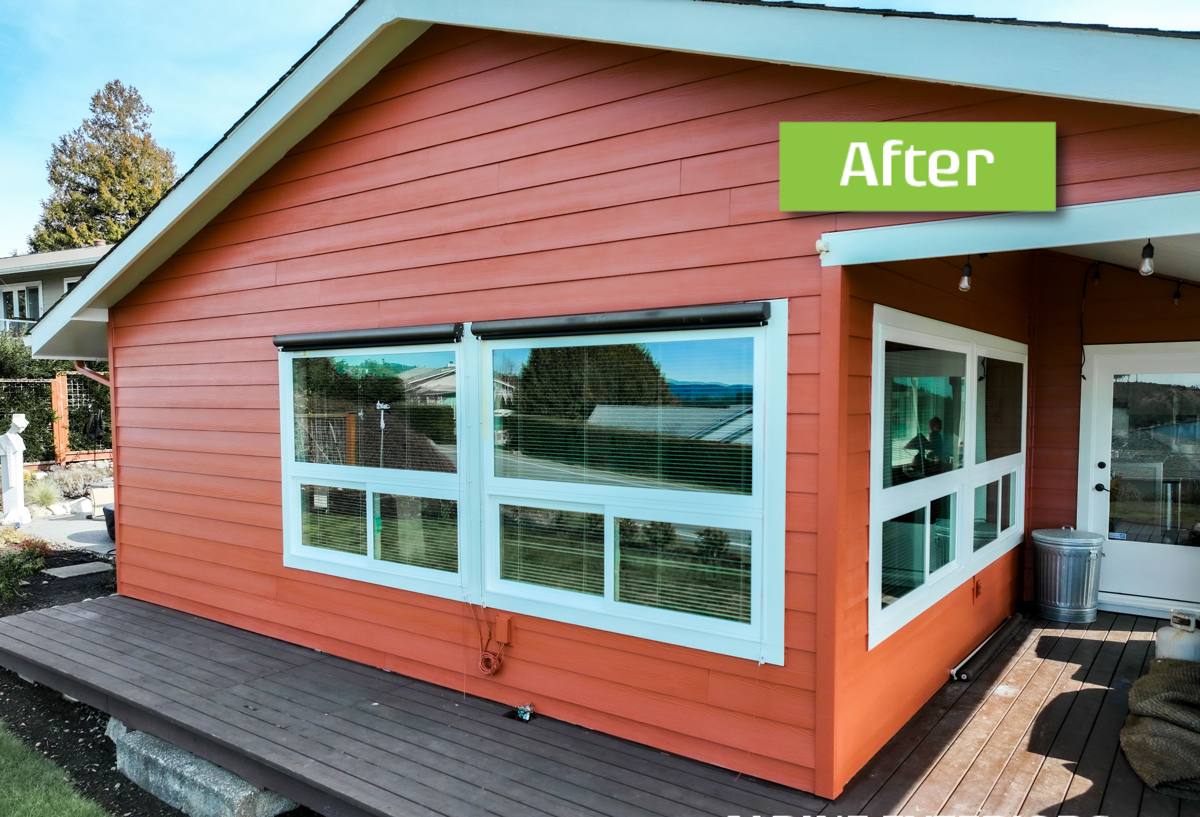
Signs a Birch Bay Home Needs Window Replacement, Not Just Repair
Repair makes sense for isolated issues — a cracked pane, a broken sash lock, a rotted section of exterior trim. Replacement becomes the right call when the problems are systemic across the window itself. Some signs we look for during an assessment:
- Fogging or moisture between panes on dual-pane windows — this means the seal has failed and the insulating gas is gone; it can't be fixed, only replaced
- Frames that feel soft, spongy, or show visible rot at the corners or sill, especially on the side of the house that takes the most weather
- Hardware that's corroded, seized, or leaves rust streaks on the sill or siding below
- Persistent drafts or a noticeable temperature difference near the window, particularly during winter wind events
- Paint or finish that keeps failing on the frame no matter how often it's touched up — usually a sign moisture is getting into the wood itself
- Difficulty opening, closing, or locking the window, which often points to a warped frame or a failed balance mechanism
Material Choice Matters More on the Water
Every window material handles coastal exposure differently. There's no single "best" answer for every home — it depends on your budget, the home's style, and how much upkeep you want to take on.
| Material | How it handles salt air and moisture | Maintenance |
|---|---|---|
| Vinyl | Won't corrode or rot; performs consistently near the water | Low — occasional cleaning |
| Fiberglass | Very stable in temperature swings, resists moisture well, holds paint if a custom color is wanted | Low |
| Aluminum | Strong and slim-profile, but bare aluminum can corrode faster in salt air unless properly coated | Moderate |
| Wood (unclad) | Best traditional look, but most vulnerable to rot and moisture in this climate without diligent upkeep | High |
| Clad wood (vinyl or aluminum exterior over wood interior) | Protects the wood from the weather side while keeping a wood interior; a common middle ground | Moderate |
For most Birch Bay homes, we steer clients toward vinyl or fiberglass for the exterior-facing performance, or clad-wood if the look of real wood on the interior matters and the budget allows for it. We're upfront when a material is a poor match for a home's exposure — a west-facing wall that takes the brunt of the weather off the bay is not the place to economize on frame material, even if it costs more up front.
Getting the Installation Right Is What Actually Prevents Failures
A quality window installed poorly will fail early, and in Birch Bay it tends to fail faster than it would somewhere drier. Most window problems we get called out to fix aren't a bad window — they're a window that was never properly flashed or sealed against wind-driven rain in the first place.
What a Correct Installation Includes
- Removing the old window fully and inspecting the framing underneath for hidden rot or moisture damage before anything new goes in
- Installing proper flashing above and around the window opening so water is directed out and away, not trapped behind the trim
- Using flexible, weather-rated sealants suited to sustained moisture exposure — not just any caulk
- Shimming the window square and level so it operates correctly and seals evenly on all four sides
- Sealing and insulating the gap between the window frame and the rough opening, which is where most air and water leaks actually originate
- Finishing exterior trim in a way that sheds water instead of holding it against the wall
Skipping or rushing any one of these steps is usually invisible on installation day and becomes a problem during the next big wind-driven storm, sometimes not until months later when moisture damage has already started behind the wall.
Our Window Replacement Process
- On-site assessment — we look at each window's condition, the home's exposure to wind and water, and any existing moisture or rot issues before recommending anything.
- Material and glass package recommendation — matched to the specific wall and exposure, not a one-size answer for the whole house.
- Measurement and ordering — precise measurements matter more on replacement work than new construction, since we're fitting into an existing opening.
- Removal and framing inspection — old windows come out fully so we can check the framing underneath, not just swap glass in place.
- Installation with proper flashing and sealing — following the steps above, every time, regardless of the window's price point.
- Interior and exterior finish work — trim, caulking, and cleanup so the job looks finished, inside and out.
- Final walkthrough — we test operation, locks, and seals with you before calling the job done.
Glass and Energy Efficiency Considerations
Whatcom County sees real temperature swings between summer and winter, and a bay-front home loses heat differently than one set back from the water. A few glass and construction choices matter more here than in a milder, drier climate:
- Dual-pane vs. triple-pane — dual-pane with a quality Low-E coating is sufficient for most Birch Bay homes; triple-pane adds cost and weight but can be worth it on a wall that takes constant wind exposure.
- Low-E coatings — these reduce heat loss in winter and heat gain in summer, and they're a low-cost upgrade relative to their long-term benefit.
- Gas fill (argon or krypton) — improves insulating performance between panes; argon is the standard choice for most residential replacements.
- Warm-edge spacers — the material separating the panes affects how well the seal holds up over years of temperature cycling; this matters more in a climate with frequent freeze-thaw swings and constant moisture.
What Window Replacement Costs Depend On
We don't quote firm numbers without seeing the job, but the factors that move the price are consistent from house to house:
| Factor | Why it affects cost |
|---|---|
| Window material | Vinyl is typically the most affordable; fiberglass and clad-wood cost more but offer different performance and appearance trade-offs |
| Number and size of openings | Larger openings and specialty shapes require more material and labor |
| Condition of existing framing | Hidden rot or moisture damage discovered during removal adds repair work before the new window can go in |
| Glass package | Triple-pane, upgraded Low-E, or specialty coatings add cost over a standard dual-pane package |
| Exposure of the wall | Walls facing the bay's prevailing wind and rain may warrant upgraded flashing details or hardware |
| Access and site conditions | Second-story windows, tight lots, or limited access can add labor time |
Why Local Experience in Birch Bay Actually Matters
A crew that mostly works inland jobs may not think twice about flashing details, sealant selection, or hardware corrosion resistance — because those shortcuts don't show up as problems in a less exposed location. In Birch Bay, they do, and usually within the first storm season. Working this specific stretch of Whatcom County coastline regularly means we've already seen which details matter on bay-front and near-bay homes: how far wind-driven rain travels up a wall, which sills collect moss first, which older frame materials are struggling under salt exposure, and which installation shortcuts fail fastest here. That's not something a generic install approach accounts for.
Simple Maintenance That Extends the Life of New Windows
A properly installed window in a quality material needs very little upkeep, but a small amount of seasonal attention goes a long way in this climate:
- Rinse frames and glass periodically to clear salt residue, especially after winter storms
- Clear moss or algae from sills and exterior trim before it spreads or holds moisture against the surface
- Check that weep holes (the small drainage openings in the frame) stay clear of debris so water can drain out properly
- Keep an eye on caulking and exterior sealant, and have any cracked or shrunken sections redone before a gap lets water in
- Test locks and hardware yearly, and address any stiffness or corrosion early rather than waiting for a full failure
If you're weighing whether your Birch Bay home's windows need repair or full replacement, we're happy to take a look and give you a straightforward assessment. Reach out for a free, no-pressure estimate using the form below.