 Blaine Exterior
 Lynden's Climate Is Harder on Siding Than Most Homeowners Realize
Lynden sits back from the water, so homes here don't take the direct salt spray that hits properties right along Drayton Harbor or Semiahmoo Bay in Blaine. But Whatcom County's marine air still carries salt-laden moisture well inland, and in the Nooksack valley that moisture gets trapped by tree cover, farmland humidity, and long stretches of overcast, wind-driven rain. The result is siding that stays damp longer than it would in a drier climate, even when it isn't taking rain head-on.
That extended dampness is what drives Lynden's long moss season. Shaded north-facing walls, siding behind mature landscaping, and lower sections near grade or planting beds are the areas we see moss and algae take hold first. On the wrong siding material, moss isn't just cosmetic — it holds water against the surface and accelerates rot, delamination, and paint failure. On the wrong installation, wind-driven rain finds every gap in flashing and caulk and works its way behind the cladding, where it can sit unnoticed for years.
None of this means Lynden needs some exotic solution. It means the siding and the installation both need to be matched honestly to a climate that's wetter, shadier, and slower to dry than a lot of people assume from an agricultural town that isn't right on the coast.
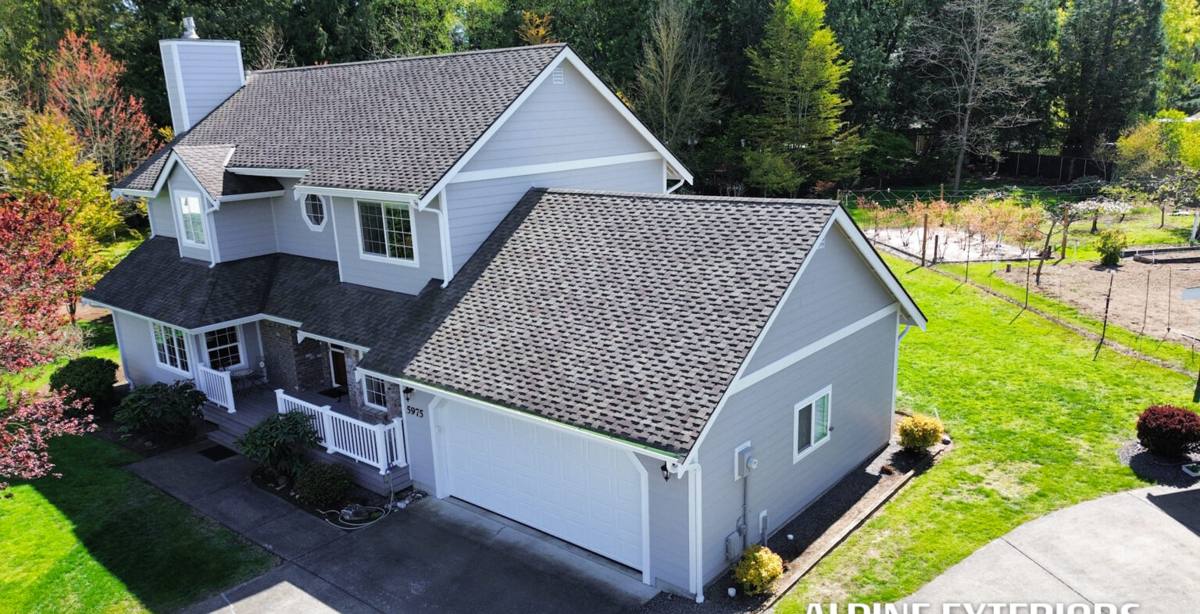
Signs Your Lynden Home's Siding Has Reached the End of Its Useful Life
Most homeowners call us after noticing one or two of these — but if you're seeing several at once, replacement is usually a better investment than another round of patching:
- Soft, spongy, or crumbling siding when pressed, especially near the bottom courses or under windows
- Persistent moss or dark streaking that comes back within a season or two of cleaning
- Paint that's peeling, bubbling, or needing repainting more often than every 7-8 years
- Visible warping, cupping, or gaps opening between boards or panels
- Cracking at butt joints, corners, or anywhere siding meets trim, windows, or doors
- A musty smell in an exterior wall, or interior drywall/trim that stays damp or discolored
- Siding that's original to a home built more than 20-25 years ago, especially if it's a material known for shorter service life
Any one of these can sometimes be repaired locally. But once moisture has been getting behind the siding for a while, the damage is often in the sheathing and framing underneath — not just the visible cladding — which is why a proper inspection matters more than a quick patch.
What a Correct Siding Replacement Actually Involves
It starts underneath, not on the surface
Full siding replacement is the one time you can see and fix what's happening behind the wall. A correct job doesn't stop at pulling old siding and nailing up new — it includes inspecting the sheathing for soft spots or rot, checking and repairing the weather-resistive barrier (the house wrap), and correcting flashing details around every window, door, deck ledger, and penetration. Skipping this step is the single most common reason a siding job fails early, regardless of what material goes on top.
Fastening and clearances matter more than people think
James Hardie fiber cement has specific installation requirements — fastener type and spacing, minimum clearance from grade, deck surfaces, and roof lines, proper joint treatment, and factory-finish touch-up standards — all spelled out in the manufacturer's published instructions. Installing it like a generic lap siding product is how you end up with a house that looks right for a year or two and then starts showing problems at the seams. Following the spec is also what keeps the manufacturer's warranty valid if something ever does go wrong.
Trim, flashing, and transitions finish the job
The parts of a siding job most likely to leak aren't the flat wall sections — they're the transitions: where siding meets trim, where a roofline intersects a wall, where a deck attaches to the house. We treat these as the priority, not an afterthought.
Why We Only Install James Hardie Fiber Cement
Blaine Exterior Co installs one siding system: James Hardie fiber cement. We don't offer vinyl, LP SmartSide, Cemplank, Allura, or primed wood siding, and that's a deliberate standard, not a limitation in what we're capable of installing.
Fiber cement is non-combustible, which matters in a region where wildfire smoke and ember exposure have become a real seasonal concern even west of the Cascades. Hardie's ColorPlus factory finish is baked on under controlled conditions rather than field-painted, which gives it far more consistent, weather-resistant color than a job-site paint job — a real advantage in a climate where field-applied coatings have less time to cure between rain events. Hardie also engineers specific product lines for different climate zones, and the HZ5 line used in our region is formulated for the freeze-thaw cycles, moisture exposure, and moss/mildew resistance that Whatcom County homes actually deal with. Backed by a strong transferable limited warranty, it's a system built for the specific conditions Lynden and the rest of the county see year after year — not a generic product we happen to sell.
Matching the Right Hardie Line to a Lynden Home
Not every Hardie product is the right fit for every house, and part of doing this job correctly is recommending the line that actually matches the home's style and exposure rather than defaulting to one option.
| Hardie Product | Best Fit For | Why It Works Locally |
|---|---|---|
| HardiePlank lap siding | Farmhouses, traditional homes, most Lynden street-facing elevations | Classic profile, wide color range, proven long-term performance in wet climates |
| HardiePanel vertical siding | Gable accents, modern or barn-style homes common on larger rural lots | Clean lines that pair well with board-and-batten trim, sheds water efficiently |
| HardieShingle | Accent gables, dormers, decorative sections | Adds texture without the maintenance burden of real wood shingle |
| HardieTrim boards | Corners, window/door surrounds, fascia | Completes the moisture-resistant envelope at the most failure-prone transitions |
Our Siding Replacement Process, Start to Finish
- On-site assessment — we walk the exterior, check for moisture damage, and evaluate flashing, trim, and drainage around the home
- Written estimate — scope, product line, color, and pricing laid out clearly before any work is scheduled
- Tear-off and sheathing inspection — old siding removed, framing and sheathing checked, any rot or damage repaired before anything new goes up
- Weather barrier and flashing correction — house wrap repaired or replaced, flashing detailed at every window, door, and penetration
- Hardie installation to manufacturer spec — correct fasteners, clearances, and joint treatment throughout
- Trim, caulking, and touch-up — finish details completed and inspected before final walkthrough
- Final walkthrough — we go over the finished work with you and address anything before we consider the job done
What Drives the Cost of a Lynden Siding Replacement
Every home is different, but these are the factors that most affect the final number:
| Factor | Why It Matters |
|---|---|
| Home size and wall complexity | More square footage, gables, and dormers mean more cutting, trim, and labor |
| Existing sheathing/moisture damage | Rot found during tear-off has to be repaired before new siding can go on |
| Product line and profile chosen | Plank width, panel style, and trim details all affect material cost |
| Number of window/door/trim transitions | Each one requires flashing and detail work beyond flat wall installation |
| Site access and lot conditions | Landscaping, fencing, and driveway access affect setup and disposal time |
We give straightforward, written estimates after seeing the home in person — not a phone-quote guess — because the sheathing condition and trim complexity genuinely change the scope.
Why Hiring a Crew That Already Works in Lynden Matters
Siding installed to spec in a dry climate can still fail here if the crew doesn't understand how Whatcom County's rain and moss patterns actually behave. We work throughout the county, from Blaine to Lynden and the towns between, so we're not learning the local conditions on your house — we already know which elevations tend to hold moisture, how far siding needs to sit off grade in a valley lot versus a coastal one, and what permitting and inspection expectations look like locally. That familiarity shows up in the details: the flashing choices, the clearances, the little judgment calls that separate siding that lasts twenty-plus years from siding that needs attention again in five.
If your Lynden home's siding is showing its age, we're happy to take a look and give you a straight answer about what it actually needs. Reach out for a free, no-pressure estimate — we'll assess the home, walk you through what we find, and lay out your options with no obligation.