 Blaine Exterior
 Building a Deck for Semiahmoo's Waterfront Exposure
Semiahmoo sits out on open water, and that changes what a deck has to put up with compared to a lot in town. Homes here catch salt-laden air off the bay, wind-driven rain that finds its way into every gap and fastener hole, and a shoulder season where moss and algae get a real head start on north-facing and shaded boards. A deck built to a generic spec doesn't hold up the same way out here as it might a few miles inland. Composite decking, installed correctly for this exposure, is one of the more sensible answers we recommend to Semiahmoo homeowners — but "composite" isn't a single product, and how it's installed matters as much as what brand of board goes down.
This page is specifically about composite decking for Semiahmoo properties — what the local conditions demand, what a correct install actually involves, and what our process looks like when we build or replace a deck out here.
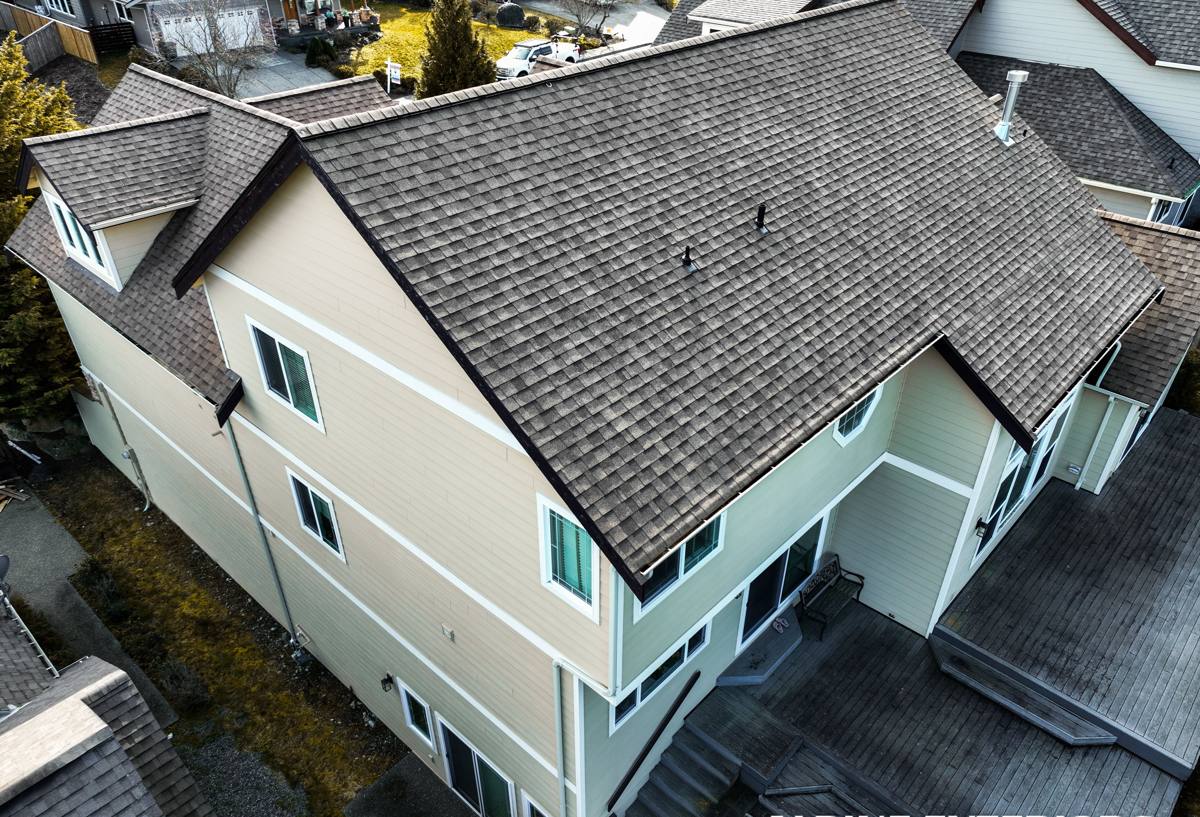
What Salt Air, Driving Rain, and Moss Season Do to a Deck
Salt Air
Airborne salt doesn't just sit on the surface — it works into fastener heads, hardware, and any exposed metal in the substructure. Over years, untreated or poorly rated fasteners corrode, streak boards, and can loosen connections you can't see from the top. This is one of the biggest reasons material choice below the decking matters as much as the decking itself.
Driving Rain
Wind off the water pushes rain sideways, not just straight down. That means water gets driven into board gaps, against ledger connections, and under rail posts more aggressively than a sheltered inland deck ever sees. Drainage and flashing details that would be "good enough" elsewhere aren't good enough on a spit exposed to weather from multiple directions.
Moss and Algae
Whatcom County's wet, mild winters and shoulder seasons give moss and algae a long growing window, especially on shaded decks or boards that stay damp under tree cover or on north sides of the house. Moss growth isn't just cosmetic — on any decking material it holds moisture against the surface and can make boards slick and unsafe underfoot if it's left unmanaged.
Composite vs. Wood vs. PVC: What Actually Makes Sense Here
We get asked to compare these three regularly. Here's an honest breakdown for a Semiahmoo-type exposure, not a sales pitch for any one product.
| Material | Salt Air / Corrosion | Moisture & Moss | Maintenance | Typical Lifespan |
|---|---|---|---|---|
| Pressure-Treated Wood | Fasteners corrode faster; wood itself is more forgiving | Absorbs moisture, needs sealing to resist moss and rot | Annual cleaning, periodic sealing/staining | 10-15 years with upkeep |
| Composite (capped) | Board face resists salt staining well; substructure hardware still needs to be corrosion-rated | Doesn't absorb water into the board core; surface still needs periodic cleaning to prevent moss film | Occasional washing, no sealing or staining | 25-30 years, manufacturer-dependent |
| PVC / Vinyl Decking | Very resistant to salt and moisture | Sheds water well; can still grow surface algae if shaded and unwashed | Low; similar to composite | 25-30+ years |
For most Semiahmoo homes we work on, capped composite is the practical middle ground — it holds up well to salt air and rain without the ongoing sealing schedule wood needs, and it costs less than full PVC systems while offering similar wood-look options. We'll walk through where PVC makes more sense (very shaded, very wet sites) case by case rather than defaulting to one product.
What a Correct Composite Install Involves Here
The composite board itself is only part of the job. On a waterfront exposure like this, the details underneath and around it are what determine whether the deck looks good in year one and still performs in year fifteen.
- Framing and ledger connections built or verified to handle sustained wind-driven rain without trapping water against the house
- Joist tape or an equivalent moisture barrier on framing members, so the substructure isn't absorbing the water the board surface sheds
- Corrosion-rated fasteners and hardware throughout — this is non-negotiable in a salt-air environment
- Proper board spacing and hidden-fastener systems that allow drainage and airflow underneath, reducing the moisture pocket where moss gets started
- Picture-frame or fascia detailing installed with expansion gaps sized for our temperature swings, so boards aren't fighting themselves as they expand and contract
- Post and rail attachment points flashed or blocked so driven rain doesn't track into the structure
Substructure and Fasteners: The Part You Don't See
Most deck problems we get called out to repair on the water side of Blaine aren't failures of the decking material — they're failures underneath it. Standard zinc-coated fasteners corrode faster in salt air and can stain composite boards from below as rust works its way up through fastener holes. Untreated or under-sized joists take on moisture over time even under a "waterproof" composite surface if there's no barrier tape and no airflow path. We spec hardware and fasteners rated for coastal exposure on every Semiahmoo project, not just where it's visible, because the substructure is what determines whether the deck is still solid in fifteen years, not just whether it looks fine in year two.
Our Process for a Semiahmoo Composite Deck
1. Site Walk and Exposure Assessment
We look at which direction the deck faces, how much sun and shade it gets, existing drainage, and the condition of any current structure — this tells us how aggressively we need to detail for rain and moss versus a more sheltered inland lot.
2. Structural Check
New build or replacement, we verify or rebuild the substructure to current code and to the corrosion-resistant hardware standard we hold for coastal exposure — not just reusing what's there if it isn't rated for it.
3. Material Selection
We go over composite board options and color/grain choices with you, factoring in how much shade the deck gets (shadier spots benefit from lighter colors and boards with better algae resistance) and your maintenance preferences.
4. Installation
Framing prep, moisture barrier, hidden fastener systems, proper spacing, and finish detailing around posts, stairs, and the house connection.
5. Walkthrough
We go over basic care specific to a salt-air, moss-prone site so you know what to expect and what (little) upkeep is actually needed.
Maintenance in a Salt-Air, Moss-Prone Climate
Composite decking is low-maintenance, not no-maintenance, especially on a waterfront lot. A short seasonal routine keeps it performing and looking right:
- Rinse salt film off the surface periodically, especially after storms with onshore wind
- Sweep debris out of board gaps so water keeps draining instead of pooling
- Wash shaded or north-facing sections with a composite-safe cleaner before moss gets a foothold, rather than after
- Check rail posts and stair connections annually for any sign of movement or corrosion streaking
- Avoid pressure-washing at close range or high PSI — it can damage the board's cap layer over time
- Keep gutters and downspouts near the deck clear so runoff isn't dumping extra water onto boards or framing
Cost Factors for a Semiahmoo Composite Deck
| Factor | Why It Moves the Price |
|---|---|
| Board tier (entry vs. premium composite) | Premium boards carry stronger cap layers and longer warranties, better suited to sustained salt exposure |
| Substructure condition | Existing framing that needs rebuilding or upgraded fasteners adds cost but is not optional on a waterfront lot |
| Deck size and shape | Cuts, curves, and multiple levels add labor and material waste |
| Railing and stair details | Composite or metal rail systems, glass panels, and multi-level stairs vary widely in cost |
| Site access | Waterfront and hillside lots can add equipment or material staging challenges |
We give a firm, itemized quote after the site walk rather than a rough per-square-foot number, because the substructure work alone can shift the price significantly from one Semiahmoo property to the next.
Why a Crew That Already Works Semiahmoo Matters
A contractor who mostly builds decks in sheltered, inland Whatcom County neighborhoods can turn out a fine-looking deck that still under-performs on a waterfront spit. The difference shows up in fastener selection, moisture barrier details, and how the framing is protected — none of which you can see once the boards are down, and none of which show up as a problem until a few winters in. We build and repair decks across Blaine and the surrounding waterfront, and we detail every Semiahmoo project for the exposure it's actually going to face, not a generic regional average.
If you're planning a new composite deck or replacing one that's showing its age, we'll walk the site with you and put together a clear, no-pressure estimate — just fill out the form below.