 Blaine Exterior
 Why Sandy Point Roofs Wear Differently
Sandy Point sits right up against the water, and that location shapes everything about how a roof ages here. Homes get a steady dose of salt-laden air, wind-driven rain that comes in sideways during winter storms, and long stretches of gray, damp weather that never quite lets a north-facing slope dry out. Add in the shade from mature evergreens common around Whatcom County, and you have ideal conditions for moss and algae to take hold. A roof that would last two decades in a drier inland part of the county can show real trouble in half that time out here if it wasn't built for this exposure in the first place.
This page is about one job: replacing a roof on a Sandy Point home the right way, with materials and details chosen for this specific stretch of Blaine coastline rather than a generic spec.
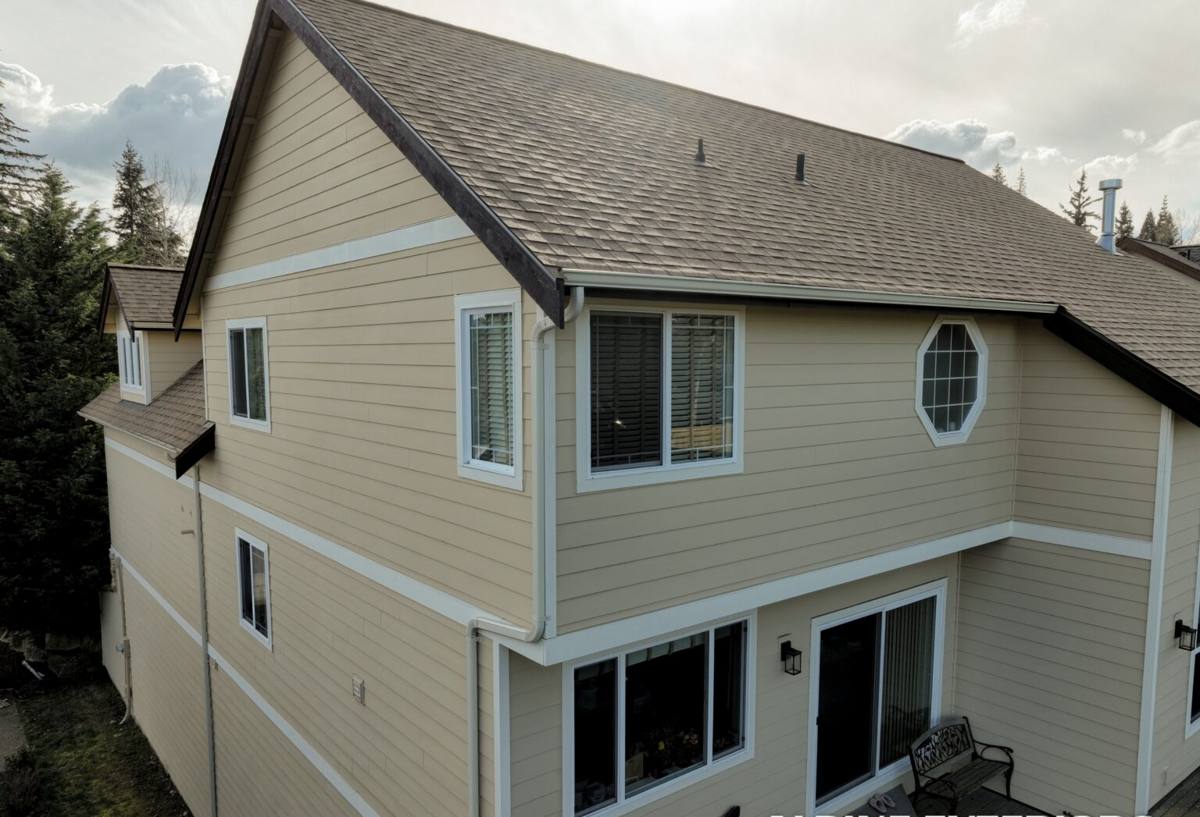
What Salt Air and Driving Rain Actually Do to a Roof
Salt air and metal components
Salt-laden moisture speeds up corrosion on anything metal — fasteners, flashing, drip edge, and vent stacks. Standard fasteners can start rusting years before the shingles themselves are due for replacement, and once a nail head corrodes and loses its grip, that's a hole waiting to leak. This is why fastener choice matters more here than it does a few miles inland.
Driving rain and wind exposure
Open water exposure means wind isn't just occasional gusts — it's sustained enough to drive rain sideways and up under standard shingle laps and around flashing edges that would hold fine in calmer conditions. Roofs near the water need tighter attention to flashing details, valley protection, and eave underlayment than the same roof set back in the trees.
Moss, algae, and moisture retention
Whatcom County's long wet season, combined with shaded slopes and salt-moisture in the air, gives moss a long runway to establish itself. Moss doesn't just look bad — it holds water against the roof surface, lifts shingle edges as it grows, and works its way under laps and around fasteners over time. A roof surface that's been hosting moss for a few seasons is often further along in hidden decay than it looks from the ground.
Signs a Sandy Point Roof Needs Replacement, Not Another Repair
Repairs make sense for isolated damage. Full replacement makes sense when the underlying system — decking, underlayment, and flashing — is failing broadly rather than in one spot. Here's what tends to point toward replacement in this area specifically:
- Moss or algae covering large sections rather than a few isolated patches
- Rust staining running down from nail heads, flashing, or vent stacks
- Soft or spongy decking felt underfoot in the attic, especially near eaves and valleys
- Granule loss heavy enough that you can see it collecting in gutters after every rain
- Curling, cupping, or lifted shingle edges on the sides that face prevailing wind and rain
- Repeated leaks in different spots each winter rather than the same one spot
- A roof already 18-20+ years old that's never had ventilation or underlayment upgraded
If you're only seeing one or two of these in isolation, a repair may still be the honest answer — we'll tell you that plainly rather than push a full replacement you don't need yet.
What a Correct Replacement Involves Here
Full tear-off and decking inspection
We don't install over an existing layer. A full tear-off is the only way to actually see the decking, confirm it's sound, and replace any sections that have gone soft from years of trapped moisture — which is common on north- and west-facing slopes in this kind of coastal exposure.
Upgraded underlayment and eave protection
For homes taking direct wind and rain off the water, we treat eaves, valleys, and low-slope transitions as places that need ice-and-water shield style membrane, not just standard felt or synthetic underlayment. This is the detail that most often separates a roof that handles wind-driven rain from one that doesn't.
Corrosion-resistant fasteners and flashing
Given the salt air, we use fasteners and flashing rated for coastal exposure rather than standard-grade hardware. It costs a little more up front and it's the difference between flashing that's still sound in year fifteen and flashing that's already staining and loosening by year seven.
Ventilation correction
Many older roofs in this area were never properly vented for how wet the local climate actually is. Balanced intake and exhaust ventilation reduces the moisture buildup in the attic that feeds both decking rot and moss growth from the underside up. We check this on every replacement, not as an upsell but because skipping it undermines everything else we install.
Material Choices for This Climate
There's no single "best" roofing material for Sandy Point — the right choice depends on your home's exposure, roof pitch, budget, and how much long-term maintenance you want to take on. Here's how the common options actually perform under salt air, moss pressure, and driving rain:
| Material | Salt Air Durability | Moss Resistance | Driving Rain Performance | Maintenance |
|---|---|---|---|---|
| Architectural asphalt shingle | Good with corrosion-resistant fasteners | Moderate — benefits from moss-resistant granules and periodic cleaning | Good with proper underlayment and flashing detail | Periodic moss treatment and gutter clearing |
| Standing seam metal | Very good with coastal-rated finish and fasteners | High — smooth surface sheds debris and moss struggles to establish | Excellent — few laps for wind-driven rain to exploit | Low — occasional inspection of seams and fasteners |
| Synthetic composite (slate/shake-style) | Good, check manufacturer coastal warranty terms | Moderate to good depending on product | Good with correct installation | Low to moderate |
We're honest about trade-offs rather than pushing one product for every home. Architectural asphalt remains the most cost-effective choice for most Sandy Point homes when installed with the coastal-specific details above. Metal costs more up front but asks less of you in maintenance and handles wind-driven rain and moss pressure better than almost anything else, which matters if you'd rather not think about your roof for the next 30-40 years. Synthetic composites sit in between, and we'll walk you through where they make sense for your specific roof.
Our Process
- On-site assessment — we walk the roof and attic, not just look from the ground, and check decking condition, ventilation, and flashing details specific to your home's exposure.
- Written estimate — a clear scope covering tear-off, decking allowance, underlayment, flashing, ventilation, and material choice, with honest ranges rather than a vague number.
- Scheduling around weather — we plan tear-off days around Whatcom County's rain patterns so your home isn't exposed longer than necessary.
- Tear-off and decking repair — old roofing comes off, decking is inspected, and any soft sections are replaced before anything new goes down.
- Underlayment, flashing, and material installation — built to the coastal details covered above, not a generic inland spec.
- Cleanup and walkthrough — magnetic sweep for stray fasteners, full site cleanup, and a walkthrough so you understand what was done and why.
Ventilation and Moisture Management After Installation
A new roof surface only solves half the problem if the attic underneath still traps moisture. Balanced ventilation lets warm, moist air escape instead of condensing against the underside of the decking, which is one of the quieter causes of premature roof failure in this climate. On homes with mature tree cover — common around Sandy Point — we also look at whether nearby branches are keeping a slope shaded and damp longer than it should be, since that's a moss and moisture factor no roofing material fully solves on its own.
Why a Crew That Already Works Sandy Point Matters
A roof replacement crew that hasn't worked this stretch of coastline will often default to standard inland specs — standard fasteners, standard underlayment coverage, standard ventilation assumptions. Those choices aren't wrong everywhere, but they leave a Sandy Point roof under-protected against the specific combination of salt air, wind-driven rain, and moss pressure it actually faces. Working in Blaine and the surrounding Whatcom County coastline regularly means we already know which details to upgrade by default rather than treating them as extras, and we're familiar with the county's permitting requirements for roofing work so there are no surprises mid-project.
Maintenance After Replacement
Even a correctly installed roof benefits from some upkeep in this climate:
- Keep gutters clear so water isn't backing up under eave edges during heavy rain
- Address moss growth early with an appropriate treatment rather than letting it spread across a slope
- Trim back overhanging branches that keep a section of roof shaded and damp
- Have flashing and fastener condition checked every few years, especially after major windstorms
- Schedule a professional inspection if you notice granule buildup in gutters or any interior staining
If your Sandy Point roof is showing its age or you just want an honest read on where it stands, we're happy to come take a look. Reach out below for a free, no-pressure estimate — we'll tell you straight whether you need a replacement, a repair, or a few more years, using the form on this page.