 Blaine Exterior
 Roof Repair Built for Grandview's Climate
Grandview homes sit close enough to the water that salt air is part of daily life, and close enough to the Canadian border that winter storms roll through with real force. That combination is hard on a roof. Salt-laden air accelerates corrosion on fasteners, flashing, and vents. Driving rain finds every weak seam and pushes water sideways under shingles and siding trim. And the long, damp, shaded stretches of the year keep moss and algae growing for months at a time. A roof repair in Grandview isn't just patching a leak — it's addressing the specific way this climate attacks a roof system over years, not just the spot where water finally showed up inside the house.
We work on roofs throughout Blaine and Whatcom County, and Grandview roofs tend to show a consistent pattern: fastener corrosion before the shingles themselves are worn out, moss buildup on north-facing and shaded slopes, and flashing failures around chimneys, vents, and roof-to-wall transitions where wind-driven rain gets pushed uphill against gravity. Understanding that pattern is what separates a repair that actually holds from one that reopens in a year.
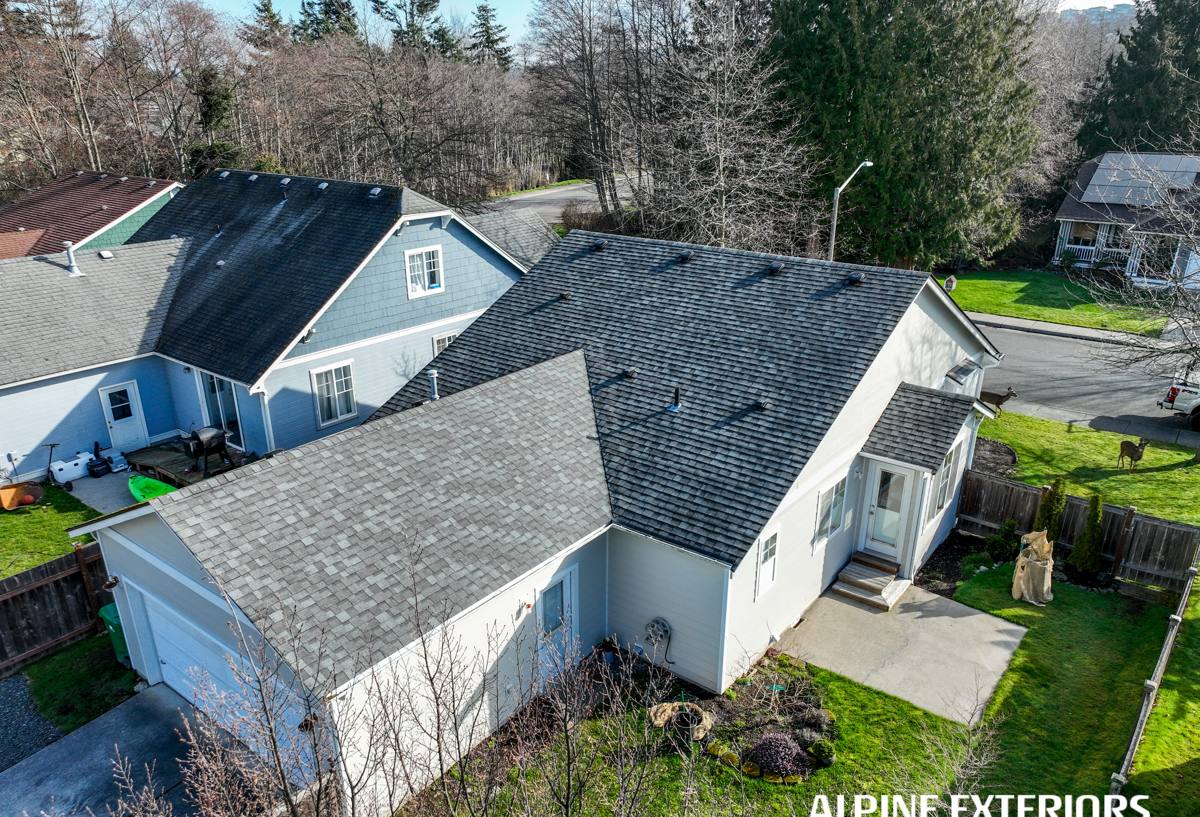
What Makes a Roof Repair "Correct" Here — Not Just Patched
A correct roof repair does three things: it stops the current leak, it addresses whatever let water in (not just where it showed up), and it doesn't create a new weak point. In a coastal, high-moisture area like this, that means paying close attention to a few things a lower-key climate wouldn't demand:
- Fastener and flashing material. Salt air corrodes standard fasteners and thin flashing faster than inland areas. We match materials to the exposure, not just to what's cheapest.
- Underlayment condition, not just shingle condition. A shingle can look fine on top while the underlayment beneath it has already failed from years of trapped moisture. We check both.
- Moss and organic growth removed and treated, not just scraped. Scraping moss off without addressing regrowth means the same repair area fails again within a season or two.
- Proper sequencing at transitions. Flashing, underlayment, and shingles have to be layered correctly so water sheds downhill at every seam — chimneys, valleys, wall intersections, and vent boots are where most Grandview leaks actually originate.
Skipping any of these turns a repair into a temporary fix. We'd rather tell a homeowner honestly what's needed than sell a quick patch that doesn't hold through the next storm season.
Signs a Grandview Roof Needs Repair
Most roof problems here don't start with a dramatic leak — they start small and get missed because they're on a slope you don't look at closely. Watch for:
- Dark streaking or thick moss growth, especially on shaded or north-facing slopes
- Granules collecting in gutters or at downspout outlets
- Soft or discolored ceiling patches after a heavy wind-and-rain event
- Curling, cracked, or lifted shingle edges
- Rust staining around metal flashing, vents, or roof jacks
- Daylight visible through the attic roof deck
- Gaps or lifted caulking around chimney flashing or skylights
Any one of these on its own might be minor. Several together, or anything paired with an active drip during a storm, means it's worth having someone look before the next round of driving rain works the problem wider.
Common Grandview Roof Repairs
The repair that's right for a given roof depends on what's actually failing — not every issue calls for the same fix. Here's how the common repair types compare:
| Repair Type | Typical Cause in This Area | What's Involved |
|---|---|---|
| Flashing repair/replacement | Corrosion from salt air, or original flashing undersized for wind-driven rain | Remove and replace flashing at chimneys, valleys, walls, or vents; reseal correctly |
| Shingle/section replacement | Wind damage, age, or granule loss from years of moss and moisture | Strip damaged section down to deck, check underlayment, reshingle to match |
| Moss and organic growth treatment | Long shaded, damp season typical of Whatcom County | Careful removal, treatment to slow regrowth, and often a look at what's keeping that slope wet longer than others |
| Vent boot / pipe boot replacement | Rubber boot material breaking down faster in coastal humidity and UV exposure | Swap failed boot, confirm surrounding shingles and sealant are sound |
| Deck repair | Sustained moisture intrusion that went unnoticed | Cut out and replace soft or rotted decking before re-covering |
A single leak can involve more than one of these at once — a failed vent boot, for example, often means the deck underneath has absorbed moisture for a while before it was noticed.
Repair or Replace? What We Actually Look At
Not every roof problem in Grandview means a full replacement, and not every roof is worth repairing indefinitely either. We walk homeowners through the honest factors rather than defaulting to the bigger job:
| Factor | Leans Toward Repair | Leans Toward Replacement |
|---|---|---|
| Age of roof | Under roughly 15 years, or recently installed | Nearing or past expected material lifespan |
| Extent of damage | Isolated to one section, flashing, or vent | Widespread across multiple slopes |
| Underlayment/deck condition | Sound where checked | Soft decking or failed underlayment in multiple spots |
| Repair history | First or second issue | Recurring leaks in different areas over recent years |
| Moss/algae condition | Surface growth, treatable | Growth has caused granule loss and mat deterioration |
We'll tell you plainly which side of that table your roof falls on, with our reasoning — not a sales pitch either direction.
Our Roof Repair Process
1. Inspection, Inside and Out
We look at the roof surface, flashing points, and vents, and we check the attic where accessible. A leak's entry point and its interior water stain are often several feet apart, especially on a sloped roof, so both ends of the picture matter.
2. A Written, Plain-English Explanation
We explain what's failing, why, and what the repair involves — no pressure, no vague line items. If the roof is a repair candidate, we say so. If it's genuinely past that point, we say that too.
3. The Repair Itself
We match materials and techniques to the exposure this roof actually faces — salt air, wind-driven rain, and shaded moisture — not a generic fix. Flashing, underlayment, and shingles get layered correctly so water sheds the way it's supposed to at every transition.
4. Cleanup and Walkthrough
We clear debris, check gutters and downspouts near the repair area for anything that could undermine the fix, and walk the work with the homeowner before we call it done.
Moss, Salt Air, and Keeping a Repair From Becoming a Repeat Job
A repair that doesn't account for regrowth or ongoing exposure is a repair you'll pay for again. In Grandview, that mainly means two things. First, moss: the long damp season here means shaded slopes stay wet longer than sun-exposed ones, and moss will return to a treated area if the underlying moisture pattern isn't addressed — sometimes that means recommending better airflow or noting where nearby trees keep a slope from drying out. Second, salt air: it's worth using corrosion-resistant fasteners and flashing on anything we touch, even in a smaller repair, because standard hardware simply doesn't last as long this close to the water. Neither of these is expensive to account for during a repair — it's expensive to ignore and redo later.
Homeowner Checklist: Before You Call for a Repair
- Note when the leak or stain first appeared and whether it worsens during storms specifically
- Check the attic (if accessible) for daylight, staining, or damp insulation
- Look at gutters for granule buildup, which signals shingle wear
- Photograph any visible roof damage from the ground — don't climb up yourself
- Know the roof's approximate age and whether it's had prior repairs
- Mention any recent storm, fallen branch, or wind event that preceded the issue
Having these details ready helps us diagnose faster and give a more accurate assessment on the first visit.
Why a Crew That Already Works Grandview Matters
Roofing crews who work outside this climate regularly tend to under-spec for it — using standard fasteners in a salt-air zone, or treating moss as cosmetic rather than a structural moisture issue. We work roofs across Blaine and Whatcom County and see the same failure patterns repeat from one Grandview roof to the next: corroded flashing before shingle wear, shaded slopes failing before sunny ones, wind-driven rain finding the same weak transitions. That pattern recognition is what keeps a repair from being a one-season fix. It also means we're not guessing at what this specific stretch of coastline does to a roof over time — we've already seen it.
If you've noticed moss buildup, a stain on a ceiling, or anything on the roof that doesn't look right, we're glad to take a look and give you a straight answer — repair, monitor, or replace. Use the form below to request a free, no-pressure estimate.