 Blaine Exterior
 Building New in Bellingham Means Building for Salt Air and Rain, Not Just Style
When you're framing a new home or a major addition in Bellingham, the window decisions you make now are harder to undo than almost anything else in the build. Once siding, trim, and interior finish work close in around a window opening, correcting a bad flashing detail or an undersized unit means tearing back finished work. That's a different problem than replacing an old window in an existing wall, and it calls for a different level of attention during rough-in.
Bellingham and the rest of Whatcom County sit close enough to the Strait of Georgia and Bellingham Bay that salt-laden air reaches most neighborhoods, not just waterfront lots. Combine that with long stretches of driving rain off the Pacific and a moss season that runs from fall through spring, and you have a climate that's genuinely tougher on window systems than most of the country. New-construction windows installed correctly the first time will handle all of that quietly for decades. Windows installed with shortcuts on flashing or fastening will show it within a few winters — fogged glass, soft framing, stained siding below the sill, or drafts that show up right when the weather turns.
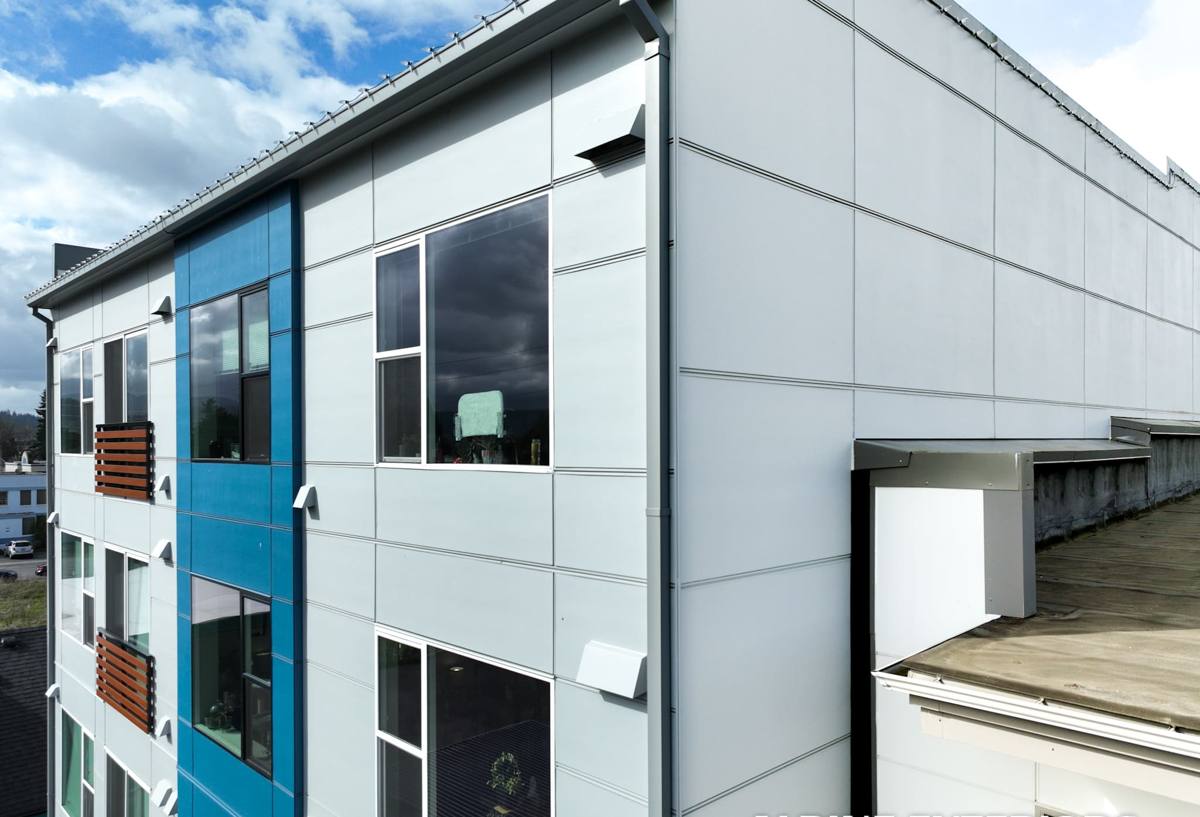
What Local Weather Actually Does to a New Window Opening
It helps to understand the specific mechanisms at work here, because they explain every recommendation that follows.
Salt Air and Metal Fatigue
Airborne salt accelerates corrosion on unprotected fasteners, low-grade hardware, and some aluminum components. It's not usually enough to worry a first-time homeowner, but on a new build we specify corrosion-resistant fasteners and hardware as a matter of course rather than reacting to it after the fact.
Driving, Wind-Driven Rain
Whatcom County storms rarely come straight down. Wind pushes rain sideways and upward under sills and around trim, which is exactly the condition that exposes a weak flashing detail. A window that would perform fine in a calmer climate can leak here if the sill pan, head flashing, and water-resistive barrier integration aren't done in the right sequence.
Moss and Sustained Dampness
Moss thrives where surfaces stay damp for extended periods — north-facing walls, shaded eaves, and anywhere water is slow to shed. Around windows, that dampness can migrate into sill trim and sheathing if drainage paths aren't built in from the start. On a new build, that means the window opening needs a way for incidental water to get back out, not just a barrier meant to keep it out entirely.
New-Construction vs. Replacement Windows: Why the Distinction Matters
New-construction windows have a nailing fin that fastens directly to the framing before the water-resistive barrier and siding go on, which lets the flashing be built in layers, shingle-style, so water always sheds outward and downward. Replacement (or "pocket") windows are designed to slip into an existing frame with the exterior trim left in place, which is the right call on a remodel but the wrong call on new framing — it skips the opportunity to build a proper flashing system from scratch.
On a genuine new build or addition in Bellingham, there's no reason to use anything but true new-construction units. It's the only approach that lets us control every layer of the water management system around the opening, which matters more here than in a drier climate.
Frame Materials and Glass: What Actually Holds Up
There's no single "best" window material — the right choice depends on budget, the home's design, and how much long-term maintenance the owner wants to take on. Here's how the common options perform in this climate specifically:
| Frame Material | Coastal Performance | Maintenance | Typical Fit |
|---|---|---|---|
| Vinyl | Good — won't corrode or rot; UV-stable formulations hold color well | Low | Most budgets, wide color range |
| Fiberglass | Very good — dimensionally stable through temperature swings, resists moisture | Low | Higher-end new builds, larger openings |
| Wood-clad | Depends heavily on cladding and detailing quality; interior wood needs protection from any moisture intrusion | Moderate to high | Traditional or high-end aesthetic |
| Aluminum | Prone to condensation and thermal transfer unless thermally broken; can corrode without proper coatings | Moderate | Modern designs, commercial-style openings |
For glass, we default to a dual-pane, low-E package with argon fill for most Bellingham builds — it balances energy performance with cost. Homes closer to open water or with more west- and south-facing glass sometimes benefit from a higher-performance glass package to manage solar heat gain and condensation resistance. We'll talk through what your specific elevations need rather than defaulting to one spec across the whole house.
What We Won't Do
We don't install window products that rely on site-applied caulk as the primary water seal instead of mechanical flashing, and we're cautious with frame systems that lack a documented, tested installation method for our wall assemblies. It's not that these products are inherently bad — it's that they shift more of the long-term performance onto caulk maintenance and installer judgment than we're comfortable staking a new build's warranty on.
Flashing and Water Management: The Part That Determines Whether Windows Last
This is the section that matters most and gets talked about least. A window unit itself is rarely the point of failure in this climate — the flashing and drainage detailing around it is.
Correct sequencing for a new-construction opening generally looks like this:
- Sill pan flashing installed first, sloped or with back-dammed edges so any water that gets past the window drains back out, not into the wall.
- Window set into the opening, shimmed level and plumb, and fastened per the manufacturer's schedule.
- Jamb flashing applied over the nailing fin sides.
- Head flashing installed last, lapping over the water-resistive barrier above so water sheds down and over every layer beneath it — never trapped behind it.
- Water-resistive barrier integrated over the whole assembly before siding goes on.
Skipping the sequence, reversing a lap, or relying on sealant to bridge a gap instead of proper flashing overlap is how new windows in this region end up with rot inside the wall years before anyone sees a stain on the interior. It's invisible work — nobody admires good flashing — but it's the difference between windows that are still tight in twenty years and windows that need remedial work in five.
Our New-Construction Window Process
On Bellingham-area builds, our process is built around getting the rough opening and flashing right before the window ever goes in the wall:
1. Plan Review and Measurement
We work from the framer's rough openings and the plan set to confirm sizes, egress requirements for bedrooms, and any structural header considerations before ordering.
2. Product Selection
We walk through frame material, glass package, and grille or hardware options against your budget and the home's exposure — which elevations face prevailing weather matters more here than in a sheltered inland climate.
3. Sill Pan and Flashing Install
Every opening gets sill pan flashing before the window is set, regardless of what the framer's schedule assumed.
4. Window Set and Shim
Units are set square, plumb, and fastened to the manufacturer's spec — over-driving or under-driving fasteners is a common source of frame distortion and seal failure.
5. Jamb and Head Flashing
Flashing is layered shingle-style so every course sheds water onto the one below it, tied into the water-resistive barrier.
6. Interior and Exterior Finish Coordination
We coordinate with your builder or trim crew so interior sill and exterior trim work happens after we've confirmed the window is sealed and operating correctly — not before.
7. Final Walkthrough
We check operation, sweep and lock function, and visually confirm flashing laps before signing off.
Choosing a Window Contractor for a Bellingham Build
New-construction window work is easy to get "close enough" and hard to verify once the wall is closed up. A few things worth asking any contractor bidding the work:
- Do they install sill pan flashing on every opening, or only when a builder specifically requests it?
- Can they explain their flashing sequence in plain terms, not just "we seal everything"?
- Are they familiar with the specific window lines they're proposing, including manufacturer installation instructions for your wall assembly?
- Do they carry current licensing and insurance appropriate for new-construction work in Washington?
- Will they coordinate directly with your framer, siding crew, or general contractor rather than working in isolation?
- What's covered under warranty — the window unit, the installation labor, or both — and for how long?
A crew that already works regularly in Blaine and Bellingham has usually already worked through these details on homes facing the same wind and rain exposure yours will see. That's not a substitute for asking the questions above, but it does mean fewer surprises mid-build.
Cost Factors Worth Understanding Up Front
New-construction window pricing depends on more than the per-unit cost of the windows themselves. The factors that move the number most are:
| Factor | Why It Matters |
|---|---|
| Frame material and glass package | Fiberglass and upgraded glass packages cost more than standard vinyl but require less long-term maintenance |
| Number and size of openings | Larger or custom-sized units and specialty shapes cost more per square foot than standard sizes |
| Exposure and elevation | Openings facing prevailing wind and rain sometimes warrant upgraded flashing details or glass performance |
| Access and building stage | Coordinating install timing with framing and siding crews affects labor efficiency |
| Egress and code requirements | Bedroom egress windows have minimum size and opening requirements that can affect unit selection |
We'll always give you a real, itemized number rather than a rough per-window estimate — new-construction pricing depends too much on your specific plan set to guess accurately from the driveway.
Why Local Experience in Blaine and Bellingham Matters
Window installation guidance from a manufacturer is written for a generic climate. It doesn't account for the fact that a north-facing wall in Bellingham holds moisture longer than the same wall would in a drier region, or that homes near the water need more corrosion-resistant hardware than homes further inland. A crew that works this specific stretch of Whatcom County regularly has already adjusted for those realities on other builds — which reduces the chance of finding out about a weak detail after the siding is already up.
If you're planning a new build or addition in the Bellingham area and want new-construction windows installed the right way from the framing stage forward, we're happy to walk your plans, talk through product options, and give you a straightforward, no-pressure estimate. Use the form below to get started.