 Blaine Exterior
 Point Roberts Sits Right at the Water's Edge — Siding Pays for It
Point Roberts is about as exposed to the elements as a Whatcom County home gets. It sits on a small peninsula surrounded by water on three sides, which means wind-driven rain, salt-laden air off the Strait of Georgia, and long stretches of shade and dampness that keep moss and algae established year-round. Add in the marine humidity that rarely lets up between fall and spring, and you have a climate that is genuinely hard on exterior siding, and one that is harder on wall assemblies than most inland Whatcom County neighborhoods ever have to deal with.
Siding here doesn't usually fail because a homeowner neglected it. It fails because the wrong product, or the right product installed the wrong way, can't keep up with what this exposure throws at it year after year. That's the starting point for every siding conversation we have with Point Roberts homeowners: what does this specific site actually need to hold up long-term, not just look good on install day.
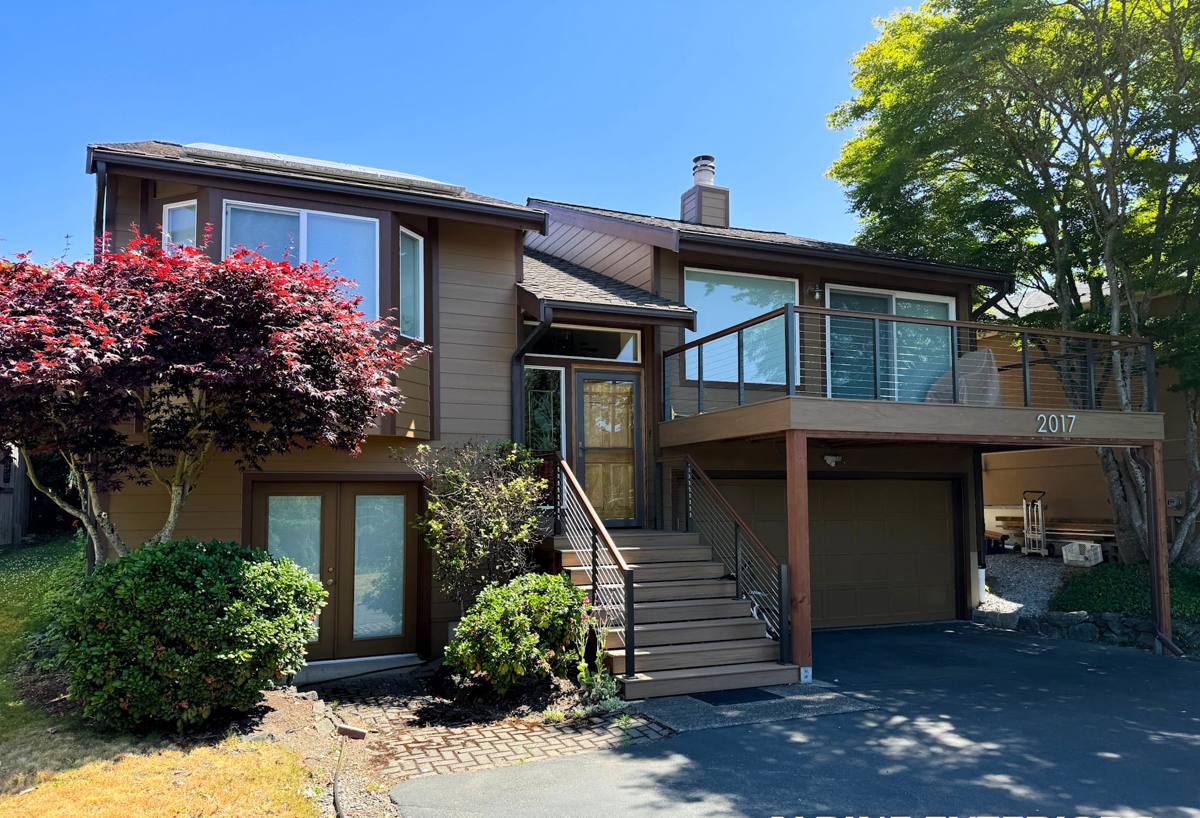
Why James Hardie Fiber Cement Fits This Exposure
A Non-Combustible, Moisture-Resistant Core
James Hardie siding is fiber cement, a mix of cement, sand, and cellulose fibers engineered to resist the swelling, cracking, and rot that come from repeated wetting and drying. In a salt-air environment like Point Roberts, that matters more than it does a few miles inland. Salt accelerates corrosion of fasteners and hardware, and it speeds up the breakdown of coatings and finishes that aren't built to take it. Fiber cement's core doesn't absorb and hold water the way wood-based products do, so it isn't feeding the freeze-thaw and rot cycles that salt air and driving rain tend to set up.
ColorPlus Finish vs. Field-Applied Paint
Hardie's ColorPlus finish is baked on in a factory, in multiple coats, under controlled conditions, not brushed or sprayed on site after installation. That matters on the coast because a factory finish holds color and resists fading, chalking, and salt-related wear far longer than a field-applied paint job typically will. It also simplifies touch-up and caulk-point maintenance down the road, since the finish is consistent panel to panel rather than dependent on the site conditions the day it was painted.
A Warranty That Actually Transfers
Hardie backs its siding with a strong, transferable warranty, a real factor if a Point Roberts home changes hands down the road, since it isn't uncommon for exterior warranties to be voided or heavily limited at resale. Combined with correct installation, that warranty is part of what makes fiber cement a long-term investment rather than a product you're re-evaluating again in a decade.
Climate-Engineered HZ Product Lines
Hardie manufactures its siding in different HZ, or HardieZone, formulations suited to different climate exposures. Western Washington, including Whatcom County and the Point Roberts peninsula, falls in the wetter HZ5 zone, and the product specified for this region is engineered around that moisture and temperature profile rather than a one-size-fits-all formulation. Getting the correct HZ product on a coastal exclave like this isn't a minor spec detail, it's the difference between siding engineered for this weather and siding that merely tolerates it.
What a Correct Installation Involves Here
Drainage Plane and Rainscreen Gap
Good siding performance starts behind the panels. On a site with this much wind-driven rain, the water-resistive barrier needs to be installed and lapped correctly, and we build in a drainage gap so any moisture that does get behind the siding has somewhere to go instead of sitting against the wall sheathing. Skipping or shortcutting this step is one of the most common reasons siding looks fine for a few years and then fails from the inside out.
Flashing, Caulking, and Fastener Placement
Every window, door, deck ledger, and roof-to-wall transition is a place where water wants to get behind the siding. Correct flashing details at those transitions matter more here than in a sheltered inland yard, because Point Roberts takes more direct, driving rain off the water than most of the county. Fasteners need to be placed and set to Hardie's specification, not overdriven, not underdriven, and in corrosion-resistant material given the salt exposure. Caulking goes at the specific joints Hardie calls for, not as a blanket fix for gaps that should have been detailed correctly in the first place.
Clearances and Ground Contact
Hardie panels need proper clearance from grade, roofing, decks, and patios so they aren't sitting in standing water or trapped moisture. On a peninsula where the ground stays damp for long stretches of the year, that clearance is one of the simplest details to get right, and one of the most commonly missed on rushed jobs.
Where Salt-Air Siding Failures Usually Start
| Vulnerable Point | What Goes Wrong Without Correct Detailing | How We Detail Around It |
|---|---|---|
| Butt joints and panel seams | Water intrusion behind the panel, swelling, and finish failure at the seam | Correct joint treatment and flashing per Hardie spec, not just caulk over a gap |
| Fasteners and hardware | Corrosion and staining from salt air, panels loosening over time | Corrosion-resistant fasteners set to the correct depth and pattern |
| Window and door trim | Water tracking behind trim into the wall assembly | Proper flashing and sealant at every penetration, checked before siding closes it in |
| Bottom courses near grade | Wicking moisture, moss and algae staying damp against the panel | Correct clearance from grade, hardscape, and roof lines |
| North- and shade-facing walls | Persistent dampness that feeds moss and mildew growth | Drainage gap behind the panel so the wall assembly can actually dry |
The Point Roberts Logistics Problem — Why a Local Crew Matters
Point Roberts is a U.S. exclave. It's part of Whatcom County and the state of Washington, but the only land route in and out crosses the Canadian border. That's not a detail most siding crews think about, but it shapes everything about how a job here actually gets done. Materials, tools, and crew all have to cross that border, which means scheduling has to account for it, and a contractor who doesn't regularly work this route can end up burning a homeowner's time and money figuring out logistics on the fly.
A crew that already works Point Roberts has that part solved. We know how to plan material deliveries and crew schedules around the crossing, and we don't treat a Point Roberts job as a special case that has to be worked out from scratch every time. That reliability matters on a job that already has enough variables, since the weather windows on an exposed coastal site are tight enough without added uncertainty about whether the crew and materials will actually show up on the day they're supposed to.
Our Process for a Point Roberts Siding Job
- On-site assessment. We look at current siding condition, moisture points, trim and flashing details, and how exposed each elevation is to wind and rain off the water, so the plan matches the actual site rather than a generic scope.
- Product and color selection. We spec the correct HZ5 James Hardie product and ColorPlus finish for the home, factoring in sun exposure, prevailing wind direction, and how each elevation will actually weather over time.
- Permitting. Point Roberts falls under Whatcom County jurisdiction, so permitting follows the same county process as the rest of unincorporated Whatcom County, and we handle that paperwork as part of the job rather than leaving it to the homeowner.
- Scheduling around the crossing. Materials and crew are scheduled with the border crossing built into the plan from the start, not treated as an afterthought that costs a day mid-project.
- Installation to spec. Water-resistive barrier, drainage gap, flashing, fastening, and clearances are all installed to Hardie's specification for this climate zone, not shortcuts that happen to look fine on install day but fail quietly over the following winters.
- Final walkthrough. We check every transition and joint before calling the job done, because those are the details that determine whether the siding is still performing in ten years, not just at the one-year mark.
Living With Moss Season: Maintenance That Actually Helps
No siding product eliminates the need for basic upkeep in a climate this damp, but correctly installed Hardie siding makes that upkeep manageable instead of constant. Moss and algae need sustained moisture and shade to take hold, and a home with good drainage detailing, proper grade clearance, and a factory finish that doesn't feed organic growth the way some coatings do will simply need less attention than a home without those things.
- Rinse siding down at least once a year to clear salt residue, pollen, and organic buildup, especially on shaded or north-facing walls
- Keep gutters clean and downspouts directed away from the foundation so roof runoff isn't adding to damp conditions at the base of the wall
- Trim back vegetation that keeps a wall shaded and damp longer than it needs to be
- Check caulking at trim, windows, and joints yearly, and have any cracked or failed sealant redone before it lets water in
- Watch for moss or algae getting a foothold at bottom courses and shaded corners, and address it early rather than letting it establish
- Have any impact damage or chipped ColorPlus finish repaired promptly so the substrate underneath doesn't get exposed
Why We Only Put James Hardie on Point Roberts Homes
We don't install vinyl, LP SmartSide, Cemplank, Allura, primed spruce, or cedar siding, and that's a deliberate standard, not a lack of options. Vinyl can crack and lose structural rigidity under sustained temperature swings and doesn't offer the same fire resistance as fiber cement. Wood-based and primed wood products carry ongoing maintenance and moisture-management burdens that are harder to justify on a site this exposed. Cedar is a genuinely attractive material, but it asks for a level of ongoing refinishing and moisture vigilance that most homeowners don't want to sign up for on a peninsula that stays damp for months at a stretch. James Hardie fiber cement, installed correctly, gives Point Roberts homes a non-combustible, factory-finished siding system engineered for exactly this kind of climate zone, backed by that transferable warranty, which is why it's the only product we put on these walls.
If you're weighing a siding project for a Point Roberts home, we're happy to take a look and talk through what your specific site needs, no pressure, no obligation. Use the form below to request a free estimate.