 Blaine Exterior
 Why Ferndale's Climate Is Hard on Siding
Ferndale sits close enough to the water and to the Blaine corridor that homes here deal with a specific combination of stresses most siding products were never designed to handle all at once: salt-laden air moving in off the strait, long stretches of driving rain through fall and winter, and shaded, damp conditions that make moss and algae almost a given on north-facing walls. Any one of those on its own is manageable. Together, over years, they expose weaknesses in siding materials and installations that would go unnoticed in a drier, calmer climate.
Salt air accelerates corrosion on fasteners and metal flashing and slowly breaks down paint films and caulking. Driving rain doesn't just fall straight down — wind pushes it sideways and up under laps, trim, and joints, which means siding here needs real drainage behind it, not just a good-looking face. And moss season, which in Whatcom County can run most of the year on shaded elevations, holds moisture against the wall surface far longer than a sunny wall ever sees. That combination is why we've seen so many Ferndale-area homes with siding that looks fine from the street but is failing quietly behind the surface.
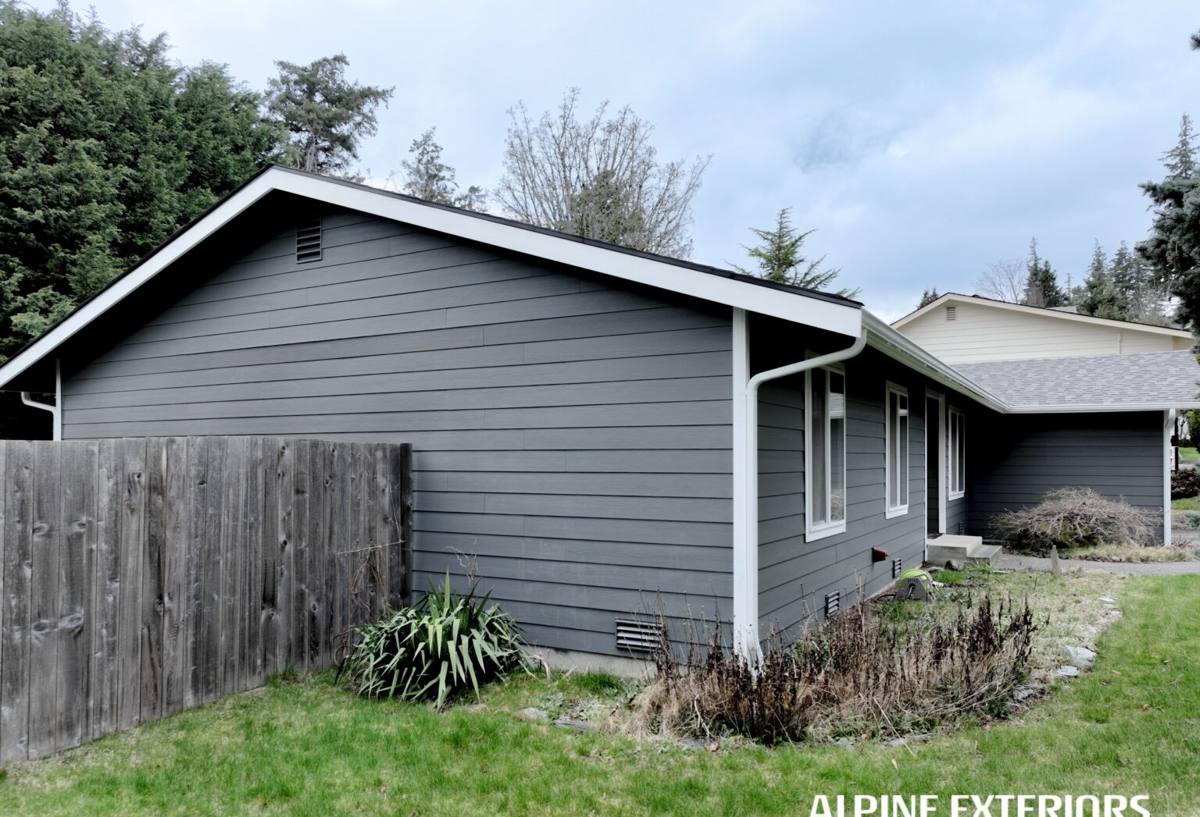
What Fiber Cement Siding Needs to Get Right in This Climate
Fiber cement itself is a stable, moisture-resistant material — it won't rot, swell, or feed insects the way wood-based products can. But the material is only half the equation. In a climate like this, how it's installed determines whether it performs for decades or starts showing problems in a handful of years.
Drainage Behind the Panel
Correct fiber cement installation in a wet coastal climate includes a drainage plane and, ideally, a rainscreen gap — a small air space between the weather-resistive barrier and the back of the siding that lets any moisture that gets past the surface drain and dry out instead of sitting against the sheathing. Skipping this step is one of the most common shortcuts we see on re-sides, and it's exactly the kind of detail that doesn't show up as a problem until years later.
Flashing, Not Just Caulk
Driving rain finds its way into any gap it can, especially around windows, doors, rooflines, and butt joints. Flashing — not caulk — is what should be doing the real work of shedding that water. Caulk has its place for sealing trim, but a wall that depends on caulk alone to stay dry is a wall that will eventually leak, especially once that caulk starts to break down from salt exposure and UV.
Fastener and Gap Specs
Fiber cement panels need to be fastened and spaced according to the manufacturer's specifications for the local climate zone — proper nail penetration, correct gaps at butt joints and trim to allow for expansion, and corrosion-resistant fasteners that won't streak or fail early in salt air. These are small details on paper, but they're the difference between siding that holds up and siding that needs attention in year eight instead of year thirty.
Why We Install Only James Hardie
We made the decision to install James Hardie fiber cement siding exclusively, and nothing else. Not LP SmartSide, not vinyl, not Cemplank or Allura, not primed spruce or cedar. That's not a marketing position — it's a professional standard we hold because of what we've seen these products do, and not do, over time in a climate like Whatcom County's.
Wood-based and wood-strand products can look and perform well initially, but they depend on field-applied caulking and paint to stay sealed at every seam, and that maintenance schedule only gets more demanding in salt air and driving rain. Vinyl doesn't rot, but it expands and contracts significantly with temperature swings, can crack or warp over time, and — depending on how it's installed — can trap moisture behind it rather than letting a wall breathe and drain the way a properly detailed fiber cement rainscreen system does. These aren't defects so much as trade-offs, and in this climate, we don't think they're trade-offs worth asking a homeowner to live with.
Built for This Climate: The HZ5 Engineering
James Hardie engineers its siding by climate zone rather than selling one product everywhere. The HZ5 line is formulated for wetter, colder regions — the Pacific Northwest included — with a moisture- and mold-resistant formulation and a factory-applied ColorPlus finish that's baked on under controlled conditions rather than painted on-site after installation. That factory finish matters here specifically: it holds color and resists the fading, chalking, and peeling that field-applied paint struggles with once salt air and UV start working on it year after year.
Fiber Cement vs. Other Common Siding Materials
Every siding material has a role somewhere. Here's how the materials most often compared to Hardie fiber cement tend to behave under Whatcom County's specific mix of salt air, rain, and moss exposure.
| Material | Moisture Behavior | Ongoing Maintenance |
|---|---|---|
| James Hardie fiber cement | Non-combustible, dimensionally stable core; performs well when a rainscreen and flashing are used | Occasional rinsing; factory finish reduces repainting needs |
| Wood / wood-strand (e.g. LP SmartSide) | Relies on intact field-applied sealant and paint at seams to resist moisture intrusion | Regular inspection and recaulking/repainting on a set schedule |
| Vinyl | Won't rot, but can trap moisture behind it if not properly vented; prone to warping in temperature swings | Low, but cracked or faded panels are hard to color-match years later |
| Cedar | Natural material, attractive, but absorbs moisture and is a food source for organic growth without diligent upkeep | Frequent refinishing, especially on shaded or salt-exposed elevations |
Our Installation Process
Every Ferndale-area project follows the same disciplined sequence, because skipping a step is exactly where problems start.
- Assessment — we inspect the existing siding and, where it's coming off, the sheathing underneath for hidden rot or moisture damage before quoting the job.
- Tear-off and sheathing repair — any compromised sheathing gets addressed before new siding goes on, not covered up.
- Weather-resistive barrier and rainscreen — a proper drainage plane and air gap go in first, tailored to this climate.
- Flashing — windows, doors, rooflines, and penetrations get flashed correctly, not just caulked.
- Panel installation — Hardie siding installed to manufacturer fastener, gap, and clearance specifications.
- Trim and finish detailing — corners, trim boards, and joints finished for both appearance and long-term water management.
- Final walkthrough — we review the completed work with the homeowner before we consider the job done.
Signs Your Current Siding Is Losing the Battle
If your home is showing any of the following, it's worth having someone take a closer look before it turns into a bigger repair:
- Peeling, bubbling, or chalky paint that keeps coming back after repainting
- Soft or spongy spots when you press on the siding, especially near the bottom courses
- Persistent moss or dark streaking on shaded or north-facing walls that returns after cleaning
- Visible warping, buckling, or gaps opening up at seams and trim
- Rising heating costs that suggest moisture-compromised insulation behind the wall
- Rust streaking from fasteners, a common sign of salt-air corrosion on older installations
What Affects the Cost
We don't publish flat prices because every home and project scope is different, but these are the main factors that move the number up or down.
| Factor | Why It Matters |
|---|---|
| Home size and wall complexity | More square footage and more corners, dormers, and trim details mean more labor and material |
| Condition of existing sheathing | Hidden rot or moisture damage found during tear-off adds repair work before new siding can go on |
| Siding profile and ColorPlus selection | Lap width, shingle-style panels, and specific color options carry different material costs |
| Access and site conditions | Multi-story sections, tight lot lines, or landscaping obstacles affect labor time |
| Trim, fascia, and accessory work | Full exterior packages beyond just the field siding add scope |
Why a Crew That Already Works Ferndale Matters
Siding performance in this climate isn't theoretical — it's specific to how homes in this area are built and where they're most exposed. A crew that already works Ferndale and the broader Blaine and Whatcom County area knows which elevations tend to take the worst of the driving rain, where moss builds up fastest, and how salt exposure differs depending on how close a property sits to the water. That local pattern recognition shows up in small decisions on the job — where to pay extra attention to flashing, which details to double-check before the panels go on — that a crew unfamiliar with the area might not think to prioritize.
It also means faster response if something needs a look after the job is done, familiarity with local permitting and inspection expectations, and a crew that has a reputation in the community to stand behind, not just a one-time job to finish and move on from.
Caring for Your New Siding
Fiber cement is low-maintenance, not no-maintenance. A periodic rinse-down helps clear salt residue and organic buildup before it has a chance to take hold, especially on shaded walls. Keeping gutters and downspouts clear prevents overflow from running down the siding face repeatedly in one spot. And it's worth a visual check after major storms for any trim caulking that may need attention — the siding panels themselves are built to hold up; the trim and joint details are where upkeep occasionally comes into play.
If you're weighing your options for your Ferndale home, we're happy to take a look and give you a straight, no-pressure assessment of what your siding needs and what correct installation looks like for your property. Use the form below to request a free estimate.