 Blaine Exterior
 Decking Built for Custer's Climate, Not a Catalog Photo
Custer sits close enough to the water that salt air is a daily fact of life, but far enough inland that homes also deal with heavy shade, slow-drying ground, and long stretches of damp weather. That combination is hard on outdoor structures. A deck that looks fine on a showroom sample can start showing problems within a couple of seasons if it wasn't built with this specific environment in mind. Composite decking has become the go-to choice for a lot of Custer homeowners precisely because it holds up better than wood against moisture and organic growth — but only when it's specified and installed correctly for our conditions, not installed the same way you'd build a deck in a dry inland climate.
We work on homes throughout the Blaine and Custer area regularly, and the deck failures we get called out to fix almost always trace back to the same root causes: poor ventilation under the boards, fastening that didn't account for board movement, or a substructure that trapped moisture instead of shedding it. None of that is a knock on composite decking as a product — it's a knock on installations that didn't respect what this climate does to a structure over time.
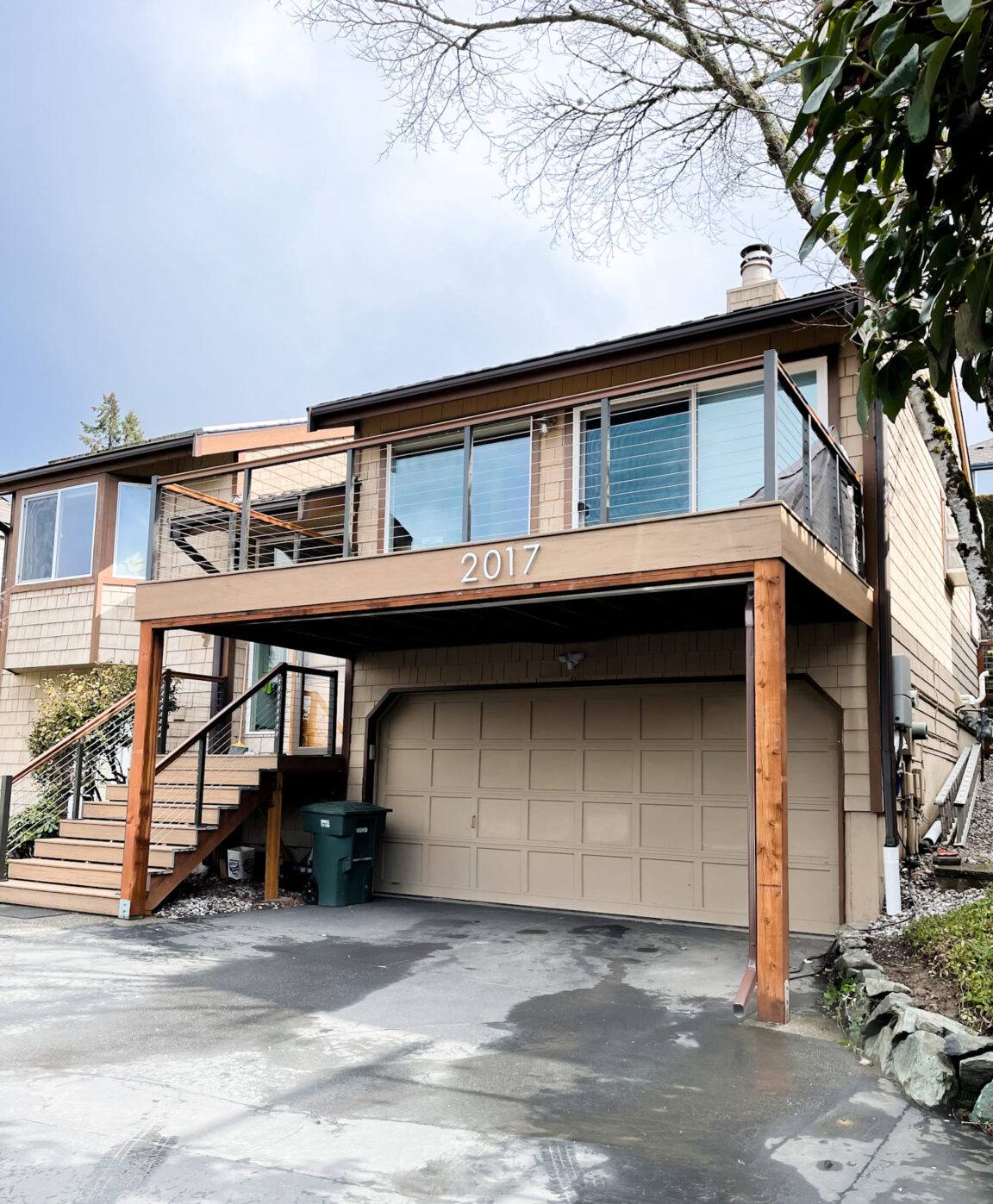
What Whatcom County Weather Actually Does to a Deck
It helps to be specific about the stresses a deck near Custer is under, because it changes what "correct" installation looks like.
- Salt-tinged air: Even homes set back from the water get some salt exposure carried on marine air, which accelerates corrosion on unprotected fasteners and hardware.
- Driving rain: Wind-driven rain doesn't just fall straight down — it gets pushed sideways under railings, into end grain, and behind ledger boards if flashing details are skipped.
- Long moss season: Shaded decks, north-facing decks, and anything under tree cover in this area can stay damp for weeks at a time in fall and winter, which is exactly the environment moss and algae need to take hold.
- Freeze-thaw swings: Whatcom County doesn't get brutal winters, but it gets enough freeze-thaw cycling that trapped moisture in a deck structure can do real damage over several years.
Any one of these on its own is manageable. Together, over a Pacific Northwest winter, they're the reason some decks age gracefully and others don't.
Why This Matters More for Composite Than People Expect
Composite decking resists rot in a way wood can't, which is a real advantage here. But composite boards still expand and contract with temperature and moisture, and the substructure underneath — the joists, ledger, and fasteners — is usually still wood or metal that's just as vulnerable to Custer's climate as any other structure. A composite deck is only as good as what's underneath it and how it was fastened down.
What a Correct Composite Deck Installation Involves
There's a real difference between a deck that's been screwed together to pass a quick look and one that's been built to actually last in this climate. The details that matter most:
Ventilation and Drainage
Composite boards need airflow underneath them. A deck built low to the ground or against a wall without adequate clearance traps moisture, and in a moss-prone climate like ours, that trapped moisture is what feeds surface growth from below as well as above. We build in proper joist spacing and clearance so air can actually move under the deck.
Fastener and Hardware Selection
Given the salt exposure in this area, we use corrosion-resistant, coated fasteners and structural hardware rated for coastal or marine-adjacent environments. Standard hardware that would be fine 50 miles inland can start rusting within a few years out here.
Ledger and Flashing Details
Where a deck attaches to the house, the ledger board and its flashing are the single most common point of hidden water damage. Driving rain finds gaps that don't show up until there's rot behind the siding. This connection gets flashed properly, every time, whether it's visible in the finished look or not.
Board Spacing for Expansion
Composite boards move with temperature more than people expect. Gaps that are too tight can buckle in summer heat; gaps that are too wide look sloppy and catch debris. We follow manufacturer spacing specs adjusted for our local temperature swings.
Composite vs. Wood Decking for a Custer Property
| Factor | Composite Decking | Wood Decking |
|---|---|---|
| Moisture/rot resistance | High — engineered to resist rot even in damp shade | Requires consistent sealing to resist rot |
| Moss and algae growth | Reduced with capped boards, but not immune in heavy shade | More prone to surface growth without regular treatment |
| Maintenance routine | Periodic cleaning, no staining or sealing | Annual or biannual sealing/staining recommended |
| Upfront cost | Higher material cost | Lower material cost |
| Long-term cost | Lower over 15-20 years due to reduced upkeep | Higher over time from repeated maintenance and repairs |
| Appearance consistency | Consistent color/grain, doesn't silver or splinter | Natural look, but weathers and changes over time |
Neither option is wrong — it depends on what a homeowner wants to spend time on. But for a lot of Custer properties, especially shaded or waterfront-adjacent lots where moisture sits longer, composite's reduced maintenance burden is the deciding factor.
Choosing the Right Composite Board for This Climate
Not all composite decking performs the same way here, and this is where honest guidance matters more than brand names.
- Capped composite (a protective outer shell over the composite core) handles moisture and staining better than uncapped composite, which matters in a climate where boards stay damp for extended periods.
- Grooved-edge boards allow hidden fastening for a cleaner look, but the grooves can collect debris and moisture in a shaded, damp yard — worth weighing against solid-edge boards depending on the site.
- Color selection affects heat absorption and how visible surface debris or early moss growth will be. Lighter colors show less dirt buildup; darker colors can run noticeably hotter in direct summer sun.
- Warranty structure varies significantly by manufacturer and by whether the installation meets their specific requirements — we review this with homeowners before they commit to a product line, because a warranty that isn't followed to spec at installation isn't worth much later.
Our Process for a Custer Composite Deck
- On-site assessment: We look at sun exposure, shade patterns, drainage, existing structure condition, and how close the deck sits to the ground.
- Substructure evaluation or rebuild: If the existing frame has any moisture damage or doesn't meet current code and ventilation standards, we address that before a single composite board goes down. Building over a compromised substructure just hides the problem.
- Product selection: We walk through board options and trade-offs based on your specific site conditions, not a one-size-fits-all recommendation.
- Installation: Proper ledger flashing, corrosion-resistant fastening, correct spacing, and ventilation clearance throughout.
- Final walkthrough: We go over basic care so the deck stays looking right through its first few Whatcom County winters.
Living With a Composite Deck in a Moss-Prone Climate
Composite decking is lower-maintenance than wood, but "lower-maintenance" doesn't mean "no maintenance," especially in an area where moss season runs long. A little regular attention keeps a deck looking and performing well for its full service life.
- Sweep off leaves, needles, and organic debris regularly, especially in fall — trapped organic matter is what feeds moss and mildew.
- Rinse the deck surface periodically with a hose to clear pollen, dirt, and early surface growth before it sets in.
- Use a soft-bristle brush and a cleaner made for composite decking on any moss or algae spots rather than a pressure washer at close range, which can damage the board surface.
- Check that gaps between boards and under railings stay clear so water keeps draining as designed.
- Inspect ledger and railing connection points once a year for any signs of moisture intrusion behind the deck.
What Affects the Cost of a Custer Composite Deck
| Cost Factor | Why It Matters |
|---|---|
| Deck size and shape | More linear footage and cuts (angles, curves, multiple levels) increase labor and material |
| Substructure condition | An existing frame that needs repair or rebuilding adds cost before decking installation even starts |
| Board tier and brand | Composite lines range widely in price based on cap technology, warranty length, and color options |
| Railing and fascia choices | Composite or metal railing systems cost more than basic wood but match the low-maintenance goal |
| Site access and grading | Sloped or hard-to-access lots common in this area can affect equipment access and labor time |
We give straightforward, itemized estimates so homeowners can see exactly where the cost is going, rather than a single number with no explanation behind it.
Why It Matters to Hire a Crew That Already Works in Custer
A lot of deck problems we see weren't caused by bad materials — they were caused by installation practices that would work fine somewhere drier and got used here anyway. A crew that regularly works Custer and the greater Blaine area already knows which details can't be skipped: the flashing that has to be right the first time, the fastener grade that actually holds up against salt air, and how much clearance a deck really needs to stay ventilated through a wet winter. That local, repeated experience is what separates a deck that needs attention in five years from one that's still solid in twenty.
If you're planning a new deck or replacing an aging one in Custer, we're happy to walk the site, talk through honest product options for your specific yard, and put together a clear estimate — no pressure, no obligation. Reach out using the form below to get started.