 Blaine Exterior
 Cherry Point's Shoreline Climate Is Hard on Siding
Homes on and around Cherry Point sit close enough to the water to catch a steady dose of marine air, wind-driven rain, and the kind of persistent shade and moisture that keeps moss and algae thriving for most of the year. That combination is tougher on exterior siding than what you'd see on a home a few miles inland in Blaine or elsewhere in Whatcom County. Salt-laden air accelerates corrosion on fasteners and metal trim, driving rain finds its way into any gap or failed joint, and a long moss season means organic growth has months to work into seams, laps, and butt joints before a dry stretch ever shows up to slow it down.
None of that means your siding is doomed — it means repairs on a Cherry Point home have to account for conditions that a generic patch job ignores. A repair that would hold up fine in a drier, more sheltered part of the county can fail here within a season or two if it doesn't address moisture, ventilation, and material compatibility correctly.
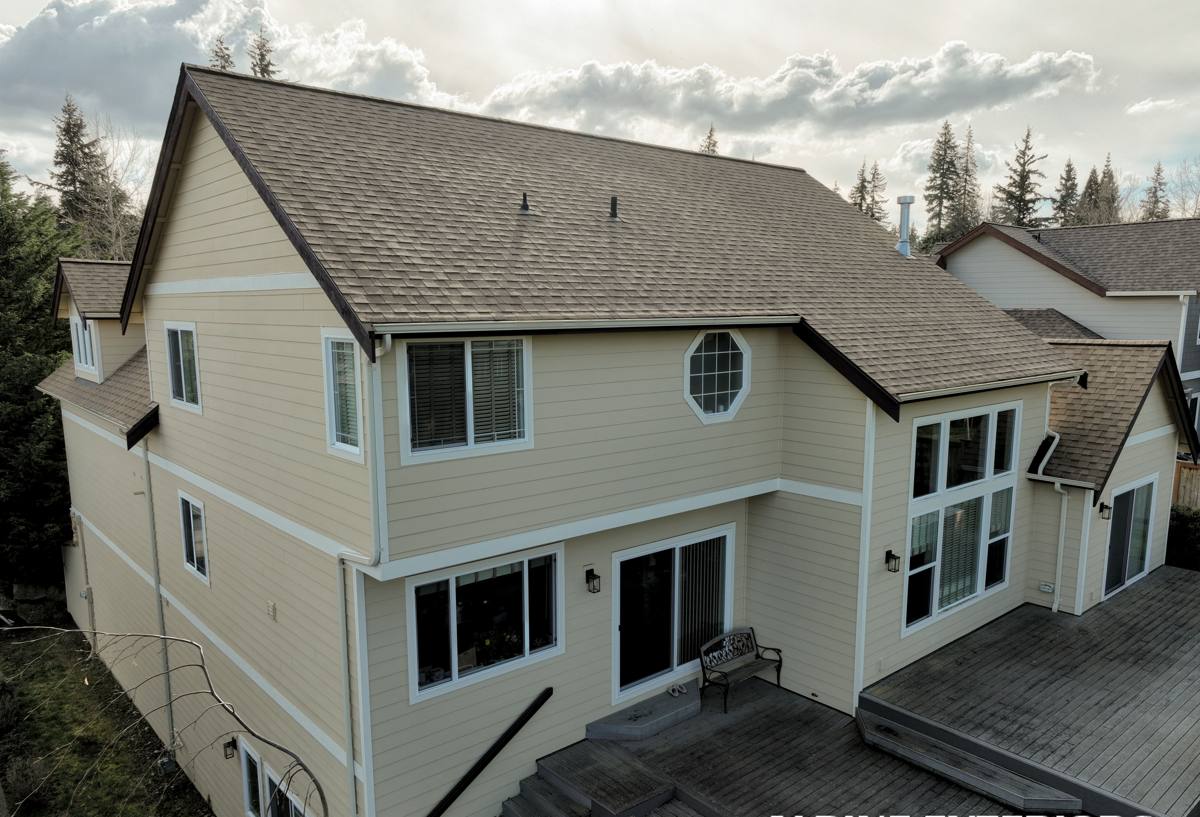
Signs Your Siding Needs Repair, Not Just Paint
A lot of siding problems get masked with a coat of paint or a bead of caulk, which buys a year or two before the underlying issue resurfaces — usually worse. Here's what we look for on an initial walk-around:
- Soft or spongy spots when you press on a board, especially near the bottom courses or around windows and doors
- Hairline cracks radiating out from nail heads or fastener locations
- Paint that's peeling, bubbling, or alligatoring in patches rather than evenly across the wall
- Dark streaking or thick moss and algae buildup concentrated on shaded or north-facing walls
- Visible gaps opening up at butt joints, corner boards, or where siding meets trim
- Boards that look warped, cupped, or slightly bowed away from the wall
- Swelling or crumbling along the bottom edge of siding close to grade or a deck ledger
- A noticeable draft or musty smell near an exterior wall that wasn't there before
Any one of these on its own might be minor. Several showing up in the same area, or the same symptom repeating across multiple walls, usually points to a moisture problem that's bigger than what's visible on the surface.
What a Correct Repair Actually Involves
Beyond the Surface
A proper siding repair doesn't stop at replacing the board you can see. Before anything goes back on the wall, we pull the damaged section and check what's behind it — the house wrap or building paper, the flashing above windows and doors, and the sheathing itself. In a wet climate like this one, damaged siding is often a symptom of a flashing detail or a caulk joint that failed months or years earlier, and if that root cause isn't fixed, the new siding will fail the same way.
Matching the Original Material
Getting the repair to actually match — in profile, exposure, and reveal — matters more than it sounds like it should. Mismatched board width or a slightly different lap exposure is one of the easiest ways to tell a home has had a patch job done, and it can also throw off how water sheds off the wall at that joint. We source materials to match the existing siding's profile as closely as possible, and where an exact match isn't available, we'll walk you through the honest options rather than forcing a mismatch and hoping it blends in.
Repair or Replace? How We Make the Call
Not every damaged section needs a full re-side, and not every home is a good candidate for a spot repair. We look at the whole picture before recommending either path.
| Factor | Favors Repair | Favors Replacement |
|---|---|---|
| Extent of damage | Isolated to one or two sections | Spread across multiple walls or elevations |
| Sheathing condition | Dry, solid wood behind the damage | Soft, delaminated, or water-stained sheathing |
| Siding age and material | Newer material still within its service life | Original siding near or past its expected lifespan |
| Moisture history | One-time cause (impact damage, isolated flashing failure) | Recurring leaks or rot showing up in different spots over time |
| Material availability | Close match available for the existing product | Discontinued profile, color, or product line |
When the underlying sheathing is sound and the damage is contained, a targeted repair is the right call and the more cost-effective one. When we're finding rot in multiple spots, or the existing siding is old enough that a matching product isn't realistically available, we'll tell you that directly instead of patching something that's going to need attention again in another year or two.
Why the Material You Repair With Matters
Not all siding materials hold up the same way once they've been cut into, patched, or exposed to a coastal climate for a repeat repair. This is worth understanding before you decide what goes back on the wall.
| Material | Repair Difficulty | Moisture / Rot Risk | Notes for a Marine Climate |
|---|---|---|---|
| James Hardie fiber cement | Moderate — cut edges need back-priming, but the board itself doesn't absorb water | Low | Non-combustible, holds paint and factory ColorPlus finish well in salt air |
| Solid or engineered wood | Straightforward to cut and fit, but repeat exposure invites rot | High | Needs consistent repainting and caulk maintenance to keep water out |
| Vinyl | Panels often need to be swapped whole rather than patched | Low for the material itself, but seams can trap moisture | UV fading over years makes new panels visibly mismatch old ones; can go brittle in cold snaps |
| OSB-based lap siding (LP-style products) | Cut edges are vulnerable and require careful sealing | High if edges or seams aren't maintained | Edge swelling is the most common repair call we see on this material |
We install James Hardie fiber cement exclusively, which means when a repair calls for new material — whether it's a full panel swap on an existing Hardie installation or a section that's better served by replacement than patching — that's what we're working with. It resists the rot that wood and OSB-based products are prone to in this climate, holds a factory finish without repeat repainting, and its climate-engineered HZ product lines are built for exactly the kind of wet, coastal exposure Cherry Point homes deal with. If your home currently has a different siding material and the damage is beyond a reasonable patch, we'll give you a straight assessment of what replacing that section with Hardie would involve — not a pitch, just the honest trade-off between patching what's there and putting something more durable in its place.
Our Siding Repair Process
- Inspection and diagnosis — we identify not just the visible damage but what caused it, including a check of flashing, caulking, and the sheathing behind affected boards
- Written assessment — you get a clear explanation of what we found, whether repair or replacement makes sense, and why
- Sourcing matching material — we track down the closest match to your existing siding's profile and finish
- Removing damaged sections — carefully, to avoid unnecessary damage to surrounding siding, and to expose the sheathing and weather barrier underneath for inspection
- Repairing or replacing the substrate — any soft sheathing, damaged house wrap, or failed flashing gets addressed before new siding goes back on
- Installing the repair — correct fastener pattern, proper flashing at joints and penetrations, and back-primed or sealed cut edges where the material calls for it
- Cleanup and haul-away — old material and debris removed, site left clean
Repair Mistakes We See Often Around Cherry Point
A few patterns show up again and again when we're called out to look at a previous repair, whether it was DIY or done by someone unfamiliar with this stretch of coastline. The most common is caulking over a problem instead of fixing it — a bead of caulk across a crack or gap might stop water for a season, but it doesn't address whatever let water in to begin with, and it usually traps moisture rather than shedding it. We also regularly find paint applied directly over soft or rotting wood, which hides the damage without slowing it down.
Mismatched patches are another recurring issue, particularly with vinyl — new panels stand out visibly against sun-faded originals, and the seam between old and new can become its own weak point. And on the moss front, we see plenty of cases where someone power-washes the growth off without addressing why it's establishing there in the first place, whether that's overhanging vegetation blocking sun and airflow or a grading issue keeping a wall damp longer than it should be. The moss comes back within a season because the underlying condition never changed.
Why a Crew That Already Works Cherry Point Matters
Siding repair on a home a few miles inland and siding repair on a home exposed to Cherry Point's shoreline conditions aren't the same job, even if the visible damage looks identical. A crew that regularly works this area knows which elevations typically take the brunt of wind-driven rain, how much faster fasteners corrode this close to salt air, and how aggressively moss and algae establish themselves given the tree cover and shade patterns common in this part of Blaine. That local pattern recognition shapes real decisions — which side of the house to inspect more carefully even when the damage is only visible on one wall, what fastener and flashing details actually hold up here versus what's standard practice inland, and how urgently a small issue needs to be addressed before the next wet season makes it worse.
Keeping Repaired Siding Solid Season After Season
Once a repair is done correctly, a little routine maintenance goes a long way toward making sure it stays that way. Rinse siding down at least once a year to keep salt residue and organic buildup from accumulating, especially on shaded walls. Keep gutters clear so water isn't overflowing directly onto siding below. Trim back vegetation that's shading a wall or blocking airflow, since that's often the real driver behind recurring moss growth. And take a walk around the exterior once a year, particularly after the wetter winter months, to catch small issues — a lifted caulk joint, a hairline crack, early moss growth — while they're still a five-minute fix rather than a full repair call.
If you're seeing any of the signs above on your Cherry Point home, or you're just not sure whether what you're looking at is a simple repair or something bigger, we're happy to come take a look. We offer free, no-pressure estimates and will give you an honest read on what your siding actually needs — use the form below to get started.