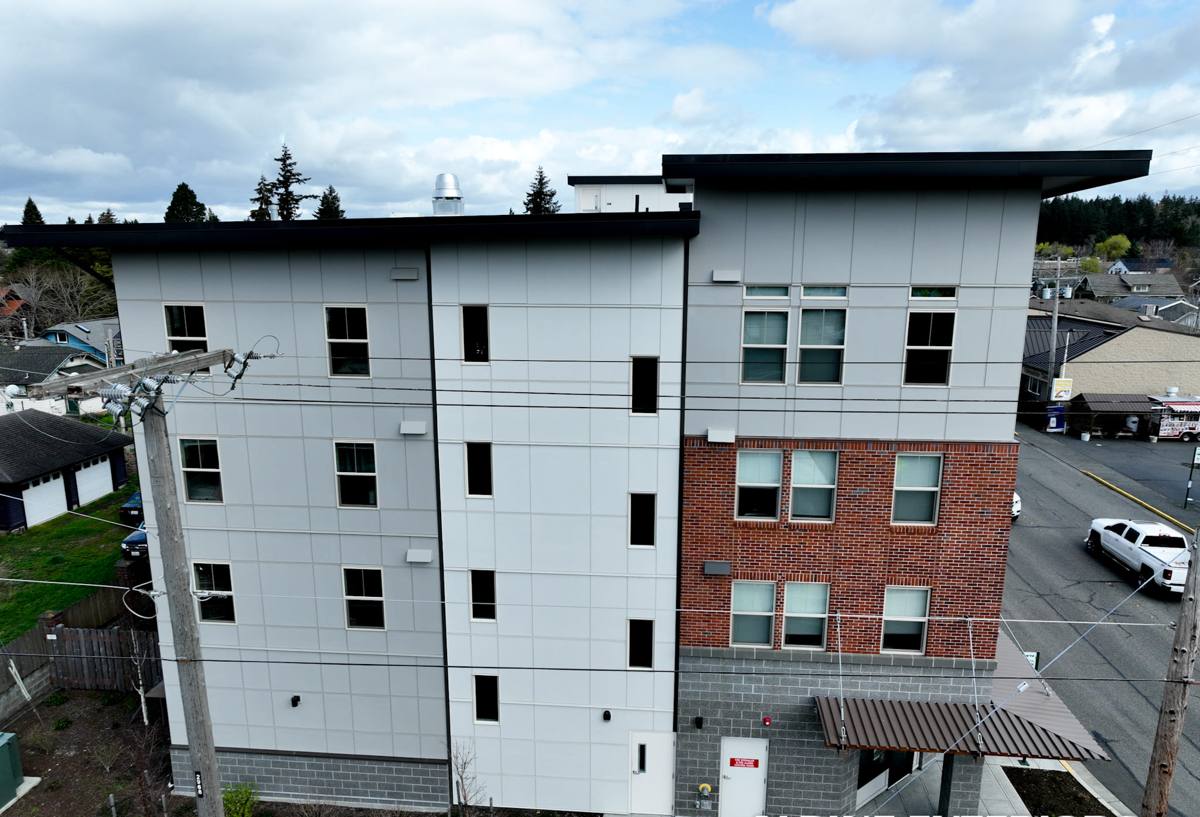
 Blaine Exterior
 Custom Windows in California Creek: Why "Off the Shelf" Doesn't Always Fit
California Creek sits in the rural stretch of Whatcom County just outside Blaine, a mix of older farmhouses, wooded lots, and newer homes spread across land that still feels more agricultural than suburban. It's close enough to the water that salt-laden air off Semiahmoo Bay and Drayton Harbor reaches most properties out here on a regular basis, and it's exposed enough to open country wind that driving rain off winter storms is a real design consideration, not an occasional nuisance. Those conditions matter for every exterior trade, but they matter in a specific way for windows, because a window opening is the single spot in a wall assembly with the most seams, the most moving parts, and the least room for a sloppy fit.
Custom windows come into play more often out here than in a newer subdivision with uniform, factory-standard openings. Older farmhouses settle over decades and go out of square. Additions and outbuildings get framed to whatever dimensions made sense for the project, not to a lumberyard's stock window sizes. Homeowners want a bay window, a picture window, or an arched unit that no standard catalog size will fill. In every one of those situations, a window ordered to a rough opening's actual measurements — not the nearest stock size with shims and extra caulk to make up the difference — is what actually performs long-term in this climate.
What California Creek's Climate Does to Windows
Salt Air and Marine Corrosion
Properties throughout California Creek pick up salt-carrying air off the bay, and that salt content accelerates corrosion on window hardware, fasteners, and any exposed metal trim faster than a dry inland climate would. It's a slower, quieter kind of wear than storm damage, but it's steady — hinges stiffen, lower-grade fasteners pit, and finishes that would hold up fine fifty miles inland start showing their age years early this close to the water.
Driving Rain and Wind Exposure
Open, rural terrain around California Creek doesn't give much wind break, and storms coming off the water push rain sideways into wall assemblies rather than straight down. That wind-driven rain finds its way into any gap a standard installation might leave — a stock-sized window shimmed into an opening it doesn't quite fit, or flashing that wasn't lapped with the actual dimensions of a custom or out-of-square opening in mind. On a custom job, the flashing detail has to be built around the real opening, not a generic one.
A Long Moss and Mildew Season
Mild, damp conditions through fall, winter, and spring give moss and mildew a long growth season across this part of Whatcom County, and window sills, trim, and the framing around older windows are common places it takes hold first. Shaded elevations and window openings tucked under eaves with poor drainage tend to show it earliest. On older California Creek homes, this is often the first visible sign that a window opening needs more than a caulk touch-up.
What Actually Makes a Window Job "Custom"
"Custom" gets used loosely in this trade, so it's worth being specific about what it actually covers on a California Creek property.
Out-of-Square Openings on Older Homes
Farmhouses and older homes throughout California Creek have often settled over decades, and a rough opening that was square when it was framed rarely stays that way. A stock window forced into an opening that's no longer square either won't fit cleanly or gets shimmed unevenly to make it work — and an uneven gap is exactly where flashing and sealing start to fail. A custom unit, built to the opening's actual current dimensions, closes that gap properly.
Additions and New Construction
When a homeowner frames an addition, a bonus room, or an outbuilding, the rough openings get built to fit the design, not to match a catalog size. Custom windows let the framing dictate the opening rather than the other way around, which matters for anyone trying to match an existing roofline, ceiling height, or exterior proportion.
Architectural Shapes and Statement Windows
Bay windows, bow windows, picture windows, and arched or specialty-shaped units all fall outside standard stock sizing by definition. These are popular choices for taking advantage of a rural California Creek lot's views or natural light, but they require more careful structural and flashing planning than a standard double-hung replacement, since they often project from the wall plane or introduce more complex water-shedding geometry.
Partial Replacements and Matching Sightlines
Replacing a few windows on a home while leaving others in place means matching sightlines, sash proportions, and trim profiles to what's already there, especially on older homes where the original windows may no longer be a standard size by today's manufacturing specs. Getting this wrong is subtle from across a room but obvious from the street.
Frame and Glazing Options for Custom Openings
Material choice matters on every window job, but it carries a bit more weight on custom work, since a custom unit is typically a longer lead-time order that's harder to swap out later if the material choice turns out to be wrong for the application.
| Frame Material | Best Fit For | Trade-Offs on Custom Jobs |
|---|---|---|
| Vinyl | Standard and moderately custom sizes, budget-conscious replacements | Most economical; limited in very large custom spans or dark exterior colors due to heat expansion |
| Fiberglass | Larger custom openings, bay/bow assemblies, paintable trim needs | More dimensionally stable across temperature swings; higher material cost |
| Wood-clad | Historic-profile matching, arched or specialty shapes | Best for matching older architectural details; requires more attention to exterior cladding durability in this climate |
Glazing matters just as much as the frame. Double or triple-pane units with a low-E coating perform better in both directions — holding heat in during cold, damp stretches and cutting solar gain in the summer — and they cut down on the interior condensation that older, poorly sealed windows are prone to in this climate. On custom shapes like bays and arches, glazing packages sometimes have to be confirmed unit by unit, since not every manufacturer offers every coating and gas-fill option on every non-standard shape.
Measurement, Ordering, and Lead Times
The single biggest difference between a standard window replacement and a custom one is time. A stock-size window can sometimes be sourced quickly; a window built to a specific rough opening, a non-standard shape, or a matched historic profile has to be manufactured to order, and that can take several weeks to a couple of months depending on the size, shape, and glazing package involved. We measure every opening ourselves before anything is ordered — not off a homeowner's estimate or an old set of plans — because an opening that's even a quarter-inch off on paper can mean a window that doesn't fit cleanly when it finally arrives. On out-of-square older openings especially, we take measurements at multiple points, not just top and bottom, since that's often where the real discrepancy shows up.
Our Process for a Custom Window Project
- On-site assessment: We look at the existing opening, check for square, evaluate the surrounding framing and siding, and talk through what the homeowner actually wants — repair, replacement, or a new architectural feature.
- Precise measurement: Every dimension gets measured directly, including checks for out-of-square conditions on older openings, before any order is placed.
- Manufacturing and lead time: Custom units are ordered to those exact measurements, with a realistic timeline communicated up front rather than an optimistic one.
- Removal and opening prep: The old window or framed opening is removed and the rough opening is corrected or reinforced as needed before the new unit goes in.
- Installation and flashing: The window is set, leveled, and flashed so that water is directed out and away from the opening, tied properly into the surrounding siding and weather-resistive barrier.
- Interior and exterior finish: Trim, sill work, and any siding integration are finished to match the surrounding wall, inside and out.
Mistakes We See on Custom Window Jobs
Most of the problems we get called out to fix on custom or specialty windows in this area trace back to a handful of avoidable issues:
- A stock-size window shimmed into an out-of-square opening instead of a properly sized custom unit
- Flashing installed as if the opening were standard, leaving uneven gaps where wind-driven rain gets in
- Caulk used as a substitute for flashing rather than as a supplement to it
- Bay or bow window framing that wasn't reinforced adequately to carry the added structural load
- Trim and sightlines that don't match the surrounding windows on a partial replacement
- Rushed measurements that lead to a custom unit arriving slightly wrong for the actual opening
Every one of these is preventable with careful measurement and installation discipline up front — they're not inherent risks of custom window work, just the results of treating a custom opening like a standard one.
Why a Local Crew That Already Works California Creek Matters
A contractor who works this part of Whatcom County regularly has already seen how older California Creek homes settle out of square, how far salt air and wind-driven rain reach inland from the bay, and how a bay or picture window needs to be framed and flashed to hold up to that exposure. That familiarity shows up in decisions a homeowner never sees directly — how a flashing detail gets lapped, how much reinforcement a projecting window assembly gets, how carefully an opening is measured before anything is ordered. Those decisions are what separate a custom window that looks and performs right for decades from one that needs attention again within a few wet winters.
Before hiring anyone for custom window work in this area, it's worth confirming a few basics:
- Current Washington contractor licensing and active liability insurance
- A written scope that separates the manufacturer's product warranty from the contractor's installation warranty
- Direct, on-site measurement of the opening before any window is ordered — not measurements taken off old plans
- A clear explanation of how flashing will integrate with the existing siding and wall assembly
- A realistic lead-time estimate for custom-manufactured units, communicated before a deposit is collected
If you're weighing a custom window project on a California Creek property — whether it's replacing an out-of-square opening on an older home, adding a bay window, or matching a specialty shape as part of an addition — we're happy to take a look and talk through what's realistic for your home and budget. Reach out below for a free, no-pressure estimate.