 Blaine Exterior
 Why Siding Wears Out Faster Near Birch Point
Birch Point sits right up against the water on Blaine's shoreline, and that location is exactly what makes siding here behave differently than siding a few miles inland. Salt-laden air off the water accelerates the breakdown of paint film, caulking, and metal fasteners. Wind-driven rain off the Strait doesn't just fall straight down — it gets pushed sideways into laps, corners, and trim joints that were never designed to handle horizontal water pressure. And Whatcom County's long, wet, low-sun stretch from fall through spring keeps exterior walls damp for weeks at a time, which is exactly the environment moss and algae need to take hold and stay there.
None of that is unique to Birch Point in a dramatic way — it's the same climate story across most of Blaine's waterfront and near-waterfront neighborhoods. But it does mean siding decisions that work fine in a drier, more sheltered part of the county can fail early here. A product or installation detail that's marginal inland can become a real problem on a lot with open water exposure.
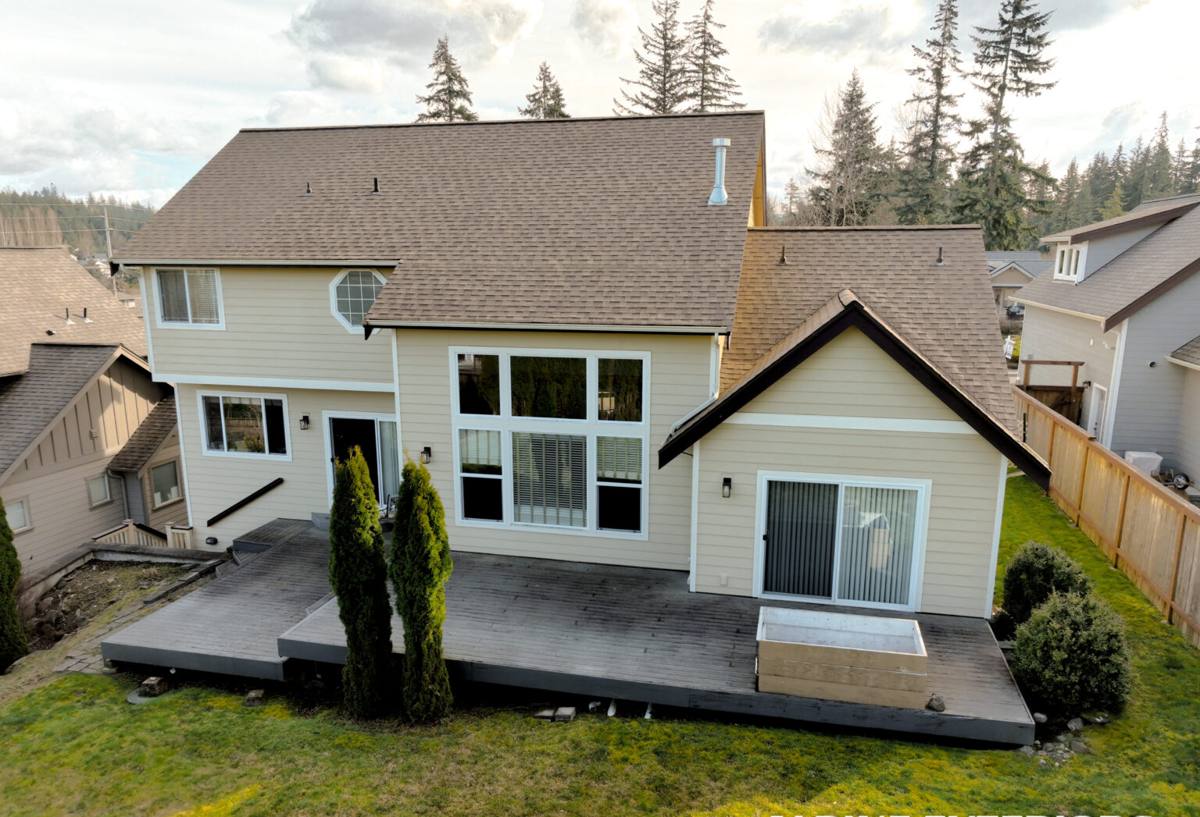
Signs a Birch Point Home Needs Replacement, Not Just Repair
Not every siding issue means a full tear-off. But there's a point where patching individual boards is just delaying an expense that's already locked in. Here's what tells us a home is past the repair stage:
- Boards that feel soft, spongy, or give slightly when pressed near the bottom edge or at butt joints
- Paint that fails again within a year or two of repainting, even after prep work
- Visible swelling, delamination, or edge cracking on wood-based or composite panels
- Moss or black algae streaking that returns within a season of cleaning
- Widening gaps at trim, corners, or butt joints that let daylight or a fingernail through
- Original siding from a build that's several decades old, especially on the water-facing walls
- Musty smell, peeling interior paint, or soft drywall near exterior walls — signs moisture has already gotten past the siding
If you're seeing two or more of these, especially on the sides of the house that catch the most weather off the water, it's worth having someone look at what's underneath before deciding between repair and replacement.
What a Correct Siding Replacement Actually Involves
Siding replacement isn't just swapping old boards for new ones in the same holes. Done right, it's a full reset of the wall's water management system, and that's where most of the long-term performance gets decided.
Tear-off and inspection
Every board comes off down to the sheathing so it can be checked for rot, delamination, or soft spots — problems that are invisible from outside but common on homes that have had water working behind the old siding for years. Any damaged sheathing gets repaired before anything new goes up, because new siding over bad sheathing just hides the problem for a few more years.
Water-resistive barrier and flashing
A correctly lapped weather-resistive barrier and properly integrated flashing at every window, door, and penetration is what actually keeps driving rain out — the siding itself is the second line of defense, not the first. On a wind-exposed lot, this detail matters more than the siding brand you choose.
Fastening and joint treatment
Manufacturer-specified fastener type, spacing, and placement affect how well siding holds up to wind load and how it manages the expansion and contraction that comes with temperature and moisture swings. Joints and seams need to be treated to the product's actual spec, not just caulked and painted over.
Why We Install Only James Hardie Fiber Cement
We don't offer vinyl, LP SmartSide, primed spruce, cedar, or other fiber cement brands as options — we install James Hardie, and only James Hardie. That's not a marketing angle; it's a standard we settled on after weighing what actually holds up long-term in a marine climate like ours against what looks fine for the first few years and then starts costing homeowners money.
Wood-based siding products, even engineered ones, rely on a factory or field-applied coating to keep moisture out of a wood-fiber substrate. In a climate with this much sustained dampness and salt exposure, that coating is under constant stress, and once it's compromised the substrate underneath can swell, delaminate, or rot — problems that are expensive to catch early and worse to catch late. Vinyl doesn't rot, but it's a thin plastic product that can warp, fade, and crack under UV and temperature cycling, and it can't be painted a darker color without risking heat-related warping.
James Hardie fiber cement is non-combustible and doesn't share wood's moisture-driven decay path. Its ColorPlus factory finish is baked on under controlled conditions and holds color and adhesion better than field-applied paint, which matters on a coastline where sun, salt, and rain are all working against a painted surface. Hardie also engineers its products by climate zone — the formulation suited to a high-moisture marine environment like Whatcom County's is different from what's specified for a dry or freeze-heavy region, and installing the right one for our actual weather is part of getting a long-term result. It carries a strong transferable warranty, which matters if the home ever sells.
Choosing the Right Hardie Profile for a Waterfront-Exposed Home
James Hardie isn't a single product — it's a system, and the right combination depends on the house and the exposure.
| Product | Where It Fits |
|---|---|
| HardiePlank lap siding | The standard choice for most Birch Point homes; available in smooth or cedarmill texture |
| HardieShingle | Used as an accent or full-facade look on homes going for a coastal cottage style |
| HardiePanel | Vertical panel option for modern facades or accent walls |
| HardieTrim | Matching trim boards so the whole envelope — not just the field siding — holds up the same way |
Color is worth thinking through too. Darker ColorPlus finishes absorb more heat and show dust or salt residue differently than lighter tones, and on a house that gets direct water-facing exposure, that's a practical consideration as much as an aesthetic one. We'll walk through the current color and profile lineup during your estimate.
What It Costs — And What Actually Drives the Number
Full siding replacement on a typical single-family home in this area generally runs somewhere in the broad range of $14,000 to $35,000 or more, and the spread is wide because the variables genuinely change the job, not just the price.
| Factor | Why It Matters Here |
|---|---|
| Home size and number of stories | More square footage and stories mean more material, labor, and staging/access work |
| What's being removed | Stripping old wood or multiple layers of siding takes longer than a single clean tear-off |
| Sheathing condition once opened up | Homes with years of hidden moisture exposure often need sheathing repair before new siding goes on |
| Trim and window count | Every window, door, and corner adds flashing and trim detail work |
| Profile and color choice | Shingle accents and custom trim packages cost more than a straightforward lap siding job |
| Site access | Waterfront and near-waterfront lots can have tighter staging space, which affects labor time |
We won't know your real number until we've seen the house, but we'll give you a written scope that shows exactly what's driving the cost — not just a lump sum.
Our Process on a Birch Point Project
- Walk-around assessment, checking water-facing walls, trim, and any areas already showing soft spots or moisture staining
- Written scope and product selection, including profile, color, and any sheathing repair we expect to find
- Site protection — landscaping, decking, and any waterfront features get covered before tear-off starts
- Tear-off, sheathing inspection and repair, then correct WRB and flashing installation
- Hardie installation to manufacturer fastening and joint spec
- Full cleanup and a final walkthrough before we call it done
Why It Matters to Hire a Crew That Already Works This Area
A crew that's already worked Birch Point and the surrounding Blaine waterfront knows which walls take the worst of the weather before they even start the assessment, and they've already seen how the local moisture and salt exposure shows up on siding that was installed without those details accounted for. That's not something you get from a crew that mostly works inland and treats every job the same regardless of exposure. Local experience also means fewer surprises with Whatcom County permitting and a crew that's accountable to a reputation in a community where word gets around.
If your siding is showing its age or you're just trying to get ahead of a problem before it becomes a bigger one, we're happy to come take a look. The estimate is free, there's no pressure, and you'll get a straight answer about whether you're looking at repair or replacement.