 Blaine Exterior
 Building Decks for the Peace Arch Climate
Homes near Peace Arch sit close enough to the water and the border that the weather patterns are their own animal. Salt-laden air drifts in off the strait, driving rain comes in sideways for months at a stretch, and the shaded, damp stretch of late fall through early spring turns any horizontal wood surface into a moss farm. A deck built for a drier inland town, or built without this specific climate in mind, will show its age here faster than the homeowner expects — soft spots, green film, fastener corrosion, and boards that cup or crown within a few seasons.
Composite decking, installed correctly, holds up well against all of that. But "installed correctly" is doing a lot of work in that sentence. The material only performs as well as the substructure, drainage plan, and fastening system underneath it. This page is about what that actually looks like for a Peace Arch property, not composite decking in general.
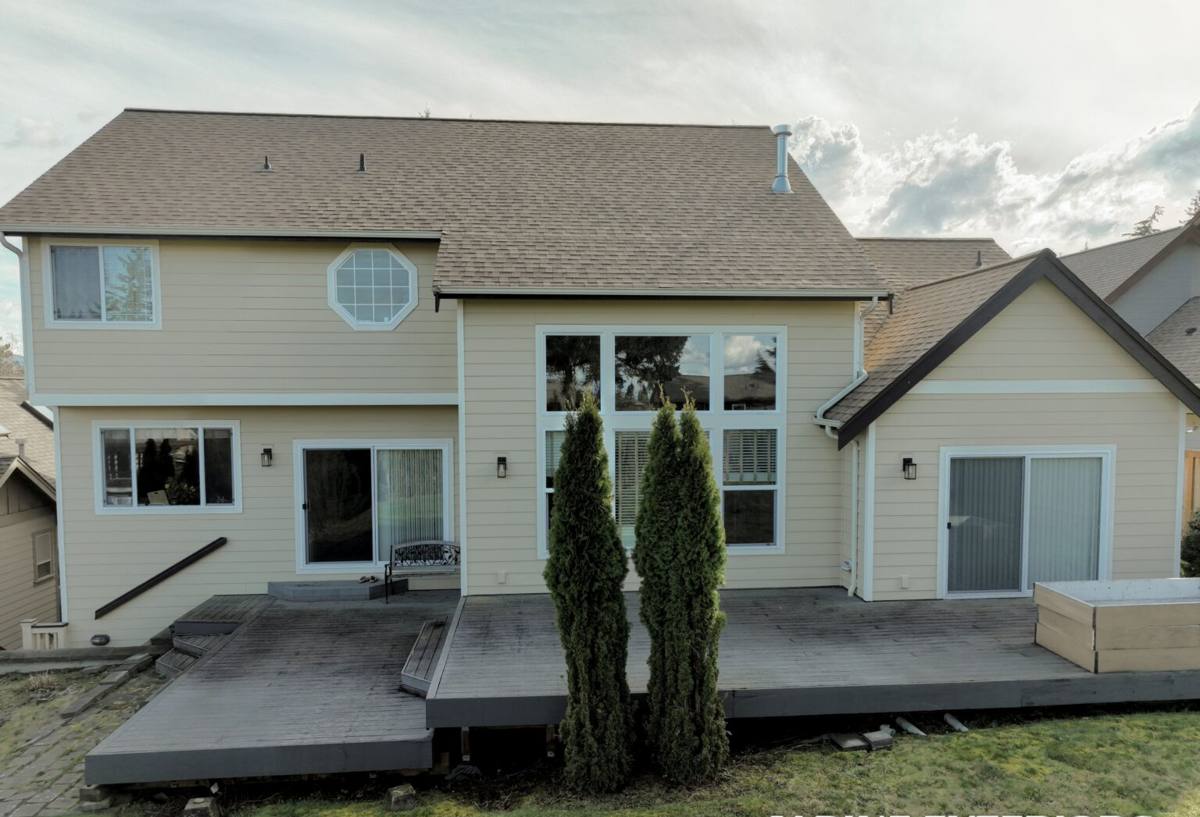
What Peace Arch Homes Actually Need From a Deck
Before we talk about boards, it helps to name the specific stresses a deck in this neighborhood has to survive year after year:
- Constant low-grade salt exposure that accelerates corrosion on any exposed metal fastener or bracket
- Long stretches of saturated ground and elevated humidity that keep framing members from ever fully drying out
- Shaded or north-facing sections that stay damp long after the rest of the yard has dried, ideal conditions for moss and algae
- Heavy seasonal rain volume that overwhelms decks without real drainage planning underneath the boards
- Wind-driven rain that gets pushed sideways into ledger connections and rim joists if flashing is done poorly
None of these are exotic problems. They're the ordinary conditions of living in this part of Whatcom County. A deck built with a generic approach — the kind that would be fine in a dry climate — tends to fail here in specific, predictable ways: fastener bleed stains, a slick green surface every winter, and soft or delaminating framing under boards that still look fine on top.
Why "the boards look fine" isn't the same as "the deck is fine"
Composite decking is marketed on the fact that the surface won't rot, splinter, or need staining. That's true, and it's a real advantage over wood. But the surface boards are only one layer of the system. The framing underneath — joists, beams, posts, and the ledger connection to the house — is still almost always dimensional lumber, and that lumber is exactly as vulnerable to Pacific Northwest moisture as it's ever been. A composite deck built on a poorly protected substructure just hides the problem longer, which is worse in some ways, because nobody notices until there's a soft spot underfoot.
The Parts of the Job That Actually Determine Lifespan
Ledger flashing and the house connection
The single most common source of hidden rot on decks in wet coastal climates is a poorly flashed ledger board — the point where the deck attaches to the house. Water that gets behind the ledger has nowhere to go and nowhere to dry, and it will sit against the house framing for months at a time in a climate like this one. We flash this connection with proper step flashing and self-adhering waterproof membrane, not just caulk, because caulk is a maintenance item and flashing is a permanent detail.
Joist protection
Every joist top gets a waterproof joist tape barrier before boards go down. This one detail is cheap relative to the whole project and it's the difference between framing that lasts 10 years and framing that lasts 25+ in a climate that stays damp as long as this one does.
Fasteners and hardware
Salt air corrodes standard hardware faster than most homeowners expect. We use stainless steel or coated fasteners and structural hardware rated for coastal exposure throughout the frame — not just at the ledger. It costs a little more up front and it's not optional for a job we're willing to put our name on this close to the water.
Airflow and clearance underneath
A deck built low to wet ground, or without cross-ventilation underneath, traps moisture against the framing and never lets it dry between storms. We plan minimum clearance and airflow paths under every deck we build here, adjusting the substructure design when grading or slope makes that harder to achieve.
Composite vs. Other Decking Materials for This Climate
| Factor | Composite Decking | Pressure-Treated Wood | PVC / Vinyl Decking |
|---|---|---|---|
| Moss and algae resistance (top surface) | Good, especially capped boards | Poor without regular treatment | Good |
| Maintenance routine | Periodic wash, no staining or sealing | Annual cleaning, staining, and sealing | Periodic wash |
| Salt air / corrosion tolerance | High for the board itself; hardware still matters | Moderate; fasteners corrode faster | High |
| Feel and appearance | Wood-look grain, wide color range | Natural wood, needs upkeep to look good | More uniform, plastic appearance |
| Typical upfront cost | Mid to upper range | Lowest | Highest |
| Long-term cost over 20 years | Low, due to minimal upkeep | Higher once labor and materials for upkeep are counted | Low |
We install composite because, for most homeowners in this area, it's the right balance: it handles the moss-and-moisture cycle far better than untreated or under-maintained wood, and it costs less than full PVC systems while still giving a warm, wood-like appearance that a lot of Peace Arch homeowners want. We're not going to tell you composite is the only right answer for every home — if a homeowner wants traditional wood and understands the annual upkeep that comes with it here, we'll build that well too. What we won't do is cut corners on the substructure just because the surface material is low-maintenance.
Board Selection: Capped vs. Uncapped Composite
Not all composite boards are built the same, and the difference matters more in this climate than in a dry one.
- Capped composite has a plastic shell wrapped around a wood-plastic composite core. This shell is what actually resists moisture absorption, staining, and surface mold. In a climate with this much sustained dampness, we recommend capped boards on every side that will see weather.
- Uncapped composite is the older-style, all-around blended material. It's more affordable but absorbs more moisture over time and is more prone to surface graying and mildew in shaded, wet spots — exactly the spots common on Peace Arch lots with tree cover or north-facing exposure.
We'll walk through specific board lines and finishes during the estimate, matched to your home's sun exposure, shade pattern, and budget — not a one-size answer.
Our Process, Start to Finish
- On-site assessment — we look at drainage, slope, sun/shade exposure, existing structure condition, and how the deck ties into the house before we talk products.
- Design and material selection — board style, color, and railing system chosen to match the home and the site conditions, with substructure specified for this climate specifically.
- Demolition and structural inspection — if replacing an existing deck, we check ledger, posts, and footings for hidden moisture damage before building over them.
- Framing with coastal-rated hardware — ledger flashing, joist tape, stainless or coated fasteners, and proper ventilation clearance built in from the start.
- Decking and railing installation — boards fastened per manufacturer spec to preserve warranty coverage, with attention to drainage gaps and expansion spacing.
- Final walkthrough — we go over the finished deck and a simple maintenance routine suited to this climate before we consider the job done.
Maintenance That Actually Matters Here
Composite decking is low-maintenance, not no-maintenance, especially with the moss season this area gets. A short, honest checklist:
- Sweep or blow off leaves and debris regularly in fall — trapped organic matter is what feeds moss and mildew on any decking surface
- Wash the deck with a soft-bristle brush and mild soap and water once or twice a year, more often on shaded sections
- Avoid pressure washing at close range or high PSI, which can damage the surface texture or capping on composite boards
- Check gaps between boards periodically to make sure debris hasn't built up and blocked drainage
- Keep gutters and downspouts near the deck clear so runoff isn't dumping directly onto or under the structure
- Inspect railing posts and ledger area yearly for any sign of movement, staining, or soft wood
Why Local Experience With Peace Arch Homes Matters
A lot of decking problems we get called out to fix weren't caused by bad materials — they were caused by a build plan that would have worked fine somewhere drier. Flashing details that get skipped, hardware that isn't rated for salt exposure, framing that never gets a chance to dry out between storms — these are climate-specific mistakes, and they don't show up on day one. They show up in year three or four, as soft framing under boards that still look brand new.
Working regularly in Blaine and the Peace Arch area means we're not guessing at how this specific stretch of Whatcom County weather behaves on a deck over time. We've seen which details hold up and which ones don't, and we build to the conditions that are actually here rather than a generic spec sheet.
Get a Straightforward Estimate
If you're planning a new composite deck or replacing one that's showing its age, we're happy to take a look and give you a clear, honest estimate — no pressure, no upsell on features you don't need. Use the form below to request a free estimate for your Peace Arch property.