 Blaine Exterior
 Why Siding in the Nooksack Area Fails Differently Than It Does Inland
Homes around Nooksack sit in a part of Whatcom County that gets hit from two directions at once. There's the marine influence coming off the Strait of Georgia and Puget Sound — salt-laden air that corrodes fasteners, trim, and anything with exposed wood grain — and there's the sheer volume of rain that Western Washington's shoulder seasons bring, often driven sideways by wind instead of falling straight down. Add a long, damp moss season that can run from late fall through spring, and you have three separate stressors working on the same wall assembly year-round.
Most siding doesn't fail all at once. It fails at the seams — literally. Caulk joints open up, end cuts that were never properly sealed start wicking moisture, and moss gets a foothold in shaded, north-facing sections where siding rarely dries out completely between storms. By the time a homeowner notices a soft spot or a stain bleeding through paint, the damage has usually been building for a season or two already. Siding repair in this area isn't about patching cosmetic issues — it's about catching moisture intrusion before it reaches the sheathing and framing behind the cladding.
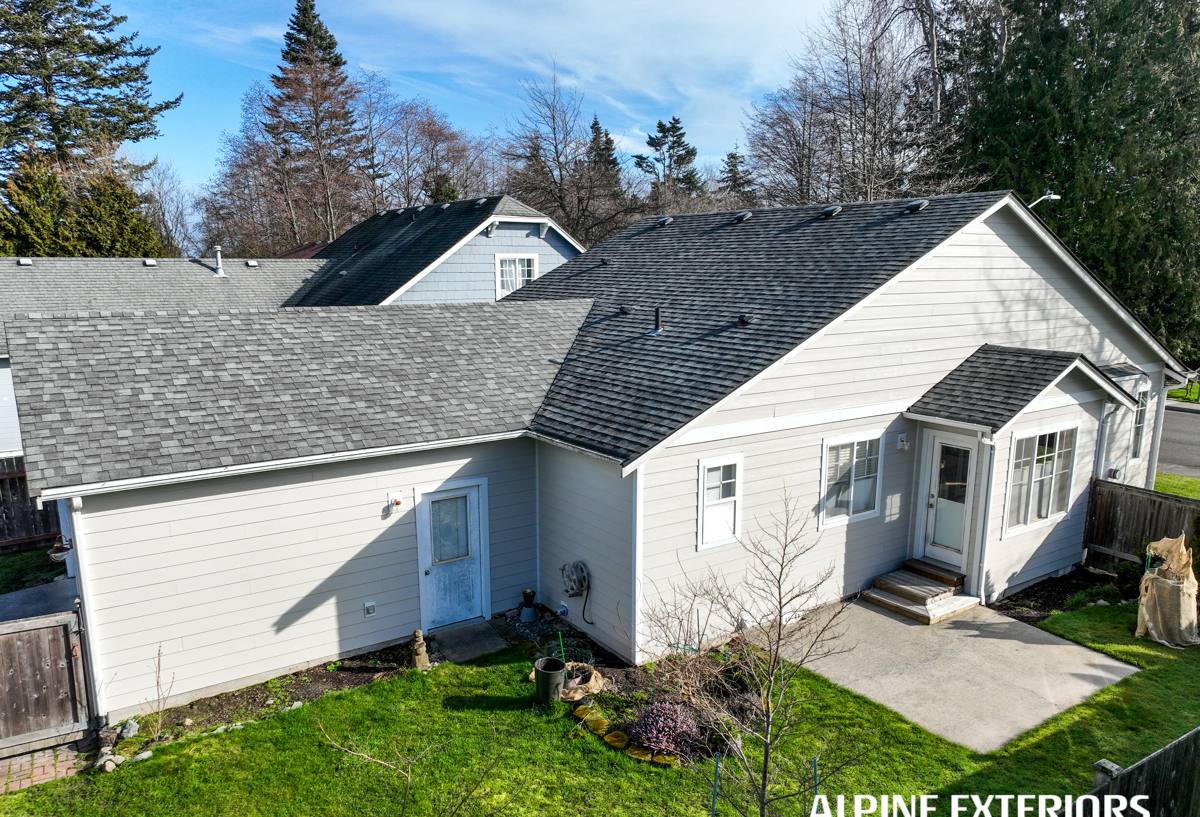
Common Repair Calls We See in This Area
Every repair job is different, but in the Nooksack area a handful of problems show up again and again:
- Moss and algae staining on shaded walls and lower courses that stay damp longer than sun-exposed sides of the house
- Caulk failure at butt joints and trim, especially on older siding where the original sealant has hardened and cracked
- Soft or delaminating panels where wood-based siding has absorbed water over multiple wet seasons
- Rusted or popped fasteners from salt-air corrosion, which leave small gaps that let water track behind the siding
- Impact damage from wind-driven debris during winter storms
- Buckled or warped sections where poor original installation didn't leave room for expansion and contraction
None of these are unusual for the region — they're the predictable result of the climate doing what it does. The question isn't whether a home here will need siding repair at some point, it's whether the repair gets caught early or waits until it becomes a bigger job.
How to Tell If You Need a Repair, Not a Full Replacement
Homeowners often assume any siding problem means a full re-side, but that's rarely true if the issue is caught in time. A proper inspection looks at both the surface damage and what's happening underneath it.
Signs a targeted repair will solve the problem
Localized staining, isolated cracked or split boards, a few areas of failed caulking, or damage confined to one wall or elevation usually point to a repair. If the sheathing behind the affected area is still dry and sound, replacing the damaged sections and correcting the underlying cause — bad flashing, a missing kick-out, an unsealed joint — is usually enough.
Signs the damage has gone further
Soft, spongy siding across multiple courses, a musty smell near an exterior wall, visible sheathing rot when a board is pulled, or repeated failure in the same spot after previous patch jobs are signs that water has been getting behind the siding for a while. In those cases, a small patch just covers the problem instead of fixing it — the honest answer is a larger repair or a full replacement of that section down to the framing.
We tell people the truth about which category their home falls into. A repair that's done right — including finding and fixing why the damage happened in the first place — should hold up. A patch that ignores the cause won't.
What a Correct Siding Repair Actually Involves
A repair that just swaps a damaged board for a new one and re-caulks the edges is treating the symptom, not the cause. Done correctly, siding repair in a wet, salt-exposed climate like this one involves several steps most homeowners never see:
- Diagnosis first. We remove enough siding to see what's actually happening behind it — flashing condition, house wrap integrity, sheathing moisture — before deciding on a repair plan.
- Address the cause, not just the symptom. If a missing or misdirected flashing detail let water in, that gets corrected as part of the repair, not left in place under new siding.
- Let framing and sheathing dry before closing the wall back up. Sealing moisture into a wall assembly guarantees the same failure comes back.
- Match materials and profile correctly. Repaired sections need to tie into the existing siding without creating a new seam that's just as vulnerable as the one that failed.
- Reseal and finish to the same standard as new installation — correct fastener type, correct joint treatment, correct paint or factory-finish match.
Skipping any of these steps is how a five-hundred-dollar repair turns into a five-thousand-dollar one two winters later.
Repair vs. Replace: How We Make the Call
| Factor | Points Toward Repair | Points Toward Replacement |
|---|---|---|
| Extent of damage | Isolated to one area or elevation | Spread across multiple walls |
| Sheathing condition | Dry, sound, no rot | Soft, discolored, or rotted |
| Age of existing siding | Newer, otherwise in good condition | At or near end of expected service life |
| Material | Fiber cement or sound original material | Wood-based product with widespread moisture history |
| History of repeat problems | First occurrence | Same area has failed before |
This is a judgment call we make on-site, not over the phone — and we'll say plainly if a repair is the right call, even when a full re-side would be the bigger job for us.
Our Process for a Nooksack-Area Repair
Repair work follows the same care as a full installation, just scoped to the affected area:
- On-site assessment — we look at the exterior damage and open up enough of the wall to check what's behind it
- Written scope and estimate — what's being repaired, why, and what it will cost, before any work starts
- Removal of damaged material — including anything compromised by moisture, not just what's visibly cracked or stained
- Correction of the underlying cause — flashing, sealant, drainage plane, or fastening issue
- Dry-in and repair of house wrap or weather barrier where it was disturbed
- Reinstallation with matched or upgraded siding, fastened and finished to manufacturer spec
- Final walkthrough so you can see exactly what was fixed and why
Why We Repair — and Replace — With James Hardie Fiber Cement
When a repair calls for new siding sections, we use James Hardie fiber cement, not a wood-based or vinyl match. This isn't about brand loyalty — it's about what actually holds up against salt air and prolonged wet weather. Fiber cement doesn't absorb water the way wood-based products do, doesn't support rot the way wood substrates can, and won't warp or buckle from moisture cycling the way vinyl can in temperature swings. James Hardie's HZ product lines are engineered specifically for climates like this one, and the factory-applied ColorPlus finish resists the fading and moss-friendly surface texture that bare-primed or field-painted products develop over time.
We don't install LP SmartSide, vinyl, Cemplank, Allura, primed spruce, or cedar siding — on repairs or full installs. Each of those has legitimate uses, but for the moisture load this region sees, we've made fiber cement our standard, and James Hardie specifically because of its warranty structure, factory finish consistency, and long track record in wet coastal climates. If your existing siding is one of these other materials, a Hardie-matched repair may mean a slightly different look at the transition — we'll walk you through the options honestly rather than pretend it's an invisible match.
What Happens If Repairs Get Put Off
Deferred siding repair is one of the more expensive mistakes a homeowner can make in this climate, mainly because the damage is invisible until it isn't. A small gap at a butt joint doesn't just sit there — every rain event pushes a little more moisture behind the siding, and every dry spell isn't long enough here to fully dry it back out. Over a season or two, that turns into:
- Sheathing that has to be replaced, not just the siding covering it
- Insulation that's lost its effectiveness from sustained moisture exposure
- Interior drywall or trim damage if water tracks far enough
- Mold growth inside the wall cavity, which is a separate and more costly problem to remediate
- A repair scope that's grown from one wall section to a much larger area
Catching problems during the early staining or caulk-failure stage is dramatically cheaper than waiting until a board is soft to the touch.
What to Ask Before Hiring a Siding Repair Crew
A lot of repair work in this region gets done by general handymen or painters rather than siding specialists, and it shows up as recurring callbacks. Before hiring anyone for a repair, it's worth asking:
- Will you open the wall to check for hidden moisture damage, or just replace what's visibly damaged?
- What's causing this specific failure, and how does the repair address that cause?
- What siding material will you use for the repair, and why?
- Do you carry manufacturer certification for the product you're installing?
- Will the repaired area be covered under a warranty, and for how long?
- Have you worked on homes in this area before, and do you understand the local moisture and moss conditions?
A contractor who can't answer the first two questions clearly is likely to hand you back a cosmetic fix rather than a real repair.
Why Local Experience in This Climate Matters
Whatcom County's coastal edge doesn't behave like siding-repair conditions in drier parts of the state, and it doesn't behave uniformly even within a few miles — shaded, wind-sheltered walls near tree lines hold moss and moisture differently than open, wind-exposed elevations. A crew that regularly works siding repairs around Blaine and the Nooksack area has already seen how local wind patterns drive rain into specific wall orientations, which elevations moss colonizes first, and where salt-air corrosion tends to hit fasteners hardest. That pattern recognition is what separates a repair that solves the problem from one that just moves it a few feet over.
It also means we're not guessing at what "normal" looks like for a home in this area versus what's an actual warning sign. That judgment call — repair versus replace, patch versus rebuild the wall assembly — is easier to get right with local, repeat experience behind it.
If you're seeing staining, soft spots, cracked caulk, or moss buildup on your siding, we're happy to take a look and give you a straight answer about what it needs. Reach out for a free, no-pressure estimate — we'll tell you honestly whether it's a repair or something bigger.