 Blaine Exterior
 Why Siding Takes More Abuse in Lynden Than It Looks Like It Should
Lynden sits inland from the coast, but it doesn't sit outside Whatcom County's weather. The same marine air that rolls off the Strait and up through Blaine still reaches Lynden's farmland and neighborhoods, and it brings the same three problems: near-constant moisture, salt-tinged air that speeds up corrosion on fasteners and trim, and long stretches of shade and damp that keep siding wet longer than most homeowners realize. None of this is dramatic. It's slow. Siding doesn't fail in Lynden because of one big storm — it fails because it stays wet for months at a time, year after year, and whatever's underneath it never fully dries out.
Moisture From Two Directions
Driving rain in this part of Washington doesn't just fall — it's pushed sideways by wind, which means it hits walls, not just roofs. Siding that isn't detailed correctly at the seams, laps, and penetrations lets that water track behind the cladding instead of shedding off the face. Add the ground moisture typical of low-lying Whatcom County properties, and a home can be fighting water pressure from two directions at once: wind-driven rain from outside, and rising damp or poor drainage from below.
Moss Season and What It Does to Siding
The long wet season here isn't just a rain problem — it's a moss and algae problem. Anything organic-based or lightly sealed will host moss growth on north-facing walls and shaded elevations for a good part of the year. Moss holds moisture against the surface it's growing on, which is exactly the wrong thing to have happening to a wall system for months at a stretch. Siding that can't tolerate sitting damp under a layer of moss without swelling, softening, or losing its finish is going to show it within a handful of years, not decades.
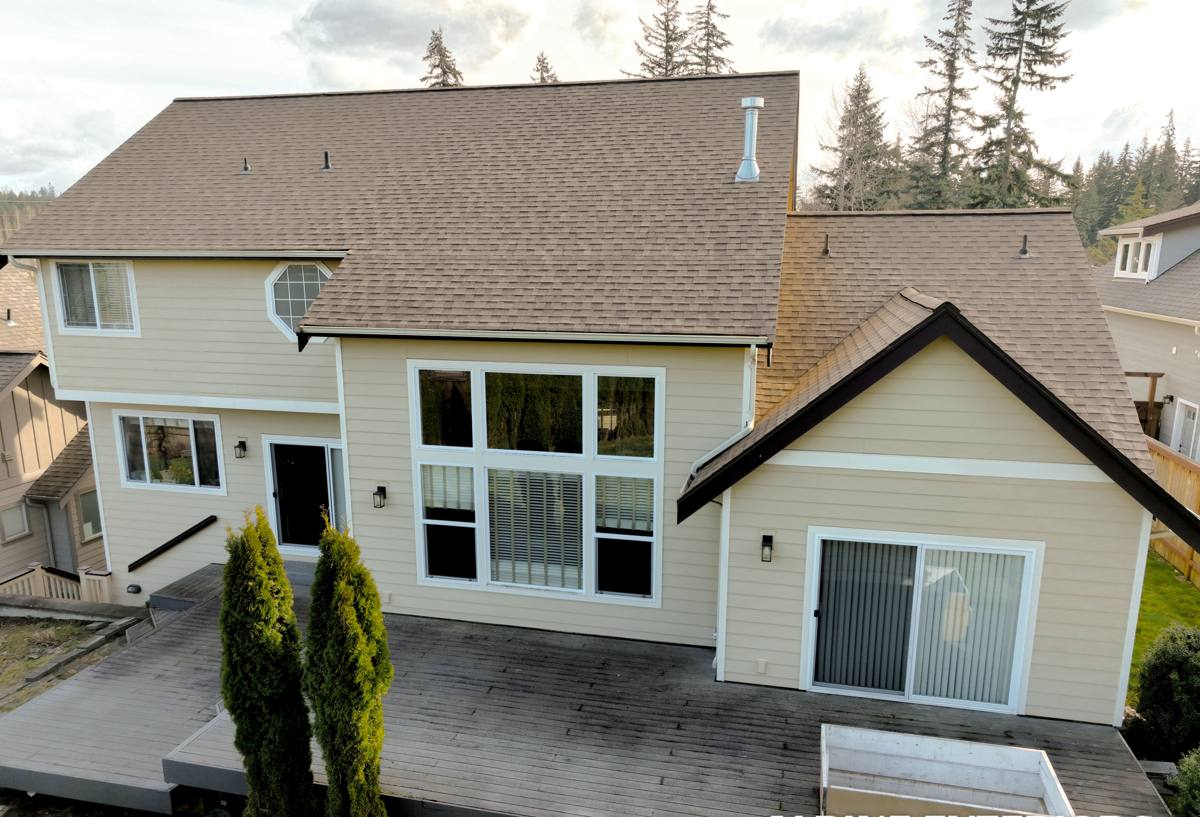
Why We Standardized on James Hardie for Homes Like These
We install James Hardie fiber cement siding exclusively. We don't install vinyl, LP SmartSide, Cemplank, Allura, or unfinished wood siding like primed spruce or cedar. That's not a marketing position — it's a decision based on what actually holds up in Whatcom County conditions over the long run.
Fiber cement is non-combustible and dimensionally stable, meaning it doesn't expand and contract with moisture the way wood-based products do. That matters directly in a climate where siding is wet more often than it's dry. James Hardie's ColorPlus factory-applied finish is baked on under controlled conditions rather than field-applied, which gives it better adhesion and UV resistance than most site-painted products — and it holds color and sheds mildew better than primed wood siding that depends on a homeowner's repainting schedule to stay protected.
We're not going to tell you every other product on the market is worthless. LP SmartSide has real advantages in cost and weight. Cedar has an appearance a lot of people love. Vinyl is inexpensive and low-maintenance in dry climates. But every one of those products asks a homeowner to accept a trade-off — recoating schedules, moisture sensitivity at seams, impact damage, or fading — that we don't think makes sense to ask a Lynden homeowner to live with, given what this climate does to a wall over ten or twenty years.
The James Hardie Lines That Make Sense for This Area
James Hardie engineers its products by climate zone, and homes here fall into the HZ5 category — the zone built for regions with sustained moisture exposure and freeze-thaw cycling. That affects which specific products and installation details we spec on a Lynden job.
| Product | Best Use | Why It Fits Here |
|---|---|---|
| HardiePlank Lap Siding | Primary wall cladding | Most common choice; horizontal laps shed wind-driven rain effectively when installed with correct overlap |
| HardiePanel Vertical Siding | Accent walls, gables, modern facades | Fewer horizontal joints means fewer water entry points on exposed elevations |
| HardieShingle Siding | Accent sections, gable ends | Gives a cedar-shake look without the moisture and moss vulnerability of real wood shingles |
| HardieTrim Boards | Corners, fascia, window/door trim | Matches the wall system's moisture behavior so trim and field siding age together |
The color coat matters as much as the product line. ColorPlus finishes are formulated to resist the fading and mildew staining that shaded, damp walls are prone to — which is exactly the exposure profile on the north and west sides of most Lynden lots.
What a Correct Installation Actually Involves
James Hardie siding is only as good as the wall assembly behind it. A huge share of the siding failures we get called out to inspect in this area aren't material failures at all — they're installation shortcuts that let water get behind a perfectly good product.
Water Management Comes First
Before a single piece of siding goes up, the wall needs a continuous weather-resistive barrier, correctly lapped house wrap or building paper, and properly integrated flashing at every window, door, and penetration. A rain-screen gap — a small air space between the wall and the siding — is what actually lets incidental moisture drain and the wall dry out between storms. Skipping this step is the single most common shortcut we see, and it's invisible once the siding is up.
Fastening, Clearances, and Joint Treatment
James Hardie publishes specific fastener patterns, minimum clearances from grade, roofing, and decks, and joint-treatment requirements for a reason: get any of them wrong and you create a spot where water collects instead of sheds. Correct ground clearance alone prevents a huge share of the rot and moss buildup we see at the base of walls in this region. Butt joints need to be caulked and painted, or shadow-lined per spec — left bare, they become one of the first places moss and algae take hold.
Cutting and Fastener Corrosion
Fiber cement dust needs to be controlled during cutting, and every fastener used has to be corrosion-resistant enough for the marine-influenced air moving through this part of Whatcom County. Standard fasteners that would be fine in a drier inland climate can start showing rust streaks within a few years out here.
Our Process, Start to Finish
- Walk-through and assessment — we look at existing siding condition, moisture damage, ventilation, and trim, not just square footage.
- Written estimate — product lines, colors, and scope specified in writing, no vague allowances.
- Tear-off and wall inspection — sheathing and framing get checked once old siding is off, before anything new goes on.
- Weather barrier and flashing — house wrap, flashing, and rain-screen furring installed and inspected before siding starts.
- Siding installation — installed to James Hardie's published fastening, clearance, and joint specifications.
- Trim, caulking, and paint touch-up — all joints and cut edges sealed and finished.
- Final walk-through — we go over the finished job with the homeowner before calling it done.
Mistakes We Commonly Find on Older Siding in This Area
- Siding installed tight to the ground or driveway grade with no clearance, trapping moisture at the bottom course
- Butt joints left uncaulked or unpainted, becoming a starting point for moss and staining
- Missing or poorly lapped flashing above windows and doors, leading to hidden rot behind the siding
- No rain-screen gap, so the wall assembly never fully dries between wet spells
- Fasteners that have corroded and streaked the finish, especially on walls facing prevailing weather
Maintaining James Hardie Siding in This Climate
Fiber cement asks for far less upkeep than wood siding, but "low-maintenance" doesn't mean "no-maintenance," especially with a moss season this long. A simple annual routine keeps a Hardie installation looking and performing the way it's supposed to for decades.
- Rinse siding once or twice a year, focusing on shaded north- and west-facing walls where moss and algae collect
- Check and clear gutters before the wet season so overflow doesn't run down the siding face
- Trim back landscaping and tree limbs that keep a wall section shaded and damp
- Inspect caulking at trim and joints every couple of years and touch up as needed
- Watch for any staining or discoloration near ground level, which usually points to a clearance or drainage issue worth having looked at
What Drives Cost on a Lynden Siding Project
| Factor | Why It Moves the Price |
|---|---|
| Tear-off scope | Removing and disposing of existing siding down to the sheathing adds labor versus installing over a clean substrate |
| Sheathing repair | Hidden rot found once old siding is off has to be repaired before new siding can go on |
| Product line mix | Combining lap siding with panel or shingle accents adds detail work compared to a single product throughout |
| Trim and detail work | Homes with more corners, windows, and rooflines require more precise cutting and flashing |
| Color and finish | Standard ColorPlus colors versus custom field-applied paint affect both cost and long-term durability |
Why It Matters That We Already Work in This Area
A crew that already installs siding around Lynden and greater Whatcom County isn't guessing at how much clearance a wall needs or which elevations take the worst of the weather — they've already seen it fail, and seen it done right, on homes with the same exposure. That local pattern recognition is what catches a flashing detail or drainage problem before it's built into a wall for the next twenty years, rather than after the homeowner notices staining or soft trim.
If you're weighing a siding replacement or new-construction siding decision in Lynden, we're happy to walk the property, look at what's there now, and put together a straightforward, no-pressure estimate — no obligation, just a clear look at what the job actually involves. Use the form below to get started.