 Blaine Exterior
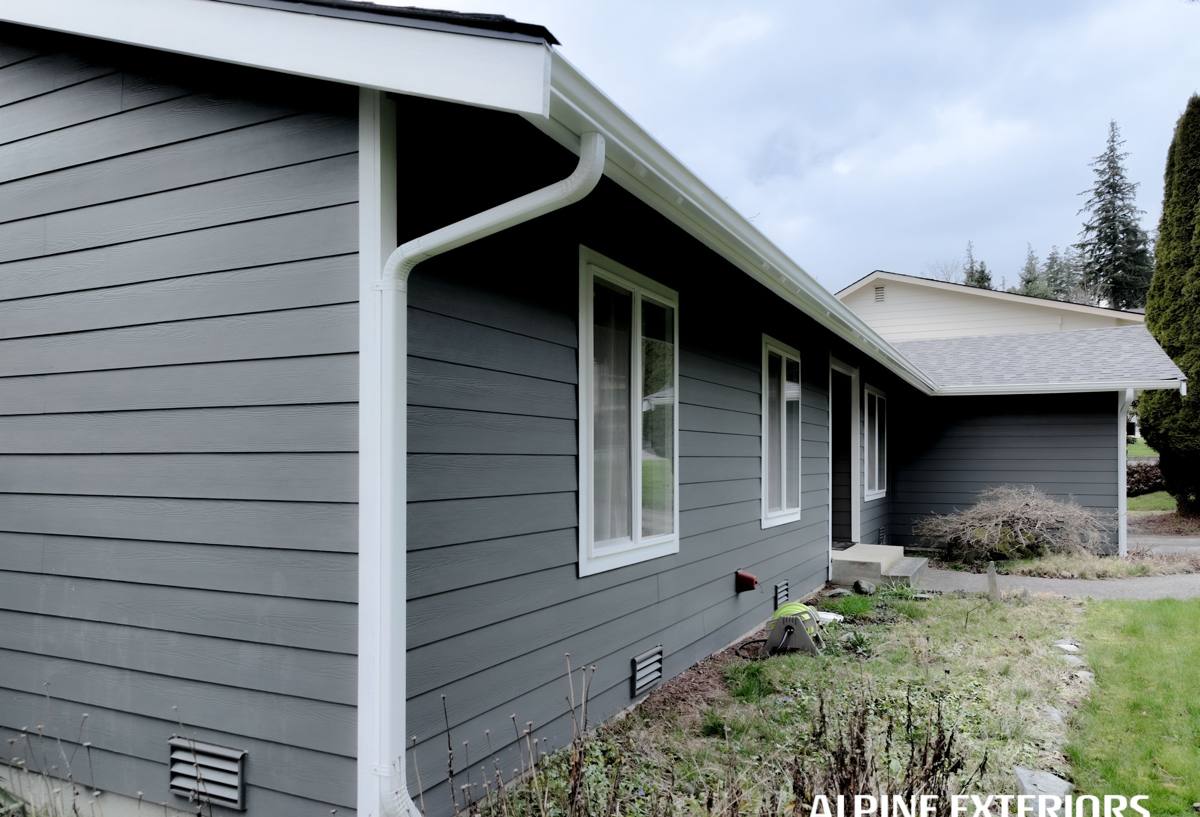
 James Hardie Siding for Everson Homes
Everson sits inland from the water compared to our home base in Blaine, tucked into the Nooksack River valley in the eastern part of Whatcom County. That's a different setting than the immediate coastline, but it's still squarely inside the weather pattern that defines exterior work across this county: rain that arrives sideways as often as it falls straight down, marine-influenced air that pushes inland on strong systems even this far from open water, and a moss season that runs longer here than in most of the country. We work Everson as part of our regular service area, not as an occasional detour, and this page is about one thing specifically — James Hardie fiber cement siding, and what it takes to get it right on an Everson home.
We install James Hardie exclusively. Not as a slogan, but as a professional standard built from years of tear-offs and service calls across Whatcom County, watching which materials actually hold up under this region's moisture and which ones quietly turn into a maintenance problem a few years in.
What Everson's Climate Puts Siding Through
Driving Rain in a River Valley
Everson's position along the Nooksack River means storms moving through the valley bring sustained, often wind-driven rain rather than the gentler, more vertical rainfall you might picture inland. That sideways-moving moisture works its way into siding joints, window trim, and anywhere flashing is doing less than it should, and it's a harder test on an installation than the same rainfall total would be in a calmer climate. A siding job that only accounts for water falling straight down tends to show gaps in a valley setting like this within the first few wet seasons.
Marine Air That Still Reaches Inland
Everson isn't waterfront, but Whatcom County's weather systems routinely carry salt-tinged marine air well past the immediate coastline, especially during the fall and winter storm pattern that dominates the region. It's a lighter dose than a home sitting directly on Semiahmoo Bay or Drayton Harbor would take, but it's still enough to accelerate corrosion on unprotected fasteners and lower-grade trim hardware over time, which is one more reason material and hardware choices matter here even away from the water's edge.
A Long Moss and Mildew Season
Mild temperatures and near-constant valley dampness add up to a moss season that can run most of the year on shaded or north-facing walls around Everson, and tree-lined river-valley lots see this early and often. Any siding surface with even a little porosity becomes a growth surface given enough sustained moisture, and once moss and mildew take hold, they hold water directly against the wall behind them — which is how a cosmetic issue turns into a moisture problem if it's left alone.
Cold Snaps and Freeze-Thaw Cycling
Sitting further from the moderating effect of open water, Everson tends to see sharper cold snaps in winter than towns right on the coast, and that adds a freeze-thaw dimension to any moisture that's already worked its way into a wall assembly. Water that soaks into a porous or poorly sealed material and then freezes expands, and that's a real accelerant for cracking and material failure over a valley property's lifespan.
Why James Hardie Is the Only Siding We Install
We used to install a broader range of siding products before narrowing to one system. That change came directly from what we kept finding on tear-offs across Whatcom County — not from a supplier relationship or a marketing push.
- Non-combustible core: Fiber cement doesn't feed a fire the way wood-based siding products can, which matters for both household safety and insurance underwriting.
- Factory-applied ColorPlus finish: The color is baked on under controlled factory conditions rather than brushed on in the field, so it resists fading and chalking far longer under sustained valley moisture and UV exposure.
- Climate-engineered HZ product lines: Hardie's HZ5 formulation targets regions with sustained moisture exposure and freeze-thaw cycling — a solid match for a Nooksack valley climate like Everson's.
- Dimensional stability: Fiber cement doesn't swell, cup, or warp the way engineered wood siding can after repeated wetting cycles through a long rainy season.
- Strong transferable warranty: Hardie backs the product with one of the stronger warranty structures in the industry, provided installation follows their published spec.
We don't install LP SmartSide, vinyl siding, Cemplank, Allura, primed spruce, or cedar. Every one of those products has a place in the broader market, and plenty of homeowners elsewhere are satisfied with them. Our position is a professional one built around this specific climate: we'd rather stand fully behind one system we trust than offer a cheaper option that quietly shifts maintenance risk onto an Everson homeowner a few winters down the road.
Where Other Products Fall Short in This Climate
| Product | Common trade-off in a Whatcom County valley climate |
|---|---|
| Vinyl siding | Panel seams give wind-driven rain an entry point; can become brittle under sustained UV and temperature swings |
| LP SmartSide / engineered wood | Wood-strand core is more moisture-sensitive at cut edges and fastener points than fiber cement under sustained valley humidity |
| Primed spruce or cedar | Needs ongoing paint and moisture maintenance to avoid rot; the long moss season here accelerates the wear cycle |
| Other fiber cement brands | May lack a climate-specific HZ-style formulation or the same factory-finish warranty depth as James Hardie |
What a Correct Installation Involves
Hardie siding performs the way it's engineered to only when it goes on correctly, and in a river-valley climate like Everson's, the installation details matter as much as the material choice itself. A few of the basics we won't shortcut:
- Rain screen gap: A small drainage cavity behind the siding lets any moisture that gets past the exterior surface drain and evaporate instead of sitting against the sheathing.
- Correct fastener type and spacing: Hardie specifies both for a reason — loose spacing or the wrong fastener is one of the more common causes of early siding failure we find on tear-offs.
- Properly lapped house wrap and flashing: Every seam and penetration needs to shed water downward and outward, which matters more on a property that takes sustained, wind-driven valley rain.
- Sealed butt joints and trim transitions: Open or poorly sealed joints are where moisture finds its way behind the siding first, and where a long moss season does the most damage if it's given the chance.
- Correct clearance above grade: Siding installed too close to the ground can wick moisture up from wet soil, a real risk on low-lying valley lots that don't drain as fast as higher ground.
None of this is exotic — it's the manufacturer's own installation spec, followed consistently on the parts that are hardest to see once the job is finished.
Choosing the Right Hardie Product Line
| Product Line | Best Use | Why It Fits an Everson Home |
|---|---|---|
| HardiePlank lap siding | Most standard single-family homes | Traditional lap profile sheds wind-driven valley rain effectively with proper overlap and flashing |
| HardiePanel vertical siding | Accent walls, gables, modern designs | Clean lines that work well as an accent alongside more traditional lap siding on rural and semi-rural lots |
| HardieShingle siding | Craftsman-style homes and accent sections | Textured look without the moisture absorption and upkeep of real wood shingle |
| HardieTrim boards | Corners, window and door casing, fascia | Factory-finished trim resists the same moisture and freeze-thaw cycling as the field siding |
The right product line and texture depend on the individual home, its style, and the homeowner's preference. What stays consistent is that we spec the product to the property's actual exposure — sun, shade, wind, and grade — rather than defaulting to whatever's easiest to order.
Our Process on an Everson Siding Project
Inspection and Estimate
Every job starts with an honest look at the home — current siding condition, any sign of trapped moisture or sheathing damage, and how sun and shade exposure vary across the different walls. That assessment drives the estimate, not a flat per-square-foot guess.
Tear-Off and Substrate Check
Once old siding comes off, we check the sheathing underneath for rot or soft spots before anything new goes up. Covering damaged sheathing with new siding just hides a problem that keeps getting worse behind the wall — we'd rather find it now.
Weather Barrier and Flashing
Given how much siding failure in this region traces back to water getting behind the cladding rather than through it, the house wrap, window flashing, and every wall penetration get real attention on an Everson job. This step is easy to rush and hard to inspect once the siding is up, so we treat it as non-negotiable.
Installation to Manufacturer Spec
James Hardie's warranty depends on the installation following their published specifications — correct fastener spacing, clearances above grade and roofline, and proper field-cutting and sealing practices. We install to that spec as the baseline, not as an upgrade.
Final Walkthrough
We walk the finished job with the homeowner, cover care and maintenance expectations specific to a valley property, and confirm the work matches what was estimated before calling it done.
Why a Crew That Already Works Everson Matters
A contractor who works this part of Whatcom County regularly understands how driving rain, valley dampness, and freeze-thaw swings actually behave on real homes here across a full year — not just how a product performs on a spec sheet. That experience shapes decisions on install day: which wall orientations hold moisture longest, where extra flashing attention actually pays off, and which fastening details are worth the added time so an Everson homeowner isn't dealing with a callback after the next hard winter storm. Everson's exposure looks different from a home sitting right on the water in Blaine, and a crew with hands-on local experience treats that difference seriously instead of applying the same approach everywhere.
Signs an Everson Home's Siding Needs Attention
- Moss or dark staining that returns quickly after cleaning, especially on shaded or north-facing walls
- Soft or spongy siding, particularly low on the wall or around window and door trim
- Peeling paint or visible warping, most common on older wood-based or engineered wood siding
- Cracked, buckled, or missing panels after a windstorm moving through the valley
- Rust staining running down from fasteners or trim hardware
- Musty odors or staining on interior walls that back up to exterior siding
Cost Factors for Everson Siding Projects
| Factor | What It Affects | Why It Matters in Everson |
|---|---|---|
| Tear-off vs. overlay | Labor scope and substrate access | Tear-off reveals hidden moisture and rot damage common under older siding in a damp valley climate |
| Substrate condition | Repair costs before new siding goes on | Long-term trapped moisture can rot sheathing and framing behind older, non-Hardie siding |
| Grade and drainage | Siding clearance and moisture management near the foundation | Low-lying valley lots can hold ground moisture longer than higher, well-drained sites |
| Home size and trim complexity | Material quantity and labor time | More corners, gables, and window trim mean more flashing detail to get right |
| Site access | Labor time and staging needs | Rural and semi-rural Everson properties can have longer driveways or different staging needs than an in-town lot |
These are general drivers, not a quote. Every home sits differently on its lot — tree cover, grade, and sun exposure all vary — so we walk the property before putting a real number on the work rather than estimating over the phone.
Repair or Full Replacement?
Not every siding problem on an Everson home calls for a full tear-off. Storm-damaged sections, an isolated trim failure around a window, or a section that's taken impact can often be repaired and matched into existing Hardie siding. But if water has been tracking behind the wall for a while, or the home still has an aging, non-Hardie product nearing the end of its service life, patching it usually just delays a bigger job while hidden rot keeps spreading underneath. We'll tell you plainly which situation you're actually looking at before recommending either path.
If your Everson home needs new siding, a repair, or just an honest second opinion on what's happening behind an aging wall, we're glad to take a look. Reach out using the form below to schedule a free, no-pressure estimate.