 Blaine Exterior
 Why Bellingham Homes Need Siding Built for This Climate
Bellingham sits close enough to the water, and gets enough wind-driven rain off the Strait and Bellingham Bay, that siding here works harder than siding in drier parts of the state. Add in Whatcom County's long gray stretch from October through May, and you've got a climate that punishes any siding material with a weak point in its water management or a finish that can't hold up to repeated soak-and-dry cycles. We work on homes throughout the Bellingham area and see the same failure patterns over and over: paint that's chalked and peeling on the north and west-facing walls, trim that's gone soft at the bottom edge, and moss creeping up from the foundation line on shaded siding that never fully dries out between storms.
None of that is unusual for this area. It's just what happens to siding that wasn't specified, installed, or finished for a coastal Pacific Northwest climate. The fix isn't a better paint job every few years — it's starting with a material and installation approach that's actually built for what Bellingham throws at it.
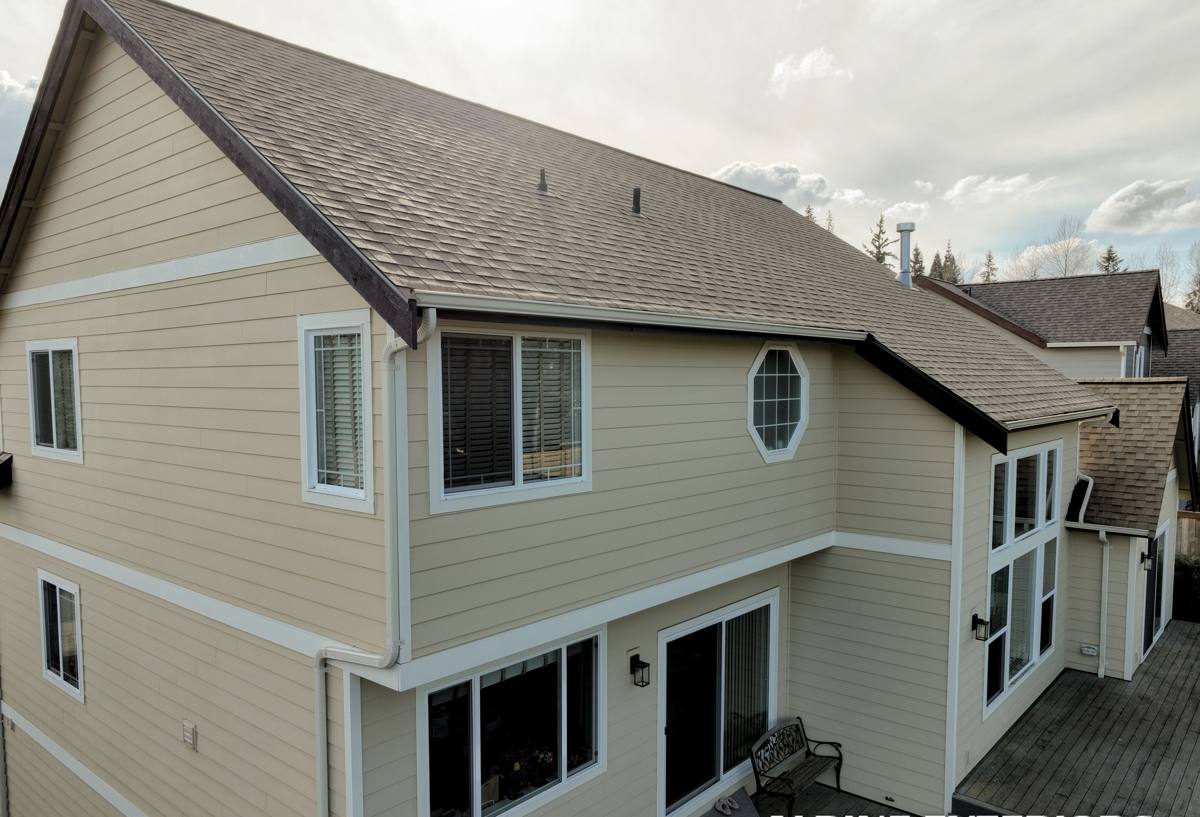
What Salt Air, Rain, and Moss Actually Do to Siding
Three climate factors do most of the damage to siding in this part of Whatcom County, and they compound each other:
Salt Air
Proximity to Bellingham Bay and the Strait of Georgia means airborne salt is a real factor, especially on homes closer to the water or exposed to onshore wind. Salt accelerates corrosion on exposed fasteners and metal trim, and it can degrade lower-quality paint finishes faster than inland exposure would.
Driving Rain
Storms here don't just fall straight down — wind pushes rain sideways into wall assemblies, especially on west and southwest exposures. Any gap in flashing, caulking, or panel overlap becomes an entry point. Over years, that moisture works its way behind the siding and into sheathing, framing, and insulation, often long before it shows up as a visible problem on the surface.
Moss Season
Bellingham's combination of shade trees, mild temperatures, and near-constant fall-to-spring moisture makes for an extended moss and algae season. Siding that stays damp — because it's shaded, because it's absorbing water, or because water isn't draining away from the wall — becomes a growth surface. Moss holds moisture against the material, which makes every other problem worse.
Put those three together and you get a simple standard for what siding in Bellingham actually needs: a material that doesn't absorb and swell, a finish that resists fading and salt exposure, and an installation that manages water instead of trusting caulk to stop it.
Why We Install Only James Hardie Fiber Cement in This Area
We standardized on James Hardie fiber cement siding for every home we side, including here in Bellingham, and we don't install vinyl, LP SmartSide, primed wood, or other fiber cement brands. That's not a marketing position — it's a decision based on what holds up under this specific climate.
Fiber cement is cement, sand, and cellulose fiber, so it doesn't absorb water the way engineered wood products can, and it doesn't expand and contract with temperature the way vinyl does. James Hardie's HZ5 product line is engineered specifically for climates with freeze-thaw cycles and sustained moisture exposure, which describes a normal Whatcom County winter. The ColorPlus factory finish is baked on under controlled conditions, which gives it better fade and moisture resistance than field-applied paint — a real advantage in an area with as much sun-to-rain variation as this one. And because it's non-combustible, it also holds up against the wildfire smoke and ember exposure that's become a more regular late-summer concern across Washington.
We won't say other products can't be installed well — but we've made a professional call that fiber cement, installed correctly, is the material that gives Bellingham homeowners the fewest headaches over the life of the siding, and it's the only thing we put our name behind.
What a Correct Fiber Cement Install Involves
Fiber cement siding is only as good as the installation underneath it. A rushed or undersized crew can turn a 30-50 year material into a 10-year problem. Here's what we treat as non-negotiable on every Bellingham job.
Water Management Comes First
Before a single board goes up, the wall needs a proper weather-resistive barrier, correctly lapped and sealed, with flashing at every window, door, deck ledger, and roof-to-wall transition. Given how much wind-driven rain this area gets, this step matters more here than almost anywhere else — it's the difference between water shedding off the wall and water finding its way behind it.
Fastening and Spacing
James Hardie specifies exact fastener types, spacing, and clearances — including a gap at the bottom of the siding away from grade, decks, and roof lines so water can drain and the board can breathe. Skipping these clearances is one of the most common corner-cutting mistakes we see on re-sides, and it's usually invisible until moss and rot show up years later.
Cuts, Caulking, and Finish
Field cuts need to be sealed per manufacturer spec, joints need proper caulking (not paint used as a gap-filler), and any touch-up paint needs to match the ColorPlus system so the factory finish and field work weather at the same rate.
| Install Step | Why It Matters in Bellingham |
|---|---|
| Weather-resistive barrier & flashing | Stops wind-driven rain from reaching sheathing |
| Proper fastener spacing & clearances | Prevents trapped moisture that feeds moss and rot |
| Grade and deck clearance gaps | Keeps splash-back and standing water off the bottom edge |
| ColorPlus-matched sealants and touch-up | Even weathering, resists salt-air fading |
| Trim and corner detailing | Closes the most common leak points on a home |
Comparing Siding Options for a Bellingham Home
Homeowners comparing bids often see very different materials proposed. Here's a straightforward look at how the main options actually perform in this climate, based on the material properties involved — not brand claims.
| Material | Moisture Behavior | Finish Durability | Typical Lifespan |
|---|---|---|---|
| James Hardie fiber cement | Does not absorb/swell; engineered water management | Factory-baked ColorPlus finish | 30-50 years installed to spec |
| Vinyl | Sheds water but expands/contracts with temperature | Color molded in, fades over time, brittle in cold | 20-30 years |
| LP SmartSide (engineered wood) | Can absorb moisture at cut edges/damage if not sealed | Field or factory finish, needs maintained edges | Manufacturer-dependent, edge-sensitive |
| Primed wood/cedar | Absorbs water, prone to swelling and rot | Needs repainting on a regular cycle | Highly maintenance-dependent |
Our Process, From Estimate to Finished Job
We keep the process straightforward:
- Walk the home and assess the existing siding, sheathing, and any moisture or rot already present
- Identify problem areas specific to the home's exposure — shaded walls, west-facing walls, low-clearance areas near grade or decks
- Provide a written estimate covering material, tear-off (if needed), and the water management work, not just the visible siding
- Install per James Hardie's published specifications, including flashing, fastening, and clearances
- Final walkthrough to confirm caulking, trim, and touch-up match before we call the job done
We don't skip the sheathing inspection step. On older Bellingham homes especially, what's under the existing siding often tells us more about the scope of the job than what we can see from the outside.
Maintenance: What to Expect After Install
Fiber cement is low-maintenance, not no-maintenance. In this climate, that means an annual rinse-down to keep moss and algae from taking hold, especially on shaded or north-facing walls, and a visual check of caulking at trim and joints every couple of years. Because the ColorPlus finish is factory-applied and warrantied separately from the substrate, most homeowners won't need to repaint on the schedule they would with site-finished wood or older vinyl.
What to Ask Before You Hire a Siding Crew in This Area
- Do they install to the manufacturer's written specifications, including flashing and clearance details, not just "how it's always been done"?
- Can they explain how they handle water management at windows, doors, and roof-to-wall transitions?
- Do they have experience with the specific exposure issues in your neighborhood — shade, wind direction, proximity to water?
- Will they inspect sheathing condition before quoting, rather than pricing blind over the existing siding?
- Is the warranty structure clear on what's covered by the manufacturer versus the installer?
Why Local Experience Matters for This Job
Bellingham and the greater Blaine area aren't a uniform climate zone — a home two blocks from the water deals with different exposure than one further inland and tucked behind trees. A crew that works this area regularly knows which walls tend to hold moisture, which neighborhoods see the worst wind-driven rain, and where moss becomes a recurring problem versus a one-time cleanup. That local pattern recognition shows up in better flashing decisions and fewer callbacks, not just faster bids.
If you're weighing a siding replacement or repair on a Bellingham-area home, we're happy to take a look and give you a straightforward, no-pressure estimate — including an honest read on what your current siding and sheathing are telling us.