 Blaine Exterior
 Why Siding in Ferndale Wears Differently Than Siding Inland
Ferndale sits in the same weather system that shapes Blaine and the rest of Whatcom County — close enough to the water that salt-laden air is a constant, close enough to open water and low terrain that driving rain finds its way onto every wall, and wet enough through the winter months that moss isn't an occasional nuisance, it's a season. None of that is exotic or extreme weather. It's just steady, patient exposure, and steady exposure is exactly what wears siding out ahead of schedule. A repair job that would hold up fine in a drier, calmer part of the state can fail here in a fraction of the time if it isn't done with this specific climate in mind.
Salt Air's Slow Chemistry
Salt in the air doesn't just sit on a wall — it works on it. Fasteners, flashing, and any exposed metal trim are the first casualties, corroding faster than they would even a few miles further inland. Once a nail head rusts and loosens, or a piece of flashing starts to pit, water gets a path behind the siding that didn't exist before. That's why a repair that only addresses the visible crack or gap, without checking the metal and fasteners around it, tends to need redoing sooner than it should.
Driving Rain and Wind-Driven Exposure
Rain that comes in sideways behaves differently than rain that falls straight down. It gets pushed up under laps, into butt joints, and around window and door trim that would stay dry in calmer weather. Homes on more exposed elevations — open to wind off the water — take the brunt of this, and it's usually those walls where we find the deepest repair needs, even when the rest of the house looks fine.
Moss: More Than Cosmetic
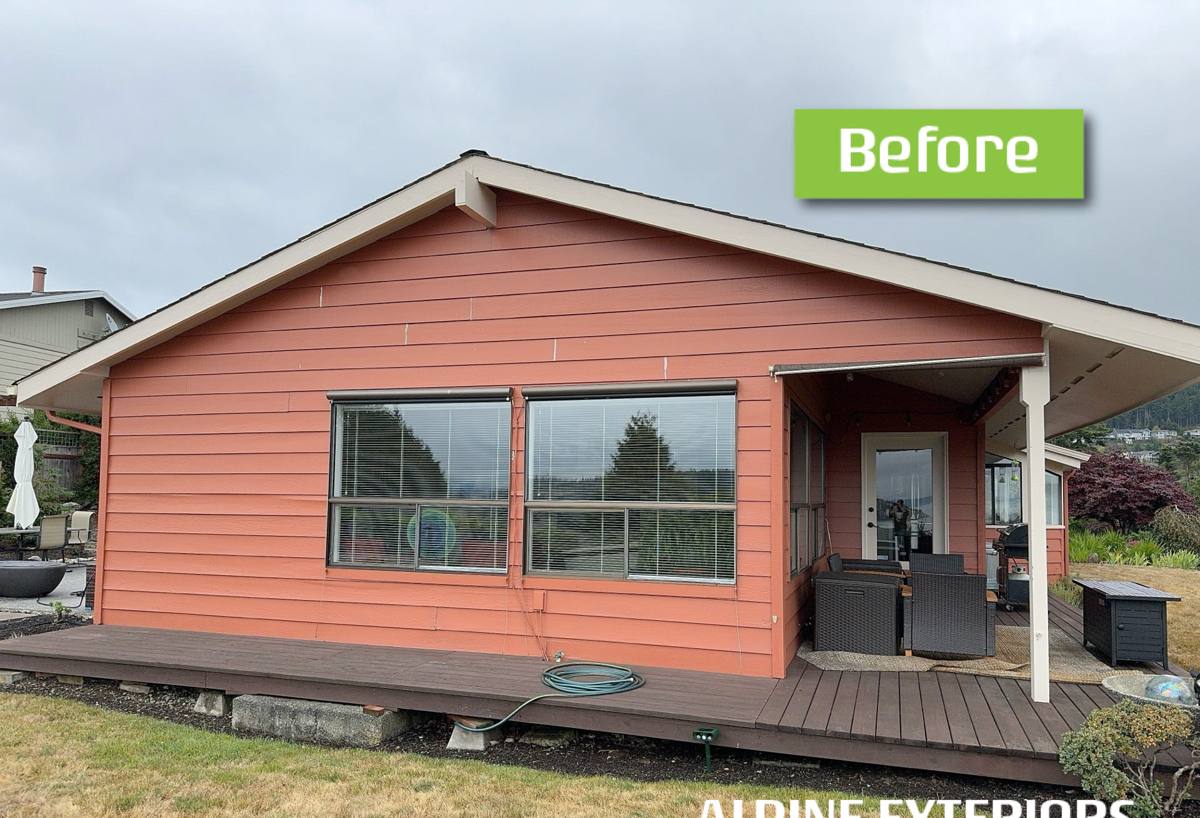
A long, mild, damp winter is ideal growing conditions for moss, and moss holding against a wall does more than look bad. It keeps a layer of moisture pressed against the siding surface for weeks at a time, well past the point where the wall would otherwise have dried out. On shaded, north-facing walls and anywhere tree cover blocks sun and airflow, that constant dampness is often the real reason a section of siding failed years before the rest of the house.
How to Tell If You Need Repair, Not Just Caulk
Homeowners often try to solve early siding problems with caulk, and sometimes that's genuinely enough. But caulk over the wrong problem just hides it for a season. These are the signs that point to an actual repair rather than a maintenance fix:
- Siding that feels soft or spongy when pressed, especially near the bottom courses or under windows
- Paint that's blistering, peeling, or bubbling in a localized area rather than evenly across the wall
- Dark streaking or staining below seams, joints, or trim — a sign water is tracking somewhere it shouldn't
- Moss or algae mats that stay damp against the siding for weeks rather than drying between rains
- Visible gaps opening up at butt joints or where siding meets trim, window casings, or corner boards
- Rust streaks around nail heads or fasteners that have backed out or popped
- A musty smell, soft drywall, or a faint stain on an interior wall that shares a wall with a suspect exterior section
Any one of these can be minor. Two or more in the same area, especially combined with soft material, usually means moisture has already gotten past the siding and into the structure behind it.
What a Correct Siding Repair Actually Involves
A repair that's done right starts before any siding comes off the wall. The goal isn't to patch what's visible — it's to find out why that section failed in the first place, because in this climate the cause is almost always moisture that found a way in and didn't get a way back out.
Diagnose Before You Cut
That means checking the drainage plane, flashing details, and any nearby penetrations — vents, hose bibs, light fixtures, deck ledgers — before assuming the siding itself is the whole story. Cutting out a damaged board without understanding why it failed just sets up the replacement to fail the same way.
Check What's Behind the Siding
Once the damaged material is removed, the water-resistive barrier and sheathing underneath need a real inspection, not a glance. Soft sheathing, saturated insulation, or a compromised barrier all change the scope of the job — sometimes significantly. A repair that skips this step and simply reinstalls new siding over a still-wet wall assembly is a repair that's going to be redone.
Fix the Water Path, Not Just the Board
If flashing has failed — around a window, at a deck ledger, or at a wall-to-roof transition — that gets corrected as part of the repair, not left in place. Kick-out flashing in particular is a small detail that gets missed often, and it's frequently the actual reason water was tracking into the wall in the first place.
Match the Material and the Finish
Finally, the replacement material has to match the existing siding's profile, exposure, and finish closely enough that the repair doesn't stand out and doesn't create a seam that behaves differently than the rest of the wall in weather. This is where the material you're repairing with — and repairing into — starts to matter as much as the labor itself.
Why We Repair — and Rebuild — With James Hardie Fiber Cement Only
We install James Hardie fiber cement exclusively. We don't install vinyl, LP SmartSide, Cemplank, Allura, or primed wood siding, and that standard applies to repair work the same way it applies to full replacements. Fiber cement doesn't swell, rot, or absorb water the way wood-based products can, it's non-combustible, and Hardie's HZ product lines are engineered for climates exactly like this one — sustained damp exposure, salt air, and long wet winters. The factory-applied ColorPlus finish also means a repaired section can be color-matched consistently instead of relying on a field-mixed paint match that will weather differently over time.
When we're called out to repair a home that isn't currently Hardie, we're honest about the options. For a small, isolated repair, patching with a closely matched material can sometimes make sense. But when the damage is more extensive, or when a home is already due for its siding to be repainted or refreshed, we'll walk you through what it looks like to transition that section — or that elevation — to Hardie instead, so you're not paying to repair the same failure points again in a few years.
Repair vs. Section Replacement — What Actually Decides It
Homeowners often ask whether a problem area can just be patched or whether it needs a larger section replaced. The honest answer is that it depends on a few specific factors, not on guesswork:
| Factor | Favors Spot Repair | Favors Section Replacement |
|---|---|---|
| Sheathing condition behind siding | Dry, solid, no rot found | Soft, delaminated, or visibly saturated |
| Extent of the damaged area | Isolated to one board or joint | Spread across multiple courses or a full wall plane |
| Age and condition of surrounding siding | Recent installation, good condition nearby | Older siding nearing the end of its service life |
| Flashing and moisture path | Flashing intact, isolated failure point | Flashing failure affecting a broader area |
| Cosmetic match after repair | New material will blend acceptably | Patch would visibly stand out from weathered siding |
In practice, most of our repair calls in this area fall on one side or the other of this table pretty clearly once we've actually opened the wall up and looked — which is exactly why we don't quote repair scope sight unseen.
Our Process for Ferndale Homeowners
The process is the same whether the job turns out to be a small patch or a larger section:
- Inspection and moisture mapping. We look at the affected area and the surrounding siding, checking for soft spots, staining patterns, and likely water paths before anything is removed.
- A clear, written scope. You get an explanation of what we found and why, not just a price — including whether we expect the issue to be isolated or more widespread once we're inside the wall.
- Removal and structural check. Damaged siding comes off, and we inspect the sheathing and barrier underneath before moving forward.
- Correct rebuild. Flashing details get fixed where needed, new material is fastened and finished to spec, and transitions are sealed properly rather than just caulked over.
- Final walk-through. We go over what was done and what to watch for, so you're not left guessing about the work.
Why a Crew That Already Works Ferndale Matters
Siding repair isn't a one-size-fits-all trade, and a crew that works up and down this stretch of Whatcom County — from Blaine through Ferndale — has already seen which walls take the worst of the wind, which construction eras in this area tend to have thinner original weather barriers, and how long moss really takes to become a moisture problem rather than just a cosmetic one. That local pattern recognition shortens the diagnosis, and it means the repair addresses the actual cause instead of just the symptom in front of us. It also means a shorter drive and a faster response if something needs a follow-up look after the next storm season, rather than waiting on a crew that only passes through occasionally.
Get an Honest Look at What Your Siding Needs
If you're seeing soft siding, staining, moss buildup, or paint failure on your Ferndale home, it's worth having someone look at it before the damage spreads further into the wall. We offer free, no-pressure estimates — we'll tell you plainly whether you're looking at a repair or something larger, and why, using the form below to get started.