 Blaine Exterior
 Birch Point's Waterfront Exposure Calls for a Different Siding Standard
Homes around Birch Point face a tougher combination of conditions than siding sitting a few miles inland. Being close to the water means more salt in the air, more wind-driven rain hitting the walls at an angle instead of falling straight down, and shaded, damp sections of the house that stay wet longer after every storm. Add in the long stretch of gray, moisture-heavy months that Whatcom County sees every year, and you have an environment that will find every weak point in a siding system — the cheap fastener, the missed flashing detail, the caulk joint that was never meant to be a primary water barrier.
We install siding across Blaine and the surrounding coastline, and the homes we work on near Birch Point consistently need the same things: a water management system that assumes rain will get behind the cladding at some point, materials that don't feed mold and moss the way bare wood does, and installation details that account for salt exposure instead of ignoring it. This page walks through what that actually looks like.
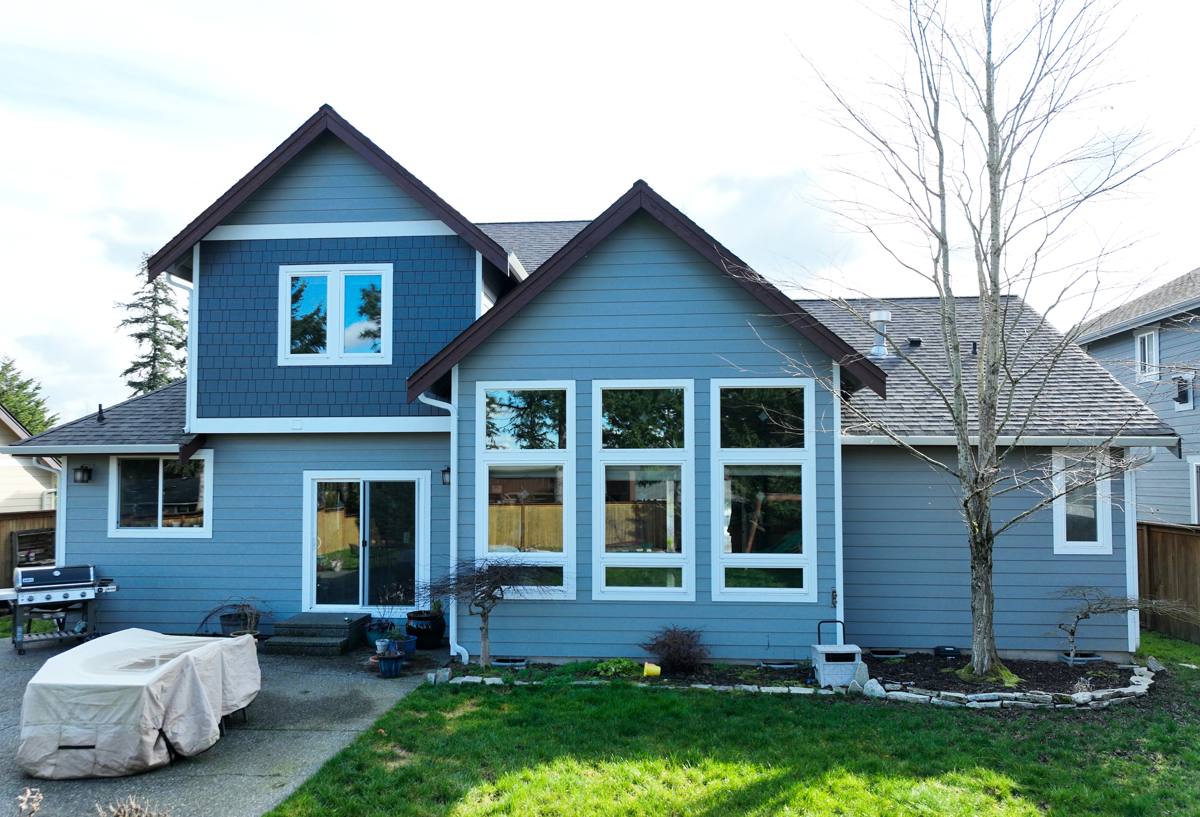
What Salt Air, Driving Rain, and a Long Moss Season Do to Siding
Salt-laden air
Airborne salt settles on every exterior surface near the water, not just the siding closest to the shoreline. Over years, it accelerates corrosion on fasteners, trim flashing, and any metal components that aren't rated for coastal exposure. It also breaks down cheaper paint films faster, which is why factory-cured finishes hold up so much better here than field-applied paint.
Wind-driven rain
Storms coming off the water don't just fall on a house — they push rain sideways into every seam, joint, and penetration. Siding that relies on face-sealed caulking instead of proper lap, flashing, and drainage details will eventually let water in, usually at corners, window trim, and butt joints where two pieces of siding meet.
Moss and prolonged dampness
Whatcom County's wet season stretches long, and shaded north- and west-facing walls near the water can stay damp for weeks at a time. Moss and algae take hold readily on organic materials and rough-textured surfaces, and once established they hold moisture against the wall even longer, which speeds up rot in anything wood-based underneath.
Why We Install Only James Hardie Fiber Cement
We made the decision to install James Hardie fiber cement exclusively and to stop offering vinyl, LP SmartSide, or wood-based siding products. Vinyl expands and contracts significantly with temperature swings and can warp or crack in high wind, and it's a poor fit for a shoreline environment where wind loads are already a factor. Engineered wood products and bare wood siding are organic materials at their core — no matter how well they're treated, they remain more vulnerable to the moisture and moss pressure that Birch Point's climate produces year after year.
Hardie fiber cement is non-combustible, dimensionally stable across temperature changes, and manufactured with HZ5 climate engineering specifically for the Pacific Northwest's wet, temperature-variable weather. Its factory-applied ColorPlus finish is baked on and warrantied against fading and peeling in a way field paint on other products isn't. It won't feed moss the way bare wood can, and it holds its shape and seal over decades rather than the handful of years that lower-cost systems often manage in coastal exposure. That's why it's the only product we put our name behind.
What a Correct Installation Actually Involves
Siding is a system, not just the visible panel. On a Birch Point home, the details underneath the surface matter as much as the product on top:
- A continuous weather-resistive barrier installed shingle-style so water always drains outward and down, never behind the barrier
- Properly lapped and sealed flashing at every window, door, and roofline intersection — the most common failure point on older installations
- Correct fastener placement and spacing per manufacturer spec, using fasteners rated for the exposure rather than whatever was on hand
- Minimum clearance between the bottom of the siding and grade, decks, or roof lines so splashback and standing water don't sit against the material
- Proper joint treatment at butt seams and corners, using manufacturer-approved sealants rather than relying on caulk alone as the water barrier
- Rainscreen or drainage gap detailing where the wall assembly calls for it, so any incidental moisture has somewhere to go
Skipping any one of these doesn't usually show up right away. It shows up three, five, or ten years later as a soft spot at a corner board, a stain below a window, or moss creeping up from a section that never quite dries out.
Choosing the Right Hardie Line and Finish for Birch Point
Not every Hardie product is specified the same way on every home, and exposure to the water is one of the bigger factors in that decision.
| Consideration | Why it matters near the water |
|---|---|
| HZ5 climate-engineered formulation | Built for the moisture cycling and freeze-thaw variability common in Northwest coastal weather |
| ColorPlus factory finish vs. primed for field paint | Factory finish resists salt-air fading and peeling far longer than a field-applied coat, and carries its own finish warranty |
| Lap siding vs. panel systems | Lap profiles shed wind-driven rain more predictably at horizontal joints; panel systems need extra attention at seams in high-exposure areas |
| Trim and fascia coordination | Matching trim components reduce the number of dissimilar-material joints where water can find a way in |
We walk through these choices with every homeowner based on which direction the home faces, how exposed it is to the water, and what look they're after — there's rarely a single "right" answer, but there is usually a clearly better one for a given house.
Our Process, Start to Finish
- On-site assessment. We look at the existing siding, sheathing condition, flashing details, and any trouble spots — especially around windows, roof lines, and low-clearance areas — before quoting anything.
- Removal and inspection. Old siding comes off and we inspect the sheathing underneath for rot or moisture damage that needs to be addressed before new siding goes on. Covering up a hidden problem is how small issues become expensive ones.
- Weather barrier and flashing. We install or repair the water-resistive barrier and flashing system correctly before a single piece of visible siding goes up.
- Hardie installation to spec. Panels or lap siding go on per manufacturer fastening and clearance requirements, not shortcuts.
- Trim, caulking, and finish details. Joints, corners, and transitions are finished with the right materials for long-term sealing, not just a clean look on day one.
- Final walkthrough. We go over the finished work with the homeowner and confirm everything meets both our standard and the manufacturer's installation requirements for warranty coverage.
Cost Factors for a Birch Point Siding Project
Every home is different, but the same handful of factors drive most of the variation in price:
| Factor | How it affects the project |
|---|---|
| Condition of existing sheathing | Rot or moisture damage found during removal adds repair scope before new siding can go on |
| Home size and wall complexity | More corners, dormers, and roof intersections mean more flashing and trim work, not just more square footage |
| Product selection | Lap vs. panel profiles and trim coordination affect material cost and labor time |
| Access and site conditions | Bluff-front or tight-lot properties can affect staging, scaffolding, and material handling |
| Existing siding removal | Full tear-off versus siding over an already-compromised wall assembly changes scope significantly |
We give straightforward, itemized estimates so homeowners can see exactly what's driving the number rather than a single lump-sum figure.
Signs Your Current Siding Is Losing the Fight
Because coastal wear happens gradually, it's easy to miss the early warning signs. Worth checking for:
- Soft or spongy spots when you press on the siding, especially near the bottom edge or around windows
- Persistent moss or algae growth that comes back within weeks of cleaning
- Visible gaps, warping, or buckling at panel seams and corners
- Paint that's peeling, chalking, or fading unevenly, particularly on the sides facing the water
- Interior stains, musty smells, or peeling paint on walls that back up to exterior siding
- Rust streaks near fasteners or trim, a common sign of corrosion in salt-air exposure
Any one of these on its own isn't necessarily an emergency, but a few showing up together usually means the water management behind the siding has already been compromised.
Why Hiring a Crew That Already Works Birch Point Matters
Coastal siding work isn't identical to siding work three or four miles inland, and a crew that hasn't dealt with wind-driven rain and salt exposure regularly can miss the details that matter most here. We've done this work throughout Blaine and along the Whatcom County coastline, and that repetition is what lets us spot the flashing detail that's about to fail, know which Hardie configuration handles a given exposure best, and install a system that's built for the specific way weather hits homes at Birch Point — not a generic install that happens to be technically up to code.
If your Birch Point home needs new siding, or you want an honest read on whether your current siding still has a few good years left in it, we're happy to take a look. Fill out the form below for a free, no-pressure estimate — there's no obligation, and we'll tell you straight what we see.