 Blaine Exterior
 Why Birch Bay Decks Take More Punishment Than Most
Birch Bay sits right on the water, and that proximity changes what a deck has to survive. Homes here deal with salt-laden air coming off the bay, wind-driven rain that gets pushed sideways under eaves and railings, and a long stretch of the year — roughly October through April — where surfaces rarely get a chance to fully dry out. That combination is harder on a deck than the weather most inland Whatcom County homes face.
Salt air accelerates corrosion on anything metal: fasteners, joist hangers, post bases, railing brackets. Driving rain finds its way into joints and ledger connections that would stay dry on a more sheltered lot. And the moisture that lingers through our long wet season feeds moss and algae growth on any horizontal wood or composite surface that doesn't get sun or airflow. A deck built to a generic spec — the kind that would hold up fine in a drier climate — tends to show corrosion, soft spots, and slick green surfaces years before it should out here.
None of this means a deck in Birch Bay can't last. It means the material choices, hardware grade, and construction details matter more than they would somewhere less exposed, and cutting corners on any of them shows up faster on a waterfront lot than it would a few miles inland.
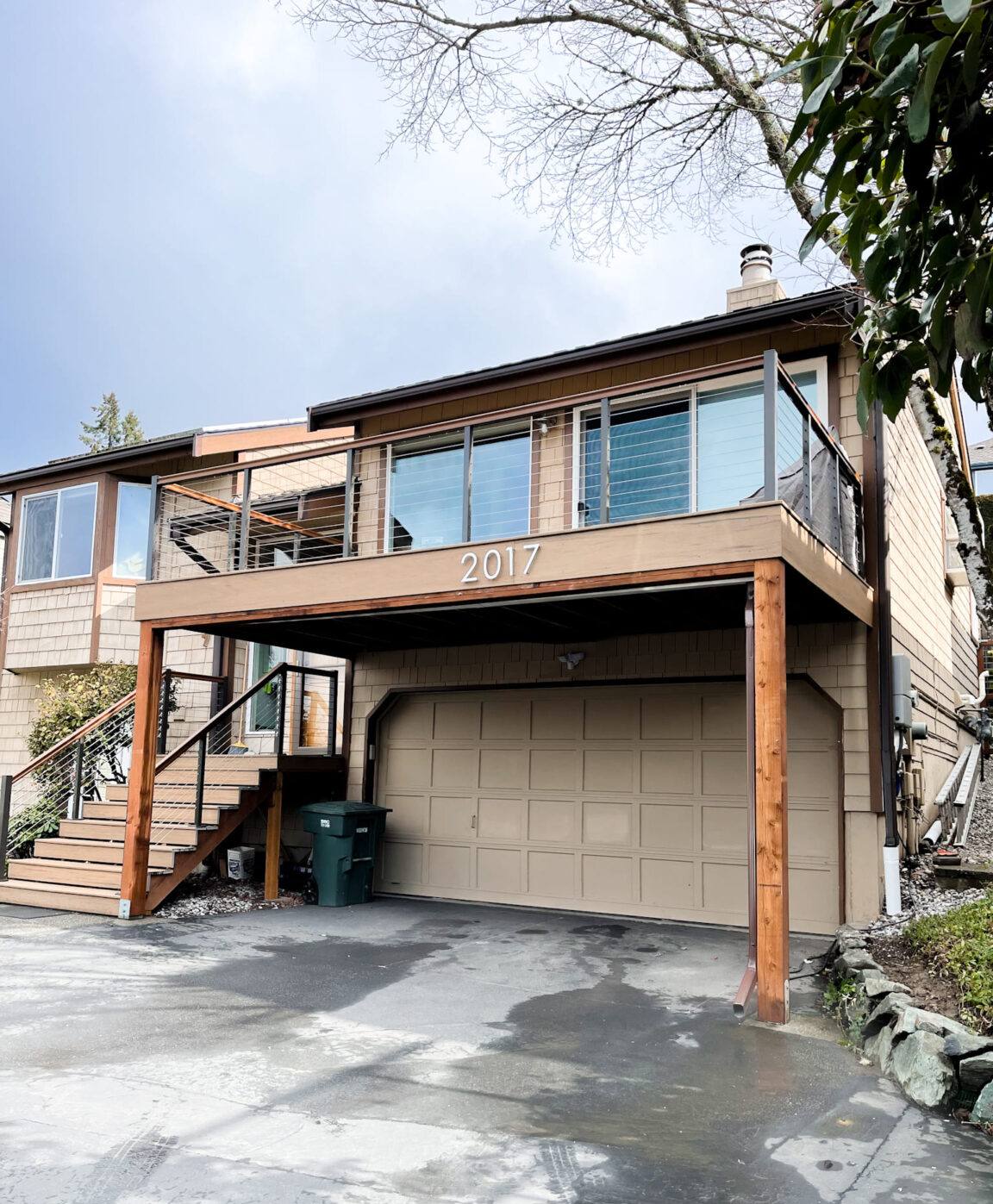
What a Coastal Deck Needs to Get Right
Corrosion-Resistant Hardware
Standard hot-dip galvanized hardware is the minimum acceptable standard for treated lumber framing almost anywhere in the Pacific Northwest, but on a bay-front or near-bay property we treat it as a floor, not a target. For fasteners, joist hangers, and structural connectors within a few hundred feet of saltwater, we lean toward stainless steel or a heavier coastal-rated coating, because the salt exposure here will pit and weaken standard-grade galvanized fasteners well ahead of their normal service life. This is a cost trade-off worth having an honest conversation about up front — better hardware costs more, but replacing rusted-out fasteners under a deck you're already living on costs a lot more.
Ledger Flashing That Actually Sheds Water
The ledger board — where the deck attaches to the house — is the single most common point of failure on decks anywhere, and driving rain makes it worse in Birch Bay. Water that would just run off a wall in calmer weather gets pushed horizontally into the ledger-to-siding joint. A correct ledger installation uses proper flashing, a water-resistive barrier behind it, and a gap or drainage path so any water that does get behind the board can escape instead of sitting against the house framing and rotting it from the inside.
Airflow Underneath
A deck that can't breathe underneath stays damp longer, and damp framing is what invites rot and moss. Where grade and deck height allow it, we build in enough clearance and skirting gaps for air to move under the structure so it actually gets a chance to dry between rain events instead of staying wet all winter.
Framing and Footings: The Part You Don't See
Footing depth has to meet local frost depth and soil-bearing requirements, and soil conditions on lots near the bay can vary — sandier, better-draining soil in some spots, and heavier or wetter soil in others depending on how close you are to the water and the grading of the lot. We dig and pour to what the soil and local code actually require on your specific site rather than assuming one footing spec fits every yard in the area.
Joist spacing, beam sizing, and post spacing all get calculated to the actual load the deck will carry — furniture, hot tubs, and gathering space all change those numbers. This is also where we make sure every structural connection uses hardware rated for the exposure level of your particular spot, since a deck twenty feet from the water needs a different hardware spec than one set back behind the house.
Choosing the Right Decking Material
There's no single "best" decking material for Birch Bay — there's a best fit for your budget, how much upkeep you want to do, and how close your lot sits to the water. Here's how the common options actually compare in this climate:
| Material | How it handles salt air & moisture | Moss/algae tendency | Maintenance |
|---|---|---|---|
| Pressure-treated fir/hem-fir | Resists rot well if properly sealed and maintained; fasteners need to be corrosion-rated | Higher — porous surface holds moisture | Needs re-staining/sealing every 1-3 years |
| Cedar | Naturally rot- and insect-resistant, but softer and more prone to weathering near salt air | Moderate to high without regular cleaning | Regular cleaning and periodic sealing to hold color and prevent graying |
| Composite/PVC decking | Doesn't absorb moisture or corrode; generally the most stable choice near the water | Still grows algae/moss film without airflow or occasional cleaning — no material is immune | Occasional washing; no staining or sealing needed |
We'll be straightforward about the trade-offs rather than pushing one product: composite costs more up front and holds up with the least ongoing work, wood costs less initially but asks for real maintenance discipline to get a long service life out of it here. What matters most is that whichever material you choose, it's paired with the right fasteners, flashing, and airflow underneath — the material alone doesn't determine how long the deck lasts.
Railings, Stairs, and Code Basics
Guard rails, stair construction, and baluster spacing follow the same building code requirements as anywhere else in Washington, but they carry extra weight on a coastal deck because railing hardware is some of the most exposed metal on the whole structure — it's vertical, it catches wind-driven rain directly, and it's handled constantly. A few things we hold to on every railing:
- Guard rails on decks more than 30 inches above grade, built to code height
- Baluster spacing tight enough that a 4-inch sphere can't pass through
- Stair stringers sized and fastened for the actual rise and run, not a generic template
- Corrosion-resistant fasteners and brackets at every railing post connection
- Post connections engineered to resist lateral load, since a loose rail post is one of the more common deck safety failures
Permits and Inspections
Deck construction in and around Blaine typically requires a building permit and inspection through the applicable local jurisdiction, and requirements can depend on deck height, size, and whether it's attached to the house. We handle the permit process as part of the job rather than leaving it to the homeowner to sort out, and we build to pass inspection the first time rather than treating code minimums as something to work around.
Our Process for Birch Bay Deck Projects
Every deck starts with a site visit, not a phone estimate — soil conditions, sun exposure, wind exposure, and how close the lot sits to the water all change the right spec for hardware and materials, and we want to see that in person before we quote it.
From there, the general sequence is: design and material selection based on your budget and how you'll use the space, permitting, footings and framing, decking installation, and railings/stairs last. We inspect our own ledger flashing and structural connections before decking goes down, since those are the details that are impossible to check once the deck is finished.
Keeping a Birch Bay Deck Looking Good Year to Year
A well-built deck still needs some seasonal attention in this climate. A short list that actually makes a difference:
- Sweep debris off the deck regularly through fall so wet leaves don't sit and feed moss
- Rinse or lightly scrub surfaces a couple times a year to knock back algae before it gets established
- Check railing post connections annually for any looseness
- Keep gutters and downspouts near the deck clear so runoff isn't dumping extra water onto or under it
- Re-seal or re-stain wood decking on the schedule the product calls for — don't wait until it's visibly gray and worn
- Clear any vegetation or debris that's blocking airflow underneath the deck
Why Working With a Crew That Knows Birch Bay Matters
A contractor who mostly builds decks inland doesn't necessarily think about hardware grade, ledger flashing detail, or airflow the same way — because they haven't had to watch what standard-spec decks do a few years into life this close to saltwater. Working with a crew that's already spent time on Birch Bay and Blaine properties means the hardware, flashing, and material choices are appropriate from the start instead of getting corrected after the first sign of trouble.
If you're planning a new deck, replacing one that's showing its age, or just want an honest read on whether yours needs attention, we're happy to take a look. Fill out the form below for a free, no-pressure estimate.