 Blaine Exterior
 Roofing in a Marine Climate: What Bellingham Homes Are Up Against
Bellingham sits close enough to Bellingham Bay and the Salish Sea that salt-laden air is a real factor in how fast roofing materials age, not just a talking point. Add in Whatcom County's long wet season, driving rain that comes in sideways off the water during winter storms, and tree cover dense enough to keep roofs shaded and damp for months at a time, and you get a climate that is genuinely harder on a roof than most of the country deals with. A new roof installed here needs to be built for that reality from the deck up, not just installed correctly on a sunny day and hoped for the best.
We install new roofs for homes throughout Bellingham as part of Blaine Exterior Co's regular service area, and the patterns are consistent: north- and west-facing slopes hold moisture longer, valleys and low-slope sections take the worst of the wind-driven rain, and roofs under mature conifers grow moss faster than anywhere else in the yard. None of that is unusual for this part of Washington. It just means the installation has to account for it.
What a Correct New Roof Installation Actually Involves
A roof replacement is more than pulling off old shingles and nailing down new ones. In a climate like this, the details underneath the visible surface are what determine whether the roof performs for its full expected life or starts causing problems in year eight.
Tear-Off and Deck Inspection
Every job starts with a full tear-off down to the sheathing. This is the only point where we can actually see the deck's condition — soft spots, delamination, or rot from a slow leak that never showed up as a stain inside the house. Any damaged sheathing gets replaced before anything else happens. Installing new roofing over a compromised deck is one of the most common shortcuts in the trade, and it's also one of the most expensive mistakes to fix later.
Underlayment and Moisture Barrier
Given how much rain Whatcom County sees in a normal winter, underlayment isn't a formality here — it's the roof's real backup layer. We use synthetic underlayment across the full deck and self-adhering ice-and-water membrane at the vulnerable spots: eaves, valleys, and around every penetration. Valleys in particular take a disproportionate amount of water during a driving rain, and that's exactly where a lot of failures start on roofs that skipped this step.
Flashing at Every Transition
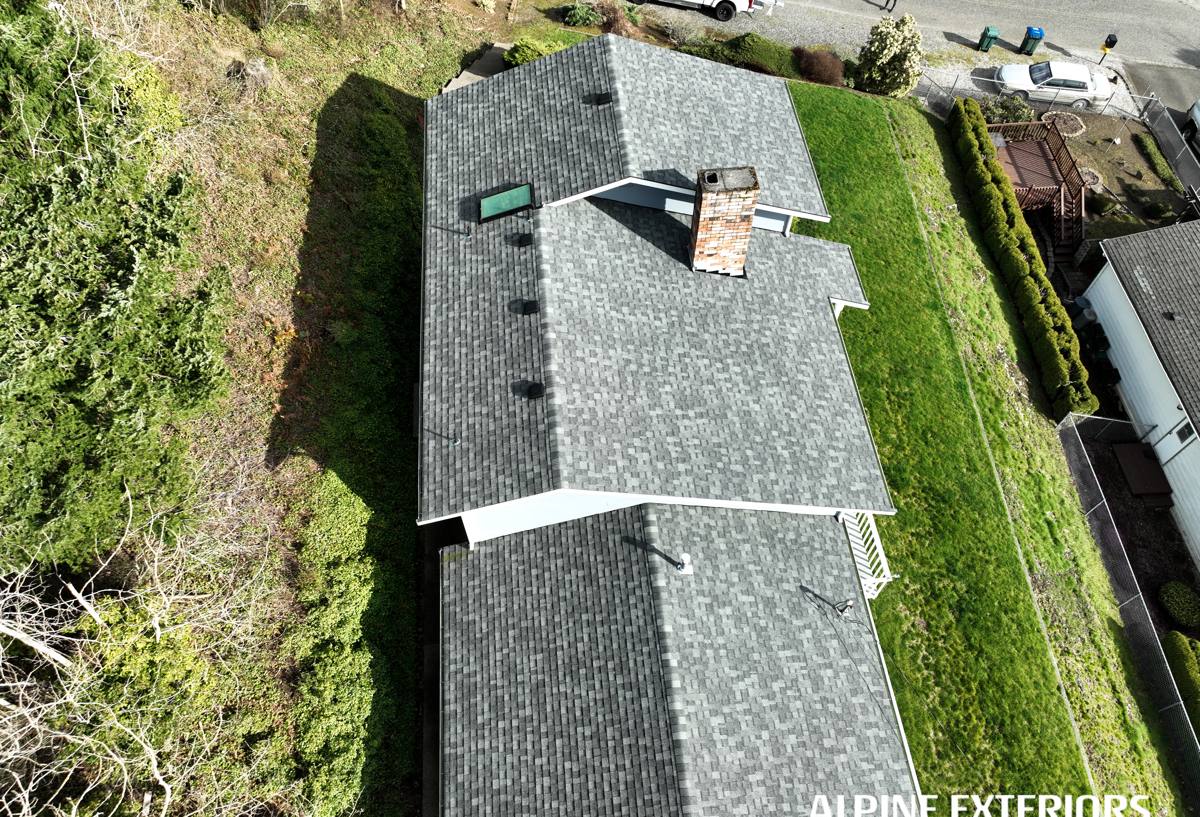
Chimneys, skylights, sidewalls, and roof-to-wall transitions are where new roofs actually fail, far more often than the shingle field itself. We install new flashing at every one of these points rather than reusing old flashing, because rust, gaps, and old sealant that's already breaking down are exactly what let wind-driven rain work its way in.
Ventilation
A roof deck that can't breathe stays damp longer after every rain, which speeds up moss growth and shortens the life of the roofing material from underneath. We balance intake at the eaves with exhaust at the ridge so airflow actually moves through the attic space instead of stalling in one spot.
Choosing the Right Material for This Climate
There's no single "best" roofing material for every home — it depends on the roof's slope, the amount of shade it sits under, and what the homeowner wants to spend both up front and over the life of the roof. Here's how the main options compare for a Bellingham install specifically.
| Material | Typical Lifespan | Moss & Moisture Resistance | Salt Air Performance |
|---|---|---|---|
| Architectural asphalt shingle | 25–30 years | Good, especially with algae-resistant granules | Solid with proper flashing and fasteners |
| Standing seam metal | 40–50+ years | Excellent — sheds moisture fast, little surface for moss to grip | Very good with coated/corrosion-resistant panels |
| Synthetic composite shake/slate | 30–50 years | Good, does not absorb water like wood shake | Good, holds up better than natural wood in coastal exposure |
| Natural cedar shake | 20–30 years with upkeep | Requires the most ongoing maintenance in a wet, shaded climate | Moderate — needs regular treatment to hold up |
For most Bellingham homes we end up recommending architectural asphalt shingle or standing seam metal. Both handle the area's rain and moss pressure well when installed correctly, and both come from manufacturers with warranty structures that are straightforward to understand. Natural cedar shake can look great, but we're honest with clients that it demands real ongoing maintenance in a climate this wet and shaded — that's a maintenance-burden tradeoff worth knowing before you commit to it, not a reason to rule it out if you're willing to keep up with it.
Building Moss Resistance Into the Install, Not Just Fighting It Later
Moss doesn't cause much damage as a thin green film, but once it establishes and thickens, it holds moisture against the roofing material continuously, and that's what shortens a roof's life. A few things we build into the installation itself help slow that down:
- Zinc or copper strips installed near the ridge, which release trace metal ions that inhibit moss and algae growth every time it rains
- Proper ventilation so the deck dries out between storms instead of staying damp
- Correct slope-appropriate material choice on low-pitch sections, which hold moisture longer and grow moss faster than steep sections
- Clean, tight flashing and shingle courses that don't leave debris-catching gaps for organic material to collect and root into
None of this eliminates the need for periodic roof cleaning if your property sits under heavy tree cover, but it meaningfully extends the time between cleanings and reduces how aggressively moss can dig in.
How Our Installation Process Works
- On-site inspection and estimate. We look at the existing roof, the deck condition where visible, ventilation, and any problem areas you've noticed, then give you a written estimate with material options.
- Material selection. We walk through the tradeoffs for your specific roof — slope, sun exposure, budget — so you're choosing based on what actually fits your house.
- Permitting. We handle the permit process required for roof replacement in the jurisdiction your home falls under.
- Tear-off and deck inspection. Full removal of old roofing, with any deck repairs identified and priced before install continues.
- Installation. Underlayment, flashing, ventilation components, and roofing material installed to manufacturer specifications, which is also what keeps your material warranty valid.
- Site cleanup. Full cleanup including a magnetic sweep for stray nails in the yard and driveway.
- Final walkthrough. We go over the completed roof with you, explain any maintenance recommendations specific to your property, and provide your paperwork.
What Drives the Cost of a New Roof
We're not going to quote a number here that doesn't mean anything without seeing your actual roof — every job depends on size, pitch, material, and current condition. What we can tell you honestly is what tends to move the price up or down, so an estimate makes sense when you get one.
| Factor | Why It Matters |
|---|---|
| Roof size and pitch | Steeper roofs take longer to work safely and use more material per square foot of coverage |
| Number of layers to remove | Tear-off of multiple existing layers adds labor and disposal cost |
| Deck condition | Rotted or soft sheathing found during tear-off requires repair before installation continues |
| Material choice | Asphalt, metal, and composite carry different material and installation costs |
| Roof complexity | Valleys, dormers, chimneys, and skylights each add flashing work and time |
| Access | Steep lots, limited driveway access, or tall roofs can affect equipment and labor needs |
Before hiring anyone for a roof replacement, a few questions are worth asking regardless of who you're talking to:
- Are you licensed and bonded to do roofing work in Washington State, and can you provide proof?
- Do you carry liability insurance and workers' compensation coverage?
- Will the estimate specify the exact underlayment, ice-and-water membrane placement, and flashing approach — or just "shingles and labor"?
- What manufacturer warranty applies, and does your installation qualify as a certified install under that warranty?
- Can you provide a local reference or a roof you've completed nearby that I can see?
Why It Matters That We Already Work in Bellingham
A roofing crew that works Bellingham regularly already knows which slopes on which streets tend to hold moss, which neighborhoods see the worst of the wind off the bay during winter storms, and what the local permitting process actually requires — none of which is something a crew coming from outside the area picks up on the first job. Blaine Exterior Co is based in Whatcom County and treats Bellingham as core service territory, not overflow work from somewhere else. That local familiarity shows up in small decisions during the install — where to add extra ice-and-water membrane, which ventilation setup makes sense for a shaded lot — that a generic install wouldn't necessarily catch.
After Installation: What Keeps a New Roof Performing
A correctly installed roof still benefits from basic upkeep, especially in a climate that stays wet as much of the year as this one does.
- Keep gutters clear so water isn't backing up under the roof edge during heavy rain
- Have moss addressed while it's still a light film, before it thickens and starts holding moisture against the surface
- After major windstorms, a quick visual check for lifted or missing shingles and displaced flashing can catch a small problem before it becomes a leak
- Keep overhanging branches trimmed back where practical, since dense shade is the biggest driver of moss growth
If you're weighing a new roof for your Bellingham home, we're glad to come take a look and walk you through what your specific roof needs — no pressure, no hard sell. Use the form below to request a free estimate.