 Blaine Exterior
 What Bellingham Siding Is Actually Up Against
Homes in and around Bellingham sit in one of the more demanding siding environments in Western Washington. You've got marine air drifting in off the water carrying salt that corrodes fasteners and trim over time, long stretches of driving rain that push moisture sideways into every seam and joint, and a moss season that can run most of the year on north-facing walls and anything shaded by trees. None of these problems are dramatic on their own. What they do is compound. A siding product that's marginal in dry inland climates gets exposed fast here, usually within five to ten years, in the form of swelling, soft spots, cracked caulk lines, or moss and algae staining that won't scrub off without damaging the finish underneath.
We work this area regularly, and the pattern is consistent: the siding failures we get called out to inspect are almost never about a single bad storm. They're about years of moisture cycling — wet, dry, wet, dry — working on a material or an installation detail that wasn't built for it.
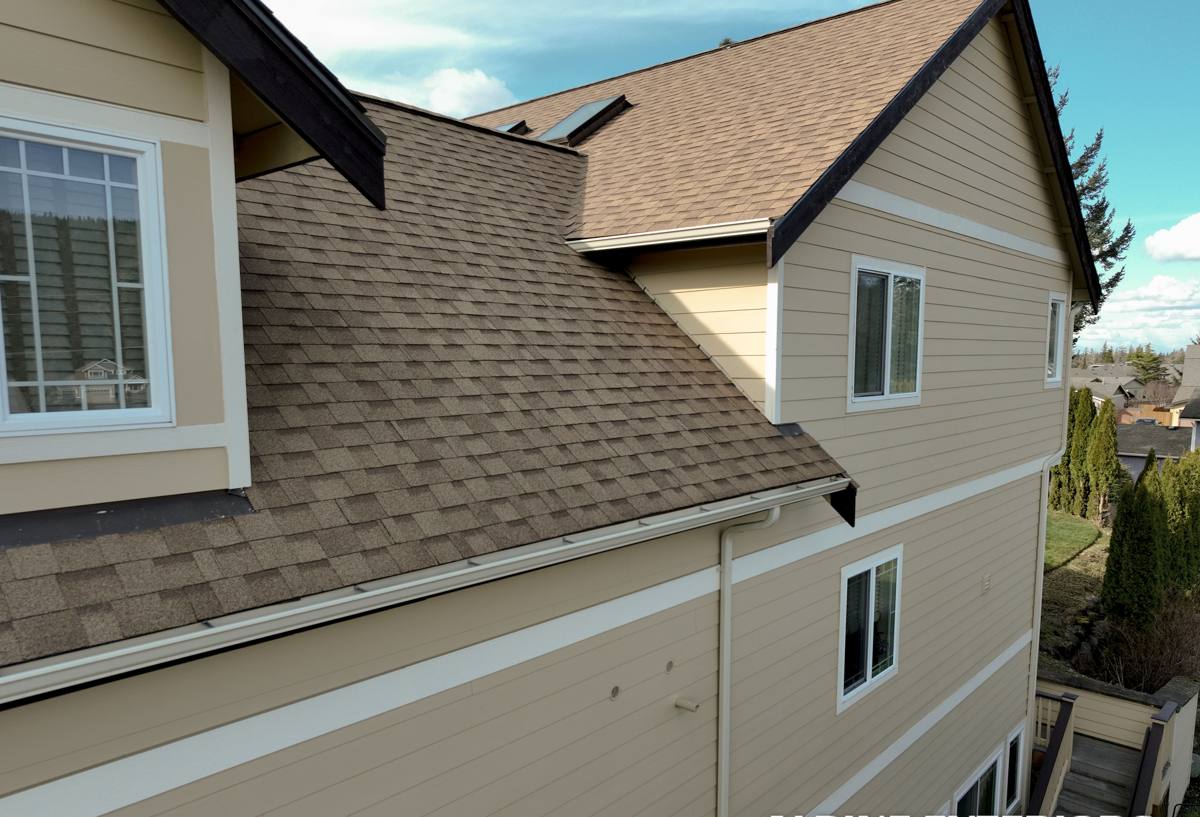
Why This Climate Punishes the Wrong Product Choice
Salt Air and Fasteners
Proximity to Puget Sound and the Strait of Georgia means airborne salt is a real factor on exterior metal — nail heads, flashing, trim fasteners. Untreated or under-rated hardware corrodes faster here than it would fifty miles inland, and once a fastener starts rusting, it telegraphs a stain straight through most siding finishes.
Driving Rain and Wind-Driven Moisture
Whatcom County storms don't just drop rain straight down — wind pushes it laterally into lap joints, corner boards, and anywhere trim meets field siding. That means the water-resistive barrier behind the siding, and the flashing details around every penetration, matter as much as the siding material itself.
Moss, Algae, and Shade
Bellingham's tree cover and cloud cover keep a lot of exterior walls damp for days at a time. Moss and algae need exactly that: shade and moisture. Once a wall surface starts holding a biofilm, it holds even more water, which accelerates whatever degradation is already happening underneath.
Why We Only Install James Hardie
We made a decision as a company to install James Hardie fiber cement exclusively — not vinyl, not LP SmartSide, not cedar, not primed spruce, not other cement-board brands. That's not a marketing angle; it's a standard we hold because of what we see on homes in this exact climate.
Wood-based siding, including engineered wood products, relies on a treated outer layer to resist moisture. In a climate with this much sustained dampness and shade, any breach in that layer — a scratch, a poorly sealed cut end, a nail that backs out — gives moisture a path in, and wood-based cores swell and soften from the inside out. Vinyl doesn't rot, but it flexes with temperature swings, its seams are a weak point for wind-driven rain, and it can't be repainted to refresh a faded or moss-stained finish — you're stuck with the factory color for the life of the product. Cedar is a beautiful, honest material, but it demands a maintenance commitment — regular refinishing, careful moisture management — that most homeowners underestimate until the siding is already showing wear.
James Hardie fiber cement is non-combustible, dimensionally stable across our wet-dry-wet cycles, and finished with a factory-applied ColorPlus coating that's baked on and warranted against fading — which matters directly here, because a factory finish resists the kind of moss and algae staining that eats into field-painted or unfinished surfaces. It's not a magic material that ignores climate, but it's engineered specifically for exposure like this.
The Right Hardie System for This Area
James Hardie makes climate-specific product lines, and for Whatcom County's combination of rain and marine exposure, we spec the HZ5 formulation, engineered for wetter, harsher climate zones rather than the HZ10 line built for hot, dry regions. On a Bellingham-area home we're typically working with:
- HardiePlank lap siding in a smooth or cedarmill texture, sized to the home's exposure and existing reveal lines
- HardieTrim boards at corners, window and door casings, and fascia, matched to resist the same moisture load as the field siding
- HardiePanel vertical siding where a home's design calls for it, particularly on accent walls or gable ends
- ColorPlus factory finish in a color selected for the home, which holds up better against moss staining than field-applied paint
The product line matters, but it's only half the equation. The other half is installation that respects how water actually moves on a wall in this climate.
What Correct Installation Actually Involves
James Hardie siding fails early almost exclusively because of installation shortcuts, not the material itself. On every job we do in this area, a few details are non-negotiable:
Water-Resistive Barrier and Flashing
A continuous, correctly lapped weather barrier behind the siding, with flashing integrated at every window, door, deck ledger, and roof-to-wall intersection. This is the layer doing the real work when wind drives rain sideways into the wall assembly.
Clearances
Hardie specifies minimum clearances from siding to roofline, grade, and decks — commonly an inch and a half to two inches depending on the detail. Skipping these clearances is one of the most common shortcuts we find on older installs, and it's a direct path for standing moisture to wick into the bottom edge of the boards.
Fastening
Corrosion-resistant fasteners, set at the manufacturer's specified depth and spacing — not overdriven, not underdriven. Given the salt air here, we don't cut corners on fastener grade.
Joints and Caulking
Butt joints backed properly and sealed with a high-quality, paintable sealant rated for the product, not just caulked at the surface. Poorly backed joints are one of the fastest ways water gets behind the siding.
Cut Edges
Every field cut gets sealed before installation. Raw, unsealed edges are a direct entry point for moisture on a product that otherwise resists it well.
Common Problems We Find on Existing Homes
When we inspect Bellingham-area homes with siding trouble, the causes are consistent enough to list out:
| Issue Found | Underlying Cause | Typical Consequence |
|---|---|---|
| Staining at bottom courses | Insufficient ground clearance | Wicking moisture, soft or delaminating board edges |
| Dark streaking on shaded walls | Moss/algae growth on field-painted or low-grade finishes | Accelerated finish breakdown, recurring cleaning needed |
| Rust bleed at nail heads | Non-rated fasteners exposed to salt air | Visible staining, eventual fastener failure |
| Cracked caulk at joints | Poor joint backing or wrong sealant | Water intrusion behind siding, hidden sheathing damage |
| Swelling near trim | Unsealed cut ends or missing flashing | Localized rot risk at framing behind the siding |
None of these are inherent flaws in fiber cement — they're installation gaps. That's the whole argument for hiring a crew that treats the details above as standard practice, not upsells.
Our Process on a Bellingham-Area Home
- On-site assessment of the existing wall assembly, moisture history, sun/shade exposure, and any rot or damage under current siding
- Product and color selection from the HZ5 line, matched to the home's exposure and design
- Removal of failing siding with inspection and repair of sheathing and framing before anything new goes up
- Installation of a continuous weather-resistive barrier with properly lapped and flashed penetrations
- Hardie board and trim installation to manufacturer clearance, fastening, and joint specifications
- Final detailing — caulking, touch-up, and a walkthrough so you know exactly what was done and why
We don't treat the tear-off as a formality. Catching a soft spot in the sheathing before new siding goes over it is the difference between a job that lasts and one that hides a problem for another decade.
Cost Factors Homeowners Should Understand
Pricing depends on the specifics of the home, but a few factors consistently move the number more than others:
| Factor | Why It Matters |
|---|---|
| Existing wall condition | Rotten sheathing or framing found during tear-off adds repair scope |
| Home complexity | Multiple gables, dormers, and trim details take more labor per square foot |
| Siding profile and texture | Lap width, panel vs. lap siding, and texture affect material cost |
| Trim scope | Full trim replacement vs. reusing sound existing trim |
| Access and site conditions | Slopes, tight lot lines, and staging needs affect labor time |
We'd rather walk your home and give you real numbers than quote a broad range that doesn't mean much until we've seen the walls.
Maintaining Hardie Siding in This Climate
James Hardie with a ColorPlus finish is low-maintenance, not no-maintenance. In a climate like Bellingham's, a little seasonal attention keeps it performing the way it's designed to:
- Rinse shaded and north-facing walls once or twice a year to keep moss and algae from establishing
- Keep gutters clear so overflow doesn't run down the wall face
- Trim back vegetation and tree limbs to reduce constant shade and leaf litter against the siding
- Check caulking at joints and trim every year or two, especially after a hard winter
- Address any fastener staining early — it's usually a quick fix before it becomes a bigger one
Why Local Experience Matters Here
A crew that mostly works drier inland climates doesn't build the same instincts around flashing details, clearance, and joint sealing that a crew working Whatcom County day in and day out does. We size up every wall against what this specific climate does to it — the salt air, the driving rain, the moss — because we've seen what happens when those details get skipped. That's the real value of hiring locally: not familiarity with a neighborhood, but familiarity with exactly how this climate finds the weak point in a siding job.
If you're considering new siding on a Bellingham-area home, we're happy to walk the property, look at what's there now, and give you a straight assessment of what it needs. There's no pressure and no obligation — just fill out the form below to get started.