 Blaine Exterior
 What "Energy-Efficient" Actually Means for a Sumas Window
Every window sold today gets called energy-efficient by somebody. The term itself doesn't mean much on its own — what matters is two numbers on the label: U-factor, which measures how much heat the window lets escape (lower is better), and Solar Heat Gain Coefficient (SHGC), which measures how much solar heat passes through the glass (lower is better for a house that already gets plenty of gray, damp weather and doesn't need help staying cool). A window can be marketed as efficient and still perform poorly for a specific climate and orientation if those numbers weren't chosen with that climate in mind. For a home in Sumas, dealing with a long heating season, sustained dampness, and wind exposure, the right numbers matter more than the sticker on the box.
It's also worth separating the window unit from the installation. A high-performance window installed with sloppy flashing or incomplete air sealing will underperform a mid-grade window installed correctly. Both halves of that equation matter, and we treat them as inseparable rather than selling one and hoping the other works out.
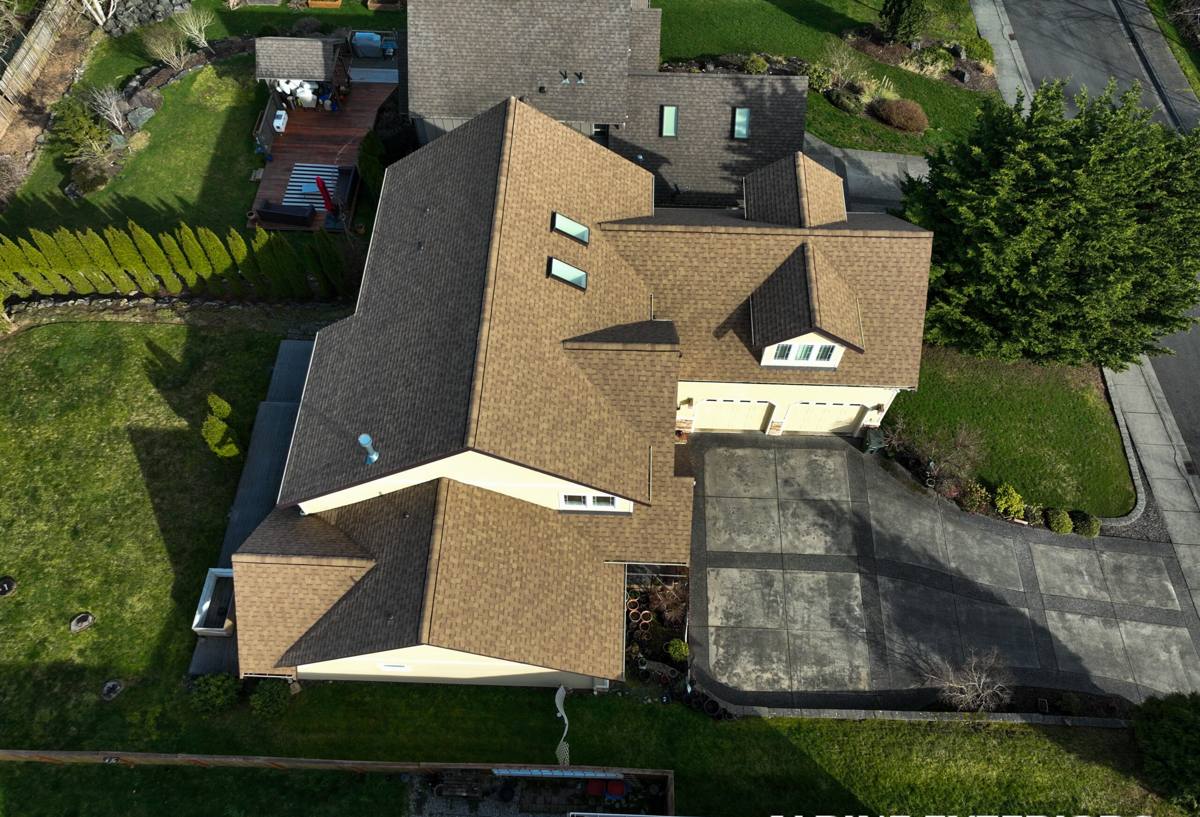
Why Sumas's Climate Makes Efficiency and Weatherproofing the Same Problem
Sumas sits inland from the coast, out toward the eastern edge of Whatcom County near the Canadian border, so it doesn't take the same direct beachfront exposure that towns right on Semiahmoo Bay or Drayton Harbor do. But the same Pacific storm systems and prevailing onshore weather that move across the county still carry salt-tinged, moisture-laden air well past the shoreline, especially during the sustained wind events that come through in fall and winter. Combine that with a low-lying valley setting that holds humidity and fog longer than higher ground, and window performance in Sumas has to account for more than just heat loss.
Wind-Driven Rain
Rain here rarely falls straight down for long. Wind pushes it sideways into window openings, testing flashing and seals in a way that vertical rainfall never would. A window that's efficient on paper but poorly flashed will let that wind-driven moisture track into the wall cavity around the frame, and by the time it shows up as staining or soft trim, it's usually been happening for a while.
Salt-Tinged, Damp Air
Even at Sumas's distance from open water, salt-laden marine air moving inland with storm systems accelerates corrosion on window hardware, weatherstripping, and lower-quality frame components over time. It's a lighter dose than a beachfront property gets, but it's real, and it compounds with the valley's general dampness.
A Long Moss and Mildew Season
Mild temperatures and persistent moisture add up to a moss and mildew season that runs most of the year in this part of Whatcom County. On windows, that shows up as green growth or grime buildup on sills, trim, and shaded frame surfaces — cosmetic at first, but a sign that a surface is staying wet longer than it should, which isn't good for caulking, weatherstripping, or wood-based trim nearby.
A Real Heating Season
Sumas gets colder, sharper winter conditions than the milder coastal towns closer to Bellingham Bay, partly from its inland position and exposure to cold outflow wind funneling down from the Fraser Valley. A house here spends more months of the year actively heated than a lot of people assume, which means a window's U-factor has a bigger, more direct effect on comfort and utility costs than it would in a milder microclimate.
What Actually Makes a Window Energy-Efficient
Past the marketing language, a handful of physical features do the actual work.
Glazing: Double-Pane vs. Triple-Pane
Double-pane glass with a quality low-E coating is a solid, proven baseline for this climate and covers most homes' needs well. Triple-pane glass adds another layer of insulation and can meaningfully cut heat loss further, at added cost and weight — worth considering on north-facing walls, rooms that run cold, or homes where winter comfort has been a persistent complaint, but not something we push as a default on every opening.
Low-E Coatings and Gas Fills
A low-emissivity (low-E) coating is a microscopically thin layer that reflects heat back toward its source — keeping indoor heat in during winter — while still letting visible light through. Argon or krypton gas fill between panes adds further insulation over plain air. These are inexpensive relative to the glass unit itself and make a real difference in a climate with as long a heating season as Sumas has.
Frame Material and Thermal Bridging
The frame conducts heat too, not just the glass, and frame material affects both thermal performance and how the window holds up to sustained regional moisture.
| Frame Material | Thermal Performance | Moisture Behavior in This Climate |
|---|---|---|
| Vinyl | Good; low thermal conductivity | Handles sustained damp well; no rot risk; quality varies by manufacturer |
| Fiberglass | Very good; dimensionally stable across temperature swings | Excellent moisture resistance; holds paint and finish well over time |
| Wood (unclad) | Good insulator | Needs consistent maintenance to resist rot in a damp valley climate; higher upkeep here |
| Wood-clad | Good; exterior cladding limits thermal bridging | Cladding protects the wood from the elements; a reasonable option when the interior wood look matters |
| Aluminum | Poor without a thermal break | Durable but conducts heat and cold readily; not our recommendation for primary living space windows here |
We'll walk through these trade-offs against your specific openings, sun exposure, and budget rather than defaulting to one material for every job.
Installation Is Where Efficiency Is Actually Won or Lost
A window's rated U-factor and SHGC are lab numbers, measured under controlled conditions. Real-world performance depends heavily on the installation — specifically, how well the gap between the window frame and the rough opening is sealed and insulated, and how the flashing is sequenced to keep wind-driven rain out of that same gap. A gap that's left with just foam and no proper air seal will leak conditioned air regardless of how good the glass is. A flashing detail that's rushed will let moisture into the wall assembly regardless of how efficient the window rating looks on paper. In a climate that combines a long heating season with sustained wind-driven rain, both failure modes are common, and both are avoidable with the same careful installation sequence — because getting the water management right and getting the air sealing right happen at the same step, with the same materials, done in the same order.
Signs a Sumas Home's Windows Are Losing Efficiency
Some signs of window failure are dramatic — a cracked pane, a window that won't stay open. Efficiency loss is usually quieter, and homeowners often adjust to it gradually without noticing how much has changed.
- Noticeable drafts near the window frame, especially during winter wind events
- Condensation forming between the panes of a double- or triple-pane unit — a sign the seal has failed
- Rooms near certain windows that feel consistently colder than the rest of the house
- Heating costs that seem high relative to the size of the home
- Visible fogging or a persistent haze that won't wipe away on the interior glass surface
- Frames that feel cold to the touch even when the glass itself doesn't
- Soft or discolored trim and sill material around the window, suggesting moisture intrusion alongside heat loss
Our Process for a Sumas Window Project
- On-site assessment — we look at each window's condition, orientation, and any signs of drafts, condensation, or moisture damage specific to that opening
- Honest recommendation — which openings actually need replacement now, which can wait, and what glazing and frame combination fits the house and budget
- Product selection — we review U-factor and SHGC ratings against your specific openings rather than quoting a generic "energy-efficient" package
- Removal and opening prep — old units come out carefully, and we address any hidden rot or flashing failure before a new window goes in, not after
- Installation, air sealing, and flashing — the new unit is set, shimmed, sealed, and flashed as one sequence, built for wind-driven rain and long-term air tightness together
- Trim and finish — exterior trim and finish work integrated cleanly with the surrounding siding
Cost Factors on an Energy-Efficient Window Project
We won't quote a number without seeing your windows, but the factors that consistently move price on this kind of project are the same from house to house.
| Factor | Why It Matters |
|---|---|
| Number of openings | A whole-house project has better per-unit economics than replacing one or two windows at a time |
| Glazing choice | Triple-pane costs more upfront than double-pane, with a real performance gain in exchange |
| Frame material | Fiberglass typically costs more than vinyl but brings better dimensional stability and finish longevity |
| Opening condition | Rot, old flashing failures, or out-of-square framing found during removal add repair work before the new unit goes in |
| Size and configuration | Larger units, or openings needing structural changes, cost more to manufacture and install than a standard-size swap |
A higher upfront cost for better glazing or frame material typically pays back over years of lower heating bills and less maintenance — but the right balance depends on how long you plan to stay in the house and what your current windows are actually costing you in comfort and energy use. We'll talk through that trade-off honestly rather than upselling every job to the top-tier option.
Why a Crew That Already Works Sumas Matters
Manufacturer installation instructions are written for average conditions, not for a specific valley's wind patterns, moisture load, or heating season length. A crew that has actually installed and serviced windows across Whatcom County — including the inland, wind-exposed communities like Sumas as well as the coastal ones — knows which details in that generic guidance are worth extra attention here and which corners get cut elsewhere without consequence. That shows up in decisions that don't make it into a sales pitch: how much overlap a flashing course needs given this area's wind-driven rain, whether a given frame material is worth the added cost for a specific orientation, and how to sequence air sealing so it isn't undone by the flashing work that comes after it. Those are the details that decide whether new windows are still performing — keeping heat in, keeping water out — in fifteen years or showing drafts and fogged glass in five.
Ready to Talk About Your Windows
If your windows are drafty, fogging between the panes, or just costing more to heat around than they should, it's worth having someone look at the actual openings before you start comparing brochures. We offer free, no-pressure estimates for window replacement in Sumas and the surrounding Whatcom County area — use the form below to get a time on the schedule.