 Blaine Exterior
 Why Grandview Roofs Take a Different Kind of Beating
Grandview sits close enough to the water that salt air is part of daily life, not an occasional nuisance. Add Whatcom County's long wet season, frequent driving rain off the Strait, and a shoulder season where moss and lichen get months of damp shade to work with, and you have a roofing environment that punishes shortcuts. A roof that would hold up fine in a drier inland climate can start showing streaking, fastener corrosion, or moss colonization within a few years out here if it wasn't built with this specific exposure in mind.
Metal roofing has a real advantage in this setting when it's specified and installed correctly. It sheds water fast, doesn't give moss the same foothold that asphalt granules do, and can be finished with coatings built to handle salt-laden air. The catch is that "metal roof" covers a wide range of products and installation quality, and in a coastal Whatcom County neighborhood like Grandview, the details matter more than they would somewhere drier and further from the water.
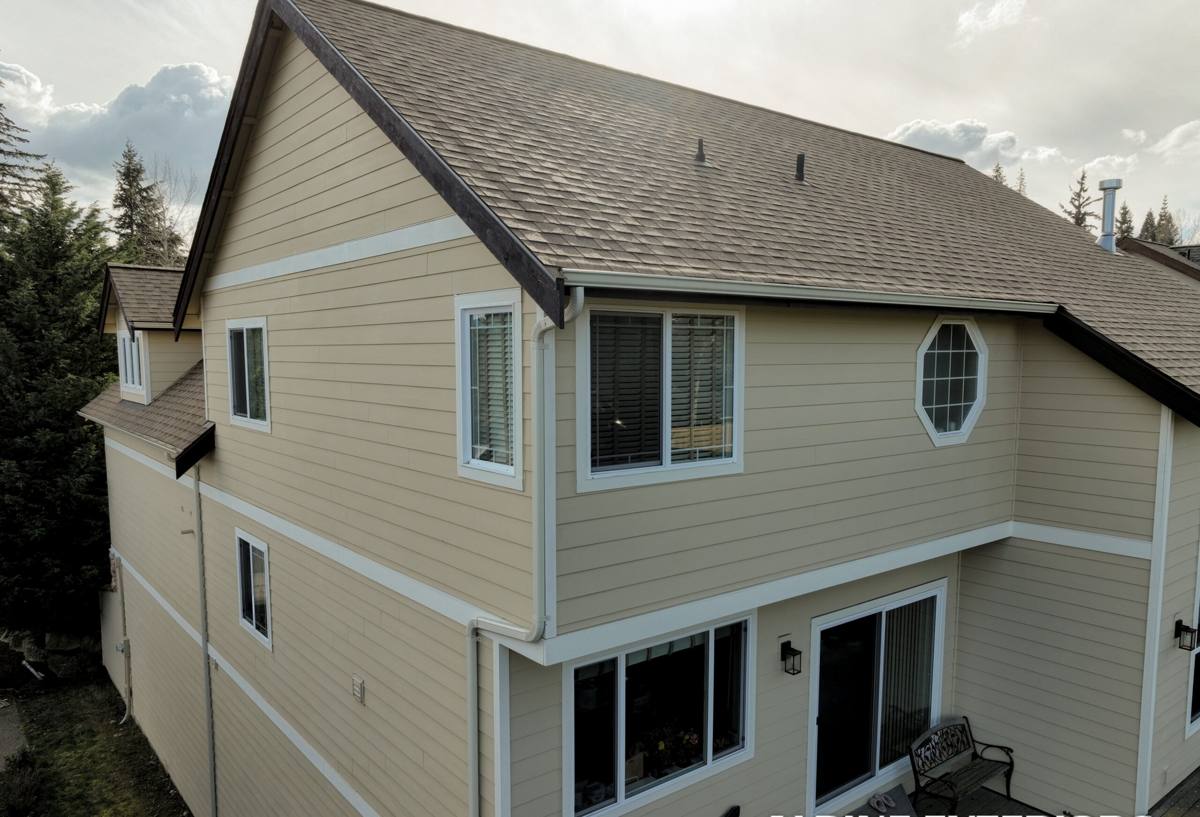
What Salt Air Actually Does to a Roof System
Corrosion Isn't Just a Coastal Cliché
Airborne salt accelerates oxidation on any exposed metal — panels, fasteners, flashing, and trim. On a properly specified metal roof, the panel finish and fastener coating are matched to handle that exposure. On a roof where the installer used standard interior-grade fasteners or an undersized flashing system because it was cheaper or on hand, you'll see rust streaks and failed seals well before the panels themselves are anywhere near the end of their service life.
Where the Weak Points Show Up First
In our experience working this stretch of Whatcom County, the first signs of trouble on a poorly matched metal roof aren't in the field of the panels — they're at the fasteners, the ridge caps, and any place dissimilar metals touch. Galvanic corrosion between the wrong metal combinations is a real issue near salt air, and it's one of the reasons product selection isn't a place to cut corners.
Driving Rain and Steep-Slope Water Management
Blaine gets rain that doesn't fall straight down. Wind-driven rain pushes water sideways and upward under laps, ridge caps, and around penetrations in a way that vertical rainfall never tests. A metal roof's watertight performance depends heavily on details most homeowners never see: underlayment selection, lap direction relative to prevailing wind, sealant placement at penetrations, and how ridge and hip caps are vented and closed off.
- Underlayment rated for high-wind, wind-driven rain exposure — not a builder's-grade minimum
- Panel laps oriented against the prevailing wind and rain direction for this specific roof
- Closed or vented ridge details matched to the panel profile, not a generic universal cap
- Flashing at every penetration — vents, chimneys, skylights — sized and sealed for wind-driven water, not just gravity flow
- Fastener spacing and torque within manufacturer spec, since over- or under-driven screws are a common source of early leaks
Moss, Algae, and the Long Wet Season
Whatcom County's wet season runs long, and shaded or north-facing roof sections in Grandview often stay damp for weeks at a stretch. Moss and algae need that sustained moisture and organic debris to establish. Metal roofing gives them far less to grab onto than asphalt shingles, since there's no granule texture holding spores and moisture close to the surface. That said, "moss-resistant" doesn't mean "moss-proof" — debris buildup in valleys, at wall-to-roof transitions, and around chimneys still needs to be cleared, or organic material will accumulate and hold moisture against even a metal surface over time.
Where Debris Actually Collects
On the roofs we work on around Grandview, the trouble spots are consistent: valleys, the uphill side of chimneys and dormers, and anywhere a roof plane meets a wall. Needles and leaf litter from nearby trees settle there, hold moisture, and — left long enough — start to feed moss growth even on a metal surface. A short seasonal check of these areas does more to protect a metal roof's finish than any chemical treatment.
Panel and Finish Choices That Matter in This Climate
Not every metal roofing product performs the same way in salt air and heavy rain. The table below covers the tradeoffs we walk homeowners through when we're specifying a system for a Grandview or broader Blaine property.
| Factor | What It Affects Here | Our Standard |
|---|---|---|
| Panel finish (coating) | Corrosion resistance in salt air, color retention | Coastal-rated coating system, not a standard inland finish |
| Fastener material | Rust streaking, seal failure at panel penetrations | Corrosion-resistant fasteners matched to panel metal |
| Panel profile (standing seam vs. exposed fastener) | Long-term watertightness, maintenance needs | Standing seam preferred on most Grandview roofs for fewer exposed penetration points |
| Underlayment | Backup protection against wind-driven rain | High-wind-rated synthetic underlayment as standard, not an upgrade option |
| Flashing metal | Galvanic compatibility with panel and fasteners | Matched metal families to avoid dissimilar-metal corrosion |
What a Correct Metal Roofing Job Actually Involves
A metal roof is only as good as the parts of the job that aren't visible from the ground. Here's what we consider non-negotiable on a proper installation, whether it's a full replacement or a re-roof over an existing deck.
- Deck inspection and repair before any panel goes down — metal roofing won't hide a soft or uneven deck, it will telegraph it
- Ice-and-water or high-performance underlayment at eaves, valleys, and penetrations, sized for this region's rain volume
- Panel layout planned around the roof's actual wind exposure, not a default orientation
- Fasteners and flashing metal chosen to be compatible with the panel material, avoiding galvanic corrosion
- Proper ventilation at ridge and soffit to prevent trapped moisture under the deck, which causes problems no surface material can fix
- Final walk-through covering seams, fastener torque, and flashing details before the crew leaves the site
Our Process for a Grandview Metal Roofing Project
Assessment and Honest Recommendation
We start with an on-site look at the existing roof, deck condition, and how the property is exposed to wind and rain given its position in Grandview. We'll tell you plainly if metal roofing is the right call for your home or if another system makes more sense for your budget and roofline — we'd rather lose a sale than install something that won't hold up.
Specification
Once we've agreed on the approach, we spec the panel profile, finish, underlayment, and flashing package specifically for salt air and wind-driven rain exposure, not a generic package pulled off a shelf.
Installation
Our crews follow manufacturer installation specs closely, because most metal roof failures we've seen elsewhere trace back to installation shortcuts, not the product itself — under-driven fasteners, mismatched flashing metal, or underlayment that wasn't rated for the exposure.
Walk-Through and Documentation
Before we call the job done, we walk the roof with you, cover what maintenance looks like, and make sure you know what warranty coverage applies to the materials and to our labor.
Maintenance That Actually Extends the Life of a Metal Roof Here
Metal roofing is lower-maintenance than most alternatives, but "low-maintenance" in Blaine's climate still means some seasonal attention. Clearing valleys and roof-to-wall transitions of needles and leaf debris once or twice a year, checking that gutters aren't backing water up under the eave edge, and having flashing and sealant points looked at periodically will do more for a metal roof's lifespan here than any single upgrade at install time. A roof that's ignored for a decade, salt air or not, will always underperform one that gets a basic annual look.
Why Hiring a Crew That Already Works in Grandview Matters
Specifying and installing metal roofing correctly for this climate isn't generic knowledge — it's shaped by what actually happens to roofs in Whatcom County's salt air and rain patterns over years, not what a spec sheet promises in ideal conditions. A crew that already works in and around Grandview has seen which fastener choices hold up, which flashing details actually stop wind-driven rain, and where moss and debris cause problems on real roofs in this specific area. That's the difference between a metal roof that performs for decades and one that needs early repairs because it was built to a generic standard instead of a coastal one.
If you're weighing metal roofing for a Grandview home, we're glad to walk your roof, talk through what it actually needs given its exposure, and give you a straight, no-pressure estimate using the form below.