 Blaine Exterior
 Everson's Climate Puts Real Stress on Windows
Everson sits inland along the Nooksack River valley, but "inland" in Whatcom County still means weather that's hard on a home's exterior. Winter storms push driving rain sideways against west- and south-facing walls for days at a time. Prevailing marine air moves in off the Puget Sound and Strait of Georgia and carries fine salt content further inland than most homeowners realize, especially during winter storm systems. Add in a long, damp shoulder season that runs from fall through spring, and you get ideal conditions for moss and algae to take hold on anything that stays wet — including window sills, frames, and the trim around them.
None of this is dramatic on its own. It's the slow, cumulative kind of wear: a sill that never fully dries out, a seal that gets tested by wind-driven rain every few weeks instead of a couple times a year, a frame corner where moss holds moisture against the material long enough to start breaking it down. Windows built and installed without that reality in mind tend to show problems years earlier than they should.
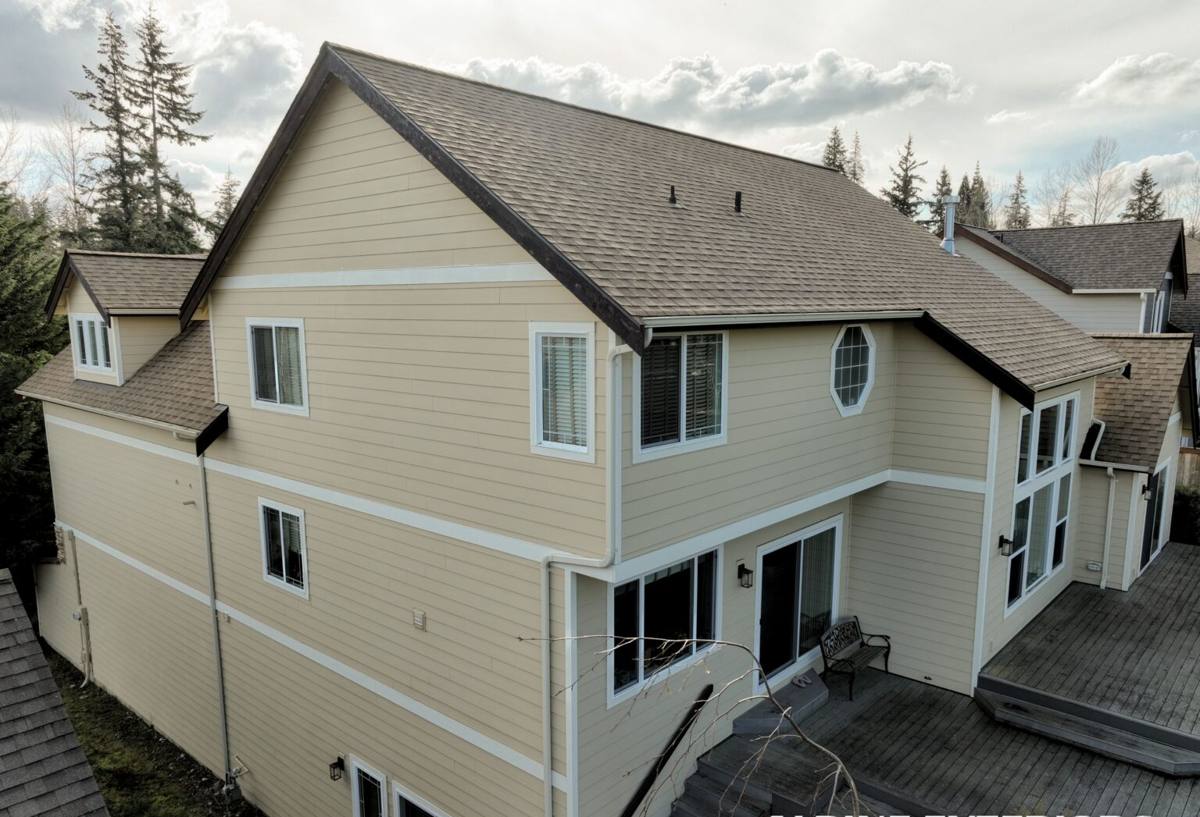
What "Custom" Actually Means for an Everson Home
Custom doesn't mean unusual shapes or high-end finishes, though we do plenty of that. For most Everson homes it means the window is built to the actual opening and actual conditions of that wall, not squeezed into a stock size with extra trim to hide the gap. Older farmhouses and older in-town homes in this area often have openings that have shifted slightly over decades of settling; newer construction usually has more standard dimensions but still varies by builder. Either way, a correct measurement accounts for the opening as it exists today, not as a spec sheet assumes it should be.
Measuring for the Real Opening
We measure width, height, and diagonal at multiple points on every opening, because a wall that looks square rarely is after 20, 40, or 80 years. That measurement also determines whether a new-construction window with a nailing flange is appropriate or whether a replacement/retrofit frame that fits inside the existing opening is the better call — a decision that affects both cost and how well the final seal performs.
Matching the Wall Assembly
What's behind the siding matters as much as the window itself. Wood-frame construction, house wrap condition, and how the original window was flashed (or wasn't) all change how we detail the new installation. A window is only as good as the wall it's set into.
Frame Materials and Glass: What Holds Up Here
There's no single "best" window material — there's a best fit for the home, the budget, and how much upkeep the owner wants to take on. In a climate with sustained damp and occasional salt-laden air, the trade-offs are worth being specific about.
| Material | Moisture Behavior | Upkeep | Typical Fit |
|---|---|---|---|
| Vinyl | Won't rot or corrode; seams and welds matter more than the material itself | Low — occasional cleaning | Most Everson homes, best value |
| Fiberglass | Very stable in wet/dry cycling, minimal expansion movement | Low | Larger openings, higher-exposure walls |
| Wood (clad exterior) | Needs a fully intact exterior cladding to keep moisture off the wood core | Higher — cladding seams need periodic inspection | Character homes where interior wood look matters |
| Aluminum | Conducts cold and can condense in our winter humidity unless thermally broken | Moderate | Specific architectural cases only |
On the glass side, we default to double-pane, low-E units with argon fill for standard replacements — it's the right balance of cost and performance for this climate. For rooms that take direct driving rain or afternoon sun, we'll talk through upgraded spacer systems and coatings, since spacer quality affects how long a sealed unit resists fogging in a persistently damp climate.
The Installation Details That Actually Stop Water
The window product matters less than most homeowners expect. The installation detailing — the parts you never see once trim goes back on — is what determines whether wind-driven rain stays outside for the next 20 years or finds its way into the wall cavity within five.
Flashing and Weather Barrier Integration
Every opening gets sill pan flashing that directs any water that does get past the window back outside the wall, not down into the framing. Housewrap or building paper gets integrated with the window flange using proper shingle-lap sequencing — top piece over the ones below it, always — so water is directed down and out at every layer, not trapped behind the new window.
Sealant Placement, Not Just Sealant Amount
More caulk is not better caulk. We seal the specific joints that need it — head, jambs, and the point where the flange meets the weather barrier — while leaving the sill weep path open so any water that does get in can drain back out. A fully sealed sill is one of the most common mistakes we find when we remove someone else's old installation, and it's often the reason a "properly caulked" window still rotted the sill underneath.
Signs Your Current Windows Are Losing the Battle
Everson's climate doesn't usually cause sudden window failure — it causes a slow decline that's easy to miss until it's a bigger repair. Worth checking for:
- Soft or spongy wood at the sill or lower corners of the frame, inside or outside
- Persistent moisture or fogging between glass panes (a failed seal on the insulated unit)
- Visible moss, algae, or dark staining building up on frames or sills that stay shaded and damp
- Drafts you can feel with a hand near the frame on a windy, rainy day
- Paint or finish that's peeling specifically at joints and corners rather than evenly across the sash
- Difficulty opening, closing, or latching that wasn't there a few years ago
- Visible daylight or gaps around the frame when viewed from inside with the lights off
Any one of these on its own might just mean a repair. Several together, especially on the same wall, usually mean the original installation is letting moisture in faster than the assembly can shed it.
How We Handle an Everson Window Project
- On-site assessment. We look at the openings, the wall assembly, and how water currently moves around each window before recommending anything.
- Honest scope and options. We'll tell you where a full replacement is warranted versus where a repair genuinely holds up, and walk through material and glass options against your budget.
- Precise measurement and ordering. Custom units are built to your actual openings, not rounded to the nearest stock size.
- Removal and inspection. Old windows come out carefully so we can inspect the framing and sill underneath for hidden moisture damage before anything new goes in.
- Correct flashing and sealing. Sill pan, shingle-lapped weather barrier integration, and targeted sealant — done the same way regardless of which room it's in.
- Interior and exterior finish work. Trim, caulking, and paint or stain matched to the home.
- Final walkthrough. We check operation, seal integrity, and finish quality with you before calling the job done.
Living With Windows in Whatcom County: Maintenance That Matters
Even a correctly installed window benefits from a little seasonal attention in this climate. Twice a year — before the wet season ramps up and again in spring — rinse frames and sills to clear off any moss or algae film before it takes hold, and check that weep holes along the sill are clear so water can drain. If you're near enough to open water to notice salt residue on cars or metal fixtures, a plain water rinse on window hardware and frames helps prevent buildup that can otherwise dull finishes or affect hardware over time. None of this is heavy maintenance — it's the kind of five-minute task that adds years to a window's service life in a climate that doesn't give exteriors much of a break.
Why Hire a Crew That Already Works in Everson
A lot of window problems we get called out to fix weren't caused by a bad window — they were caused by an installer who didn't detail for this specific climate. Flashing sequences that work fine in a drier region don't necessarily hold up against sustained wind-driven rain. A crew that regularly works Whatcom County homes has already seen which details matter here and which corners genuinely can't be cut, because we're the ones who get the callback if they are.
We're a local Blaine-based crew, and Everson is well within the area we work regularly. That means we're familiar with the range of home ages and construction styles in this part of the county, and we're close enough to stand behind the work if anything needs a follow-up visit.
If your windows are showing their age or you're planning a renovation, we're happy to come take a look and put together a straightforward, no-pressure estimate — just fill out the form below.