 Blaine Exterior
 Living on the Water in Birch Point Changes What Your Siding Has to Do
Homes along Birch Point sit closer to the weather than most houses in Whatcom County. The water moderates temperatures but it also throws salt-laden air, wind-driven rain, and near-constant humidity at every exterior surface for most of the year. Siding that performs fine three miles inland in Blaine can struggle here, simply because the exposure is more constant and more corrosive. That's the starting point for any siding conversation in this neighborhood: the product and the installation both need to be matched to shoreline conditions, not just "Pacific Northwest weather" in general.
We've worked on enough homes along this stretch of coastline to know where problems actually start — and it's almost never the siding material itself. It's gaps in the details: a missed flashing, a caulk joint where there shouldn't be one, siding hung too close to grade or a roofline. Get those details right and fiber cement will outlast most of what's installed around it.
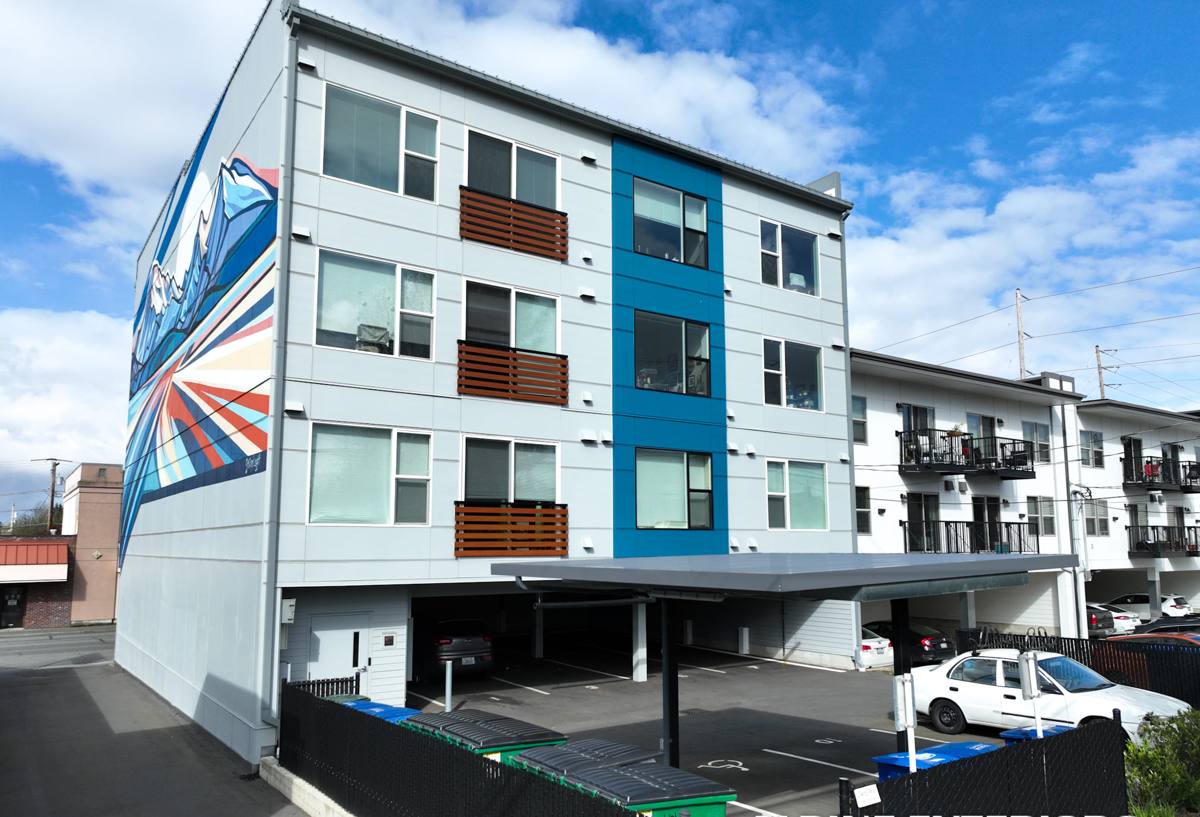
Salt Air, Driving Rain, and Moss: The Three Forces at Work
Salt Air
Airborne salt accelerates corrosion on fasteners, trim caps, and any metal flashing that isn't rated for coastal exposure. It also settles into porous or poorly sealed siding surfaces over time, which is one reason factory-applied finishes matter more here than they do further inland — field-applied paint has more seams and weak points for salt and moisture to work into.
Driving Rain
Wind off the water doesn't just fall as rain — it drives sideways, which pushes water into laps, seams, and butt joints that would stay dry in a calmer setting. Siding systems depend on overlaps, drainage planes, and proper clearances to shed that kind of rain. Any shortcut in the installation shows up first at wall penetrations and inside corners, exactly where wind-driven rain concentrates.
Moss and Sustained Moisture
Whatcom County's long wet season keeps north- and shade-facing walls damp for weeks at a time, which is ideal for moss and algae growth. Moss holds moisture against the wall surface long after the rain stops, which is hard on paint film and can accelerate rot in any wood-based product hiding underneath a facade. Siding that resists moisture absorption in the first place has a real advantage in this kind of sustained-damp environment.
What a Correct Fiber Cement Siding Job Actually Involves
Fiber cement is a forgiving, durable material — but only when it's installed the way the manufacturer engineered it to be installed. In a coastal setting like Birch Point, we treat the following as non-negotiable:
- A drainage gap (rain screen) behind the siding so any water that gets past the surface can drain and dry instead of sitting against the wall sheathing
- Correct clearance between the bottom of the siding and grade, decks, roofing, and other horizontal surfaces — this is one of the most commonly shorted details on older installs
- All cut edges primed or sealed before installation, since a raw cut edge is the fastest path for moisture into the board
- Fasteners installed at the correct spacing, depth, and location — not overdriven, not into butt joints where they can split the board
- Flashing at every window, door, and penetration, lapped correctly with the water-resistive barrier so water is directed out, not in
- Caulk used only where the manufacturer specifies it — not as a substitute for proper flashing or clearance
None of this is exotic. It's standard fiber cement installation practice. The problem is that it's also the kind of detail that's invisible once the wall is closed up, which is exactly why the contractor's discipline matters as much as the product on the label.
Why We Only Install James Hardie — Not Vinyl, Not LP, Not Cemplank
We install James Hardie fiber cement exclusively. We don't install vinyl siding, LP SmartSide, Cemplank, Allura, or primed wood products, and in a place like Birch Point that's not a marketing position — it's a practical one.
Vinyl expands and contracts with temperature swings and can warp or crack under sustained wind exposure; it also isn't a fire-resistant material, which matters more each year as wildfire smoke and ember exposure become a regional concern even west of the Cascades. Engineered wood products like LP SmartSide use wood fiber with a resin binder, which performs well in many climates but depends heavily on unbroken factory coating and careful field sealing of every cut edge — a tall order in a spot where every wall gets wet repeatedly through the winter. Other fiber cement brands compete reasonably well on the base material, but we've standardized on one manufacturer so our crews install one system, know its specifications cold, and can back every job with one consistent warranty structure — rather than mixing installation standards across products.
James Hardie's fiber cement is non-combustible, holds a factory-applied ColorPlus finish that's baked on rather than field-sprayed, and is engineered specifically for regional climate zones — which matters enormously in a place that gets Birch Point's combination of salt exposure, driving rain, and a moss season that can run half the year.
Climate-Engineered HZ Siding and Why It Matters Here
James Hardie doesn't build one siding for the whole country. Its HZ ("Hardie Zone") product lines are engineered around regional climate demands — moisture behavior, temperature cycling, and the specific stresses different parts of the country put on exterior cladding. For a Pacific Northwest coastal property, that means siding designed around sustained moisture exposure and cooler, wetter conditions rather than the high-heat, high-humidity profile of a Gulf Coast installation.
The practical benefit for a Birch Point homeowner is straightforward: the board itself is built to handle the climate it's going on, rather than being a generic product installed everywhere regardless of region. Paired with correct installation — proper clearances, flashing, and drainage — this is what gives fiber cement its long service life in a marine environment instead of becoming another maintenance headache.
Our Installation Process
- On-site assessment — we look at wall orientation, existing moisture damage, current cladding, trim condition, and exposure to wind and salt spray before recommending anything.
- Tear-off and inspection — removing the existing siding lets us check the sheathing and framing underneath for hidden rot or moisture damage before it gets covered up again.
- Water-resistive barrier and rain screen installation — this is the layer that does the real work of keeping incidental moisture away from the structure.
- Flashing at every penetration — windows, doors, vents, hose bibs, and anywhere else the wall plane is interrupted.
- Hardie panel or plank installation — fastened to specification, with correct clearances maintained at grade, roofline, and deck transitions.
- Trim, caulking, and final inspection — caulk applied only where specified, with a final walk-through against manufacturer detailing before we call the job done.
We don't skip steps to save a day on the schedule, and we don't treat the parts nobody sees after closeup as optional.
What Fiber Cement Siding Costs — And What Drives the Range
Every Birch Point home is different, and pricing depends on more than square footage. Rather than quote a number that won't hold up house to house, here's what actually moves the price:
| Cost Factor | Why It Matters | Relative Impact |
|---|---|---|
| Tear-off of existing siding | Extra labor, disposal, and time to inspect and repair sheathing underneath | Medium–High |
| Wall complexity (dormers, gables, trim detail) | More cuts, more flashing, more time per square foot installed | High |
| Panel vs. lap siding profile | Different install methods and material costs | Medium |
| Access and site conditions | Waterfront lots, slopes, and tight setbacks can slow staging and scaffolding | Medium |
| Color and finish selection | Factory ColorPlus finishes vs. field-painted options carry different costs | Low–Medium |
| Hidden sheathing or framing repair | Only discovered at tear-off; can't be estimated with certainty upfront | Variable |
We walk every property before quoting so the number reflects your actual wall conditions, not a generic per-square-foot estimate that may not survive tear-off day.
Why Hiring a Crew That Already Works Birch Point Matters
A contractor who mostly works inland jobs doesn't necessarily think about wind-driven rain clearances or salt-air fastener corrosion the same way a crew that regularly works this shoreline does. It's not about skill level — it's about which failure modes are top of mind on install day. We've seen what happens on Birch Point walls when clearances are shorted or flashing is treated as an afterthought, because we've been called back to open up other crews' work and explain what went wrong. That's the kind of local pattern recognition that doesn't show up in a general contracting license, only in repeated exposure to this specific stretch of coastline.
It also means we're not guessing about which wall orientations take the worst of it, or how long moss season really runs in this part of Whatcom County. That local knowledge shapes real decisions — where we're strictest about flashing detail, which walls get the most attention during tear-off inspection, and how we sequence a job around the wet season.
After Installation: What Birch Point Homeowners Should Keep an Eye On
Correctly installed Hardie siding is low-maintenance, not zero-maintenance. In a marine climate, a little routine attention goes a long way toward protecting the investment:
- Rinse salt residue off exterior walls periodically, especially on sides facing the water
- Keep gutters and downspouts clear so water isn't overflowing onto siding below
- Trim back vegetation and clear debris that traps moisture against north- or shade-facing walls where moss takes hold fastest
- Watch caulk joints at trim and penetrations for cracking or separation over time, and have them addressed before water gets behind them
- Have the exterior inspected periodically, particularly after major windstorms common to the area
If you're weighing a siding replacement on a Birch Point property, we're happy to take a look and walk you through what your specific walls need — no pressure, no obligation. Reach out for a free estimate and we'll give you a straight answer about what correct fiber cement installation would look like on your home.